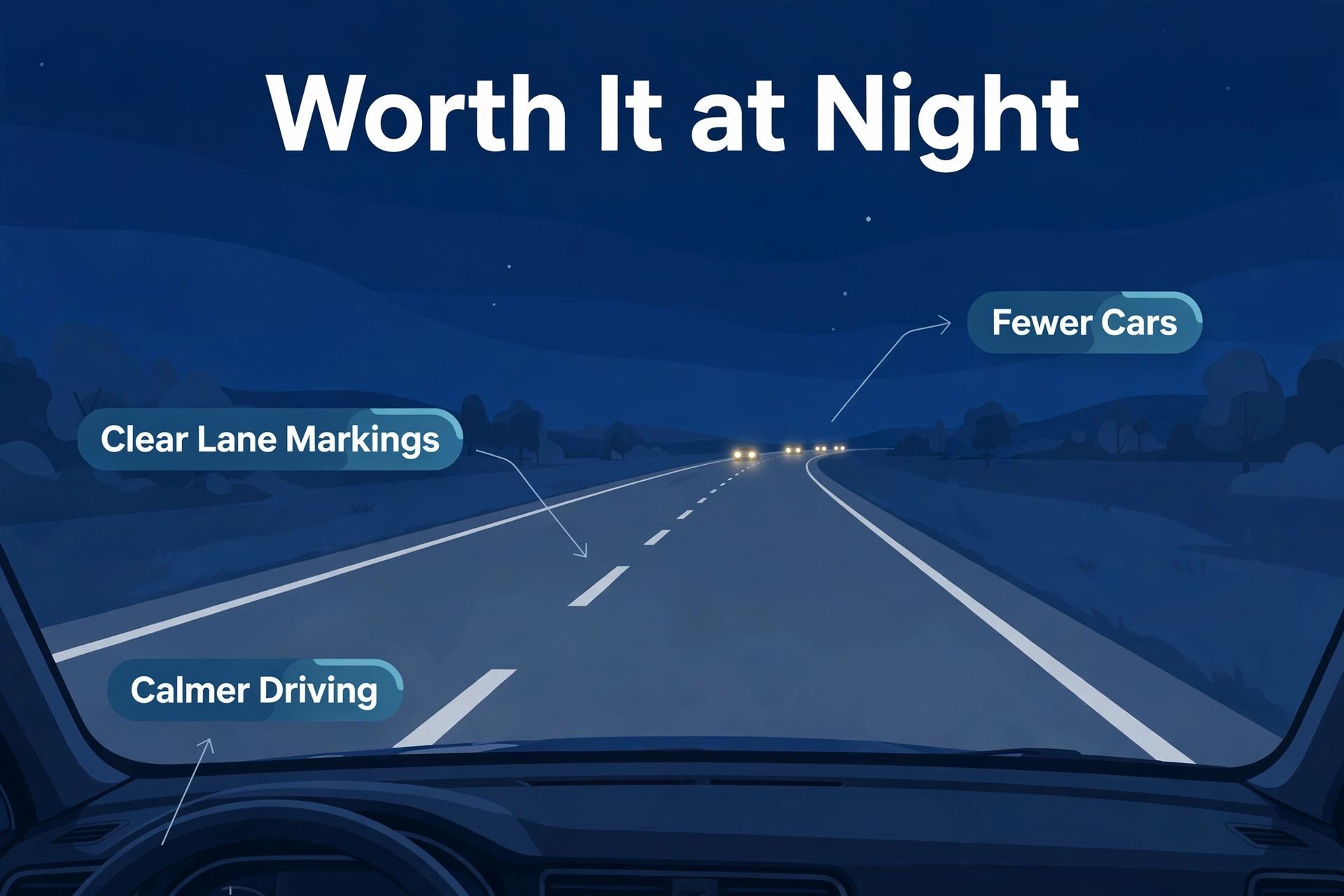
I drive for a living after dark. However, delivery routes, 10 PM to 4 AM, five nights a week, year-round. In fact, rain, fog, the dead stretch of unlit county road where my headlights are the only light for miles. I’ve owned four dash cams. Two of them were mistakes I paid for twice: once at the checkout, once when the footage I needed turned out to be glowing mush.
The mistake was always the same. For example, i bought the big number on the box — 4K! In addition, ultra HD! — and assumed it handled the night. It doesn’t. Not by itself. The camera that finally reads plates on my routes is a 1440p with a Sony STARVIS 2 sensor. In addition, it embarrasses the “4K” bargain unit I ran before it. After dark, the sensor is the purchase decision. The resolution number is the decoration.
Three things from someone who actually lives this: why the sensor outranks the resolution number after dark, what STARVIS 2 changed in 2026’s cameras, and which models keep coming up in owner discussions when night footage is the topic. Community-recommended picks, not lab-test winners — same as always. Verify specs yourself before buying.
Best Dash Cam for Night Driving: Why Night Is the Real Test
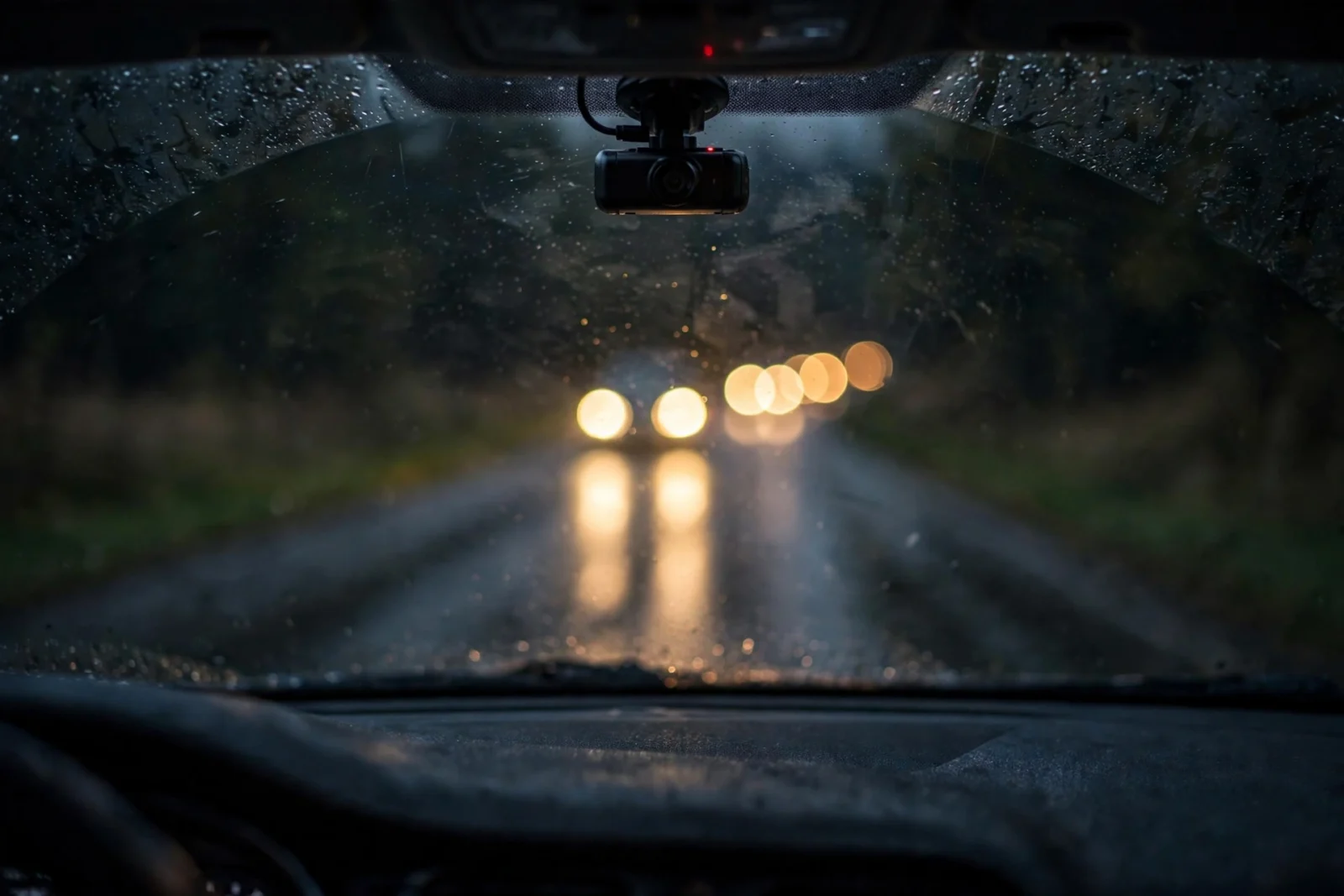
Two in the morning. Wet two-lane road, no streetlights, an oncoming truck throwing headlights across my windshield. A car cuts the corner ahead of me, clips my mirror, keeps going. That’s the footage that mattered — thirty seconds of dark, glare, and one plate I needed readable. My old camera gave me a white smear where the plate should have been. That’s when I stopped shopping by resolution.
Daylight is easy mode. Furthermore, light everywhere, gentle contrast, any modern camera looks fine — which is exactly why daytime samples teach you nothing. Moreover, judging a camera by daylight footage is like judging a raincoat in sunshine. Looks great. Tells you nothing.
Night is a different physics problem. Also, the sensor has to drag detail out of near-darkness while headlights assault it. In addition, those retroreflective plates bounce your own headlights back at the lens and white-out exactly the plate you’re trying to read. A good night camera balances both extremes at once. A bad one picks one and destroys the other.
And the cruel part: night is when you need footage most. A large share of serious crashes happens after dark — worst visibility, slowest reactions. My old bargain camera failed at the exact moment evidence mattered. Yours will too, if you buy it the way I did.
Sensor Beats Resolution After Dark
The camera I bought in 2022 was a 4K. Big box, big number, small price — I felt clever. First rainy night on an unlit road, I pulled the footage: every plate a glowing blob, every headlight a white starburst eating the frame. All those pixels, and the information I needed simply wasn’t in them. Resolution counts pixels. The sensor decides how much light each pixel gets. In darkness, light is the scarce resource. I’d bought a bigger blurry picture.
Here’s the one sentence that would’ve saved me that money: at night, a bigger sensor with bigger pixels beats a higher resolution with tiny pixels.
Sony‘s STARVIS 2 — the current generation in 2026’s better dash cams — was built for exactly this: bigger effective pixels, better low-light sensitivity, and composure in the brutal contrast between dark road and blinding headlights. First, it’s the reason my current 1440p camera reads a plate at thirty feet that the old “4K” couldn’t see at ten.
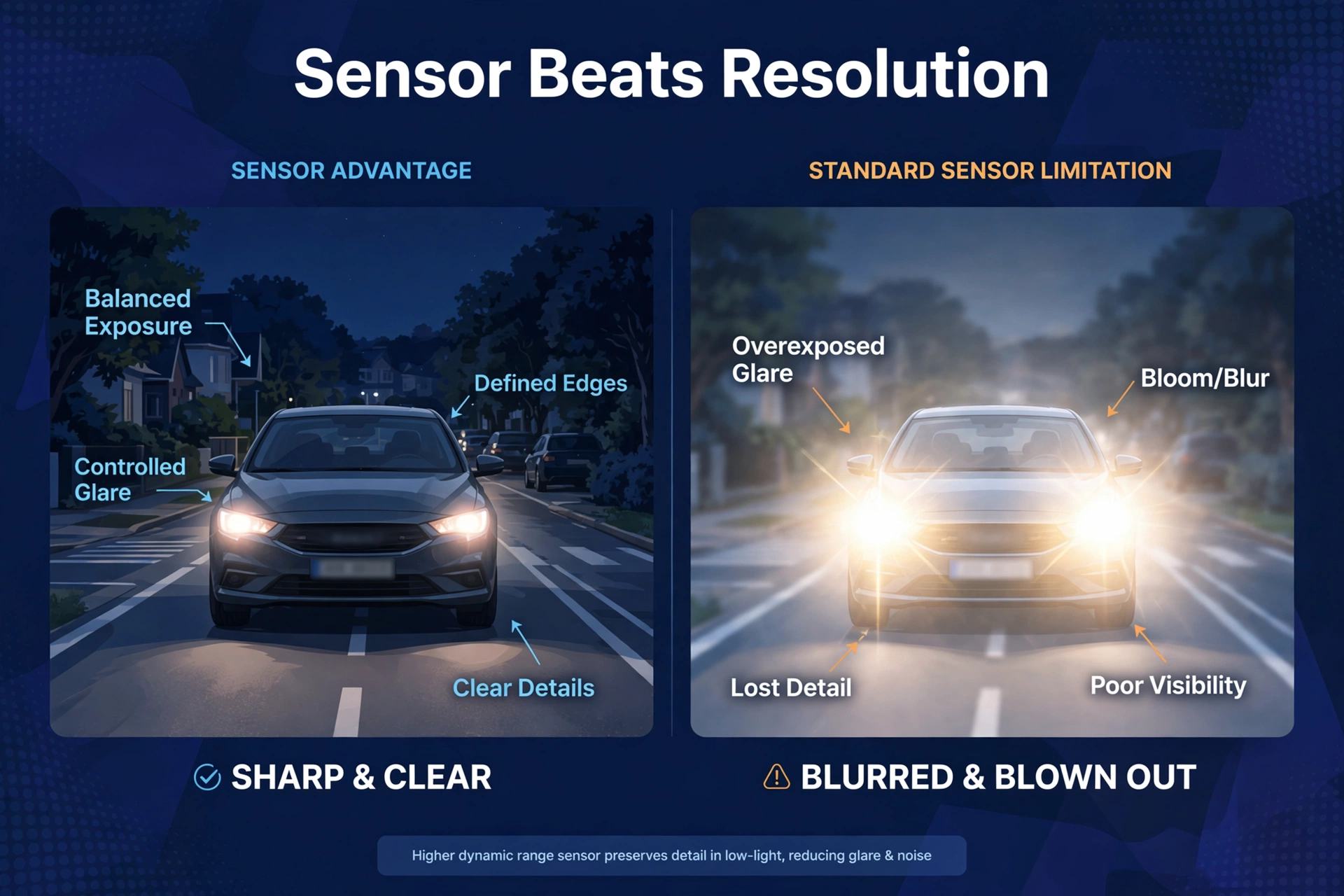
Second, the cheap 4K crams smaller pixels into roughly the same area — each pixel starved of light — and you get noisy, smeary footage where plates dissolve into glow. The pixels exist; the information doesn’t. Comparing two cameras for night use? Sensor model first, resolution second. Always.
And when a listing won’t name the sensor at all? I learned to read that silence. It’s the answer.
What to Check for Night Performance
After four cameras, this is the checklist I actually run before spending a cent. Nothing exotic — just the stuff that decides after-dark footage, minus the marketing.
Caption: Night-performance checklist — what actually decides after-dark footage quality.
| Feature | Look for | Why it matters |
|---|---|---|
| Image sensor | Sony STARVIS 2 (named in specs) | Low-light sensitivity; the single biggest factor |
| HDR / WDR | True HDR processing | Balances headlight glare against dark surroundings |
| Aperture | f/1.6 or wider (smaller number = more light) | More light reaches the sensor |
| Bitrate | High bitrate for the resolution | Compression artifacts destroy plate detail first |
| Rear camera sensor | Not an afterthought — check it too | Rear plates matter as much as front ones |
| Parking mode at night | Motion + impact detection with low-light sensor | Parked hits happen in dark lots |
If I could only pick one row, it’d be the sensor — everything else is a multiplier. HDR can’t rescue a blind sensor. No bitrate setting invents light that was never captured. I know, because I’ve watched footage from cameras that had every row checked except the first one. Glowing mush, all of it.
The Picks Owners Recommend for Night Use
I didn’t lab-test these. Nobody paid me to rank them. These are the models that keep surfacing in owner communities whenever night footage is the topic — night drivers comparing actual plates read at actual 2 AMs. Verify current specs before buying; lineups shift.
Thinkware U3000 — the night-vision flagship
Thinkware built its whole reputation on night performance, and the U3000 is the current flagship — running what the company calls Super Night Vision 4.0. Owners consistently rank its after-dark clarity among the best money can buy. The radar-assisted parking mode pulls real weight too, which matters when your car sits in dark lots between shifts like mine does.
Premium price, no getting around it. Finally, what you’re paying for: the sensor and the parking-mode engineering. Meanwhile, owners mostly say it’s worth every penny. From everything I’ve seen of the night samples, I believe them.
Our Thinkware vs BlackVue comparison puts it head-to-head with its main rival.
Viofo A229 Pro — night performance, dual-channel value
The Pro’s night reputation is earned, not marketed — a strong sensor plus 4K resolution that actually has the light-gathering muscle behind it. This is the camera that taught me 4K isn’t the enemy; a weak sensor is. Owner night samples show readable plates in conditions where my old budget camera gave up long ago. It runs warm and costs more than the Plus. Both true.
My take: if you drive at night, this is the Viofo to get. See Viofo A229 Plus vs Pro for the full trade-off.
Viofo A229 Plus — the sensible night pick
A step behind the Pro’s night clarity — but a mile ahead of anything near its price. This is the one I’d hand a friend who drives nights and winces at flagship money. Runs cooler too, which counts when a camera bakes on your windshield all summer between night shifts.
What about budget night cams?
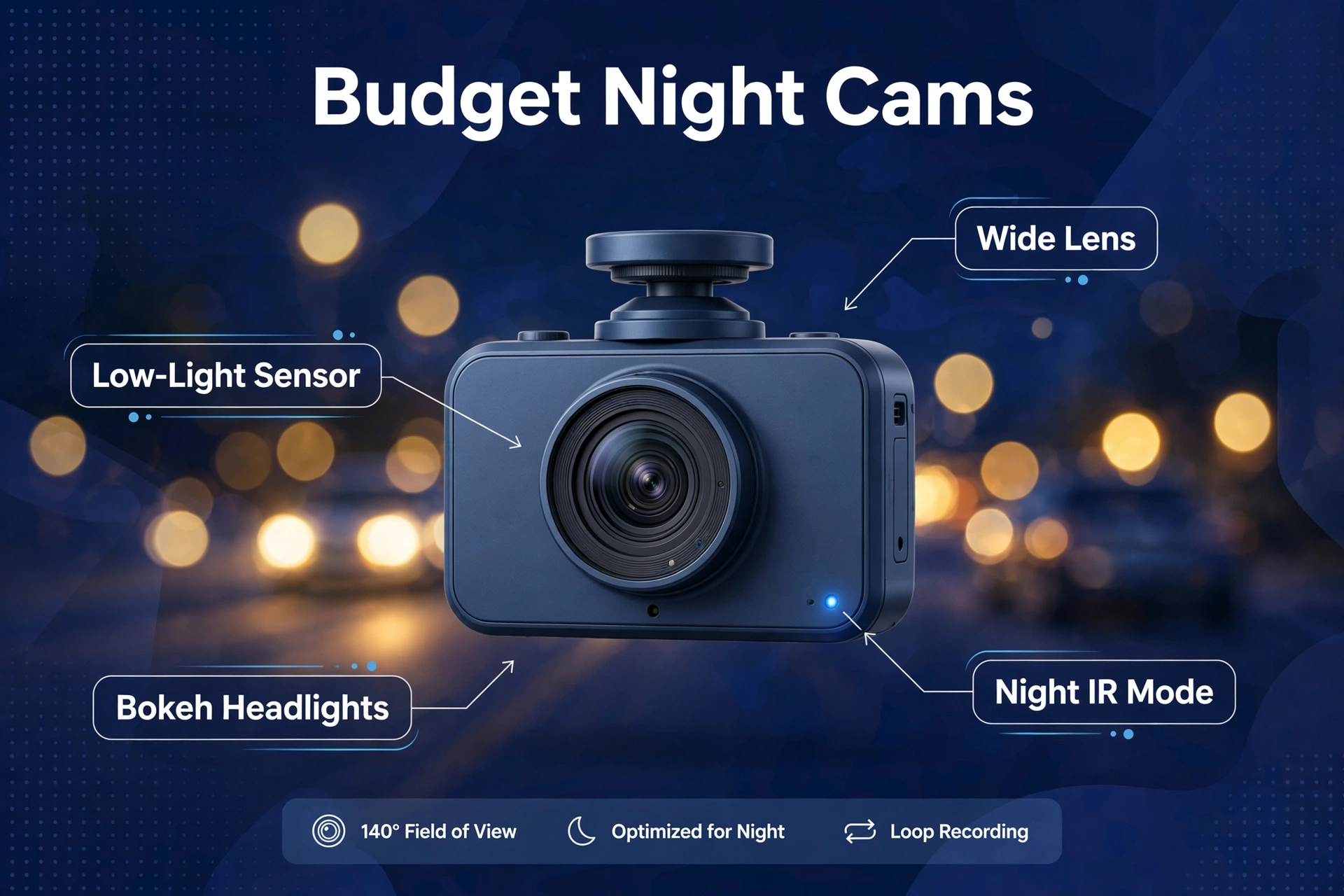
Straight answer from someone who’s tried: physics doesn’t do discounts. Sub-$100 cameras run smaller, older sensors, and night footage betrays them — plates become guesses. I know, because guess-work footage is what my second camera gave me. Drive at night regularly? Stretching to a STARVIS 2-class camera is the single highest-value upgrade in dash cams, full stop. Our best front and rear dash cam guide covers solid dual-channel coverage at every budget tier.
How to Judge Night Samples Like a Reviewer
Manufacturer stills are cherry-picked. Owners publish the truth — shaky, rainy, badly lit. That’s the footage you want, because that’s your footage on a Tuesday night in November.
Start with matching darkness. Nevertheless, footage from a lit highway tells you nothing about my unlit county road — different problems entirely. In fact, search the model name plus “night” on video sites, and skip anything from the manufacturer or a seller. Owner uploads only. The worse the conditions, the more honest the sample.
Three things to watch for. As a result, one: plate readability at distance — pause when a car passes and try reading it. In contrast, if you can’t, neither could you after a real incident. Two: headlight handling — do oncoming lights bloom into white blobs that eat the scene, or does the camera hold it together? Three: shadow detail — road edges, lane markings, the world past your headlight beam, or just pure black?
Compare identical scenarios across cameras, not different ones. Similarly, a camera that shines on a lit street and struggles on a dark road isn’t “bad” — it’s showing its limits. Specifically, what you want: the camera whose worst case stays usable. Mine had to handle the unlit road at 2 AM. Judge against your worst case, not the brochure’s best.
One more trick — check the upload date. Firmware updates genuinely improve night processing on good cameras, so a two-year-old sample may undersell today’s performance. Favor recent uploads. And be suspicious of any sample reel with zero readable plates. That’s a camera hiding its weakness, and I fell for that one in 2022.
Don’t Forget the Rear Camera at Night
The dual-channel night trap got me on camera number three: good sensor up front, cheap sensor in back. By day you’d never know. At night the rear footage collapses — precisely when you need it for rear-end evidence. Someone tailgated me for six miles on a dark highway once, then kissed my bumper at a light. Front footage: crystal. Rear footage: a dark rectangle with two glowing dots. Half a camera, full price.
So interrogate the rear sensor with the same skepticism as the front. Is it named? Same generation? And notice how scarce rear-channel night samples are next to front ones. In fact, that gap tells you exactly what manufacturers would rather show.
Strong front sensor plus weak rear sensor equals half a night camera. Don’t pay full price for half a camera.
Settings and Habits That Help at Night
Start free, because this one’s embarrassing: clean the windshield, inside and out. The grimy film on interior glass scatters headlight glare straight into the lens — and this one fix improves night footage more than any menu option. I ran a camera for a year wondering why the glare was so bad. It was the glass. It was always the glass.
Exposure? However, leave it on auto. For example, i spent a week fiddling with manual exposure on camera number two and made everything worse. In fact, the metering was tuned for this exact scenario. In addition, trust it. If the camera offers HDR or WDR, switch it on; that’s what tames headlight blowout. Separate day and night HDR modes? Use both. They exist for a reason.
Mounting matters more than people think. Furthermore, behind the rearview mirror, dead center. Off-center drags A-pillar and dashboard reflections into frame. And a light-colored dashboard bounces straight into the windshield at night. In fact, a dark dash mat costs little and helps more than you’d expect on those long dark drives.
Last: run the highest bitrate available. Compression attacks fine detail first — the plate characters you need. Storage is cheap. Evidence isn’t.
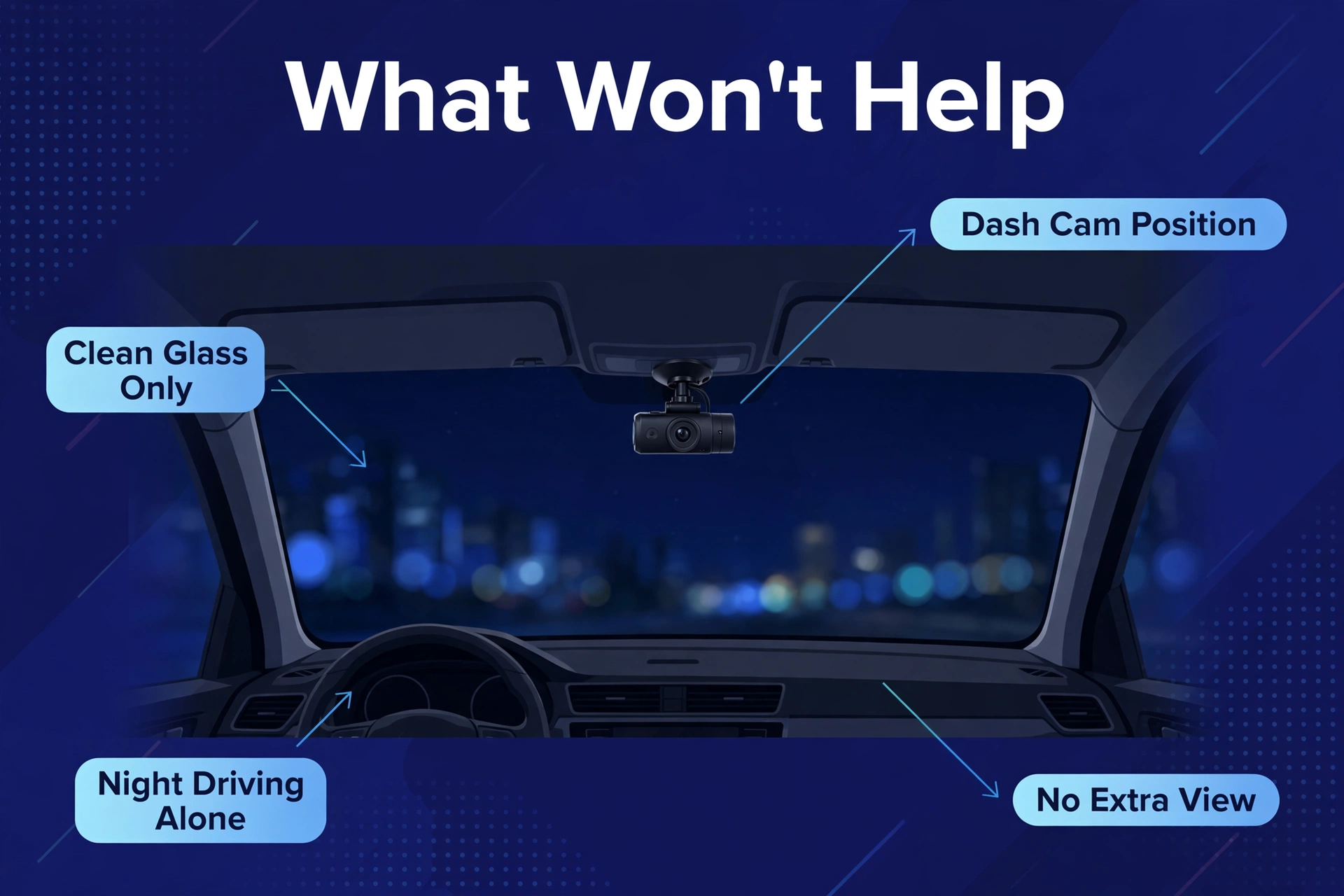
What Won’t Help (Save Your Money)
More megapixels alone won’t save you. Worth repeating, since it’s the industry’s favorite upsell and it cost me a camera in 2022: pixels without light sensitivity are decoration. Bigger numbers, same darkness.
Then there are the infrared LEDs on road-facing cameras. Moreover, iR illuminators genuinely help a cabin camera a few feet away. For a plate thirty feet ahead? The light dies long before it arrives. Road-facing “night vision LEDs” are pure marketing. I know because I almost paid extra for them. Skip them.
Digital zoom on plate stills — zooming blur gives you bigger blur. Also, i tried. First, don’t. Capture quality at the sensor is everything; software can’t recover what was never recorded.
Some drivers add a second cheap camera, hoping two angles compensate. Second, they don’t. Finally, two weak sensors hand you two sets of unreadable footage, plus a wiring headache. One capable night camera beats two mediocre ones at any hour. I ran the two-camera setup for a month. Never again.
And don’t overexpose your way to “brighter” night video. Cranking exposure washes plates into white rectangles — the auto exposure is balancing a genuinely hard scene, and manual “fixes” usually trade one problem for a worse one. If the camera has an HDR or night mode, that’s the lever. When in doubt, reset to defaults and judge fresh.
Frequently Asked Questions
What is Sony STARVIS 2?
Sony’s current generation of image sensors, built for low-light surveillance and automotive cameras. Dash cams using it capture noticeably cleaner night footage than older STARVIS or generic sensors — and the gap shows up most in license plates. It’s the reason my 1440p camera outperforms my old “4K” after dark.
Is 4K better than 1440p for night driving?
Not automatically. A 1440p STARVIS 2 camera beats a cheap 4K at night — larger pixels gather more light, and that’s physics, not opinion. I learned it the expensive way. Only consider 4K for night use with a genuinely capable sensor. Check the sensor model, not the box.
Why are license plates unreadable in my night footage?
Usually one of three culprits: a weak sensor, headlight glare overwhelming the exposure, or heavy compression destroying detail. That was my 2022 camera in one sentence. A STARVIS 2-class sensor plus HDR plus high bitrate fixes most cases — that combination resolves the majority of complaints people bring to forums.
Do I need a rear camera for night driving?
For complete evidence, yes. Rear-end collisions happen at night too, and a front-only camera misses them entirely. Just make sure the rear sensor isn’t an afterthought — some dual-channel kits pair a good front sensor with a weak rear one, and that’s half a purchase. Ask me how I know.
Will parking mode work at night?
Yes — and night is when parking mode earns its keep, since dark parking lots are prime hit-and-run territory. It needs motion or impact detection, and the camera must be hardwired with a voltage cutoff so it can’t drain your battery.
Is a dash cam worth it if I mostly drive at night?
Arguably more so. Night means the worst visibility and the murkiest fault disputes — and my whole job happens in those hours. Our is a dash cam worth it guide runs the full cost-benefit math.