

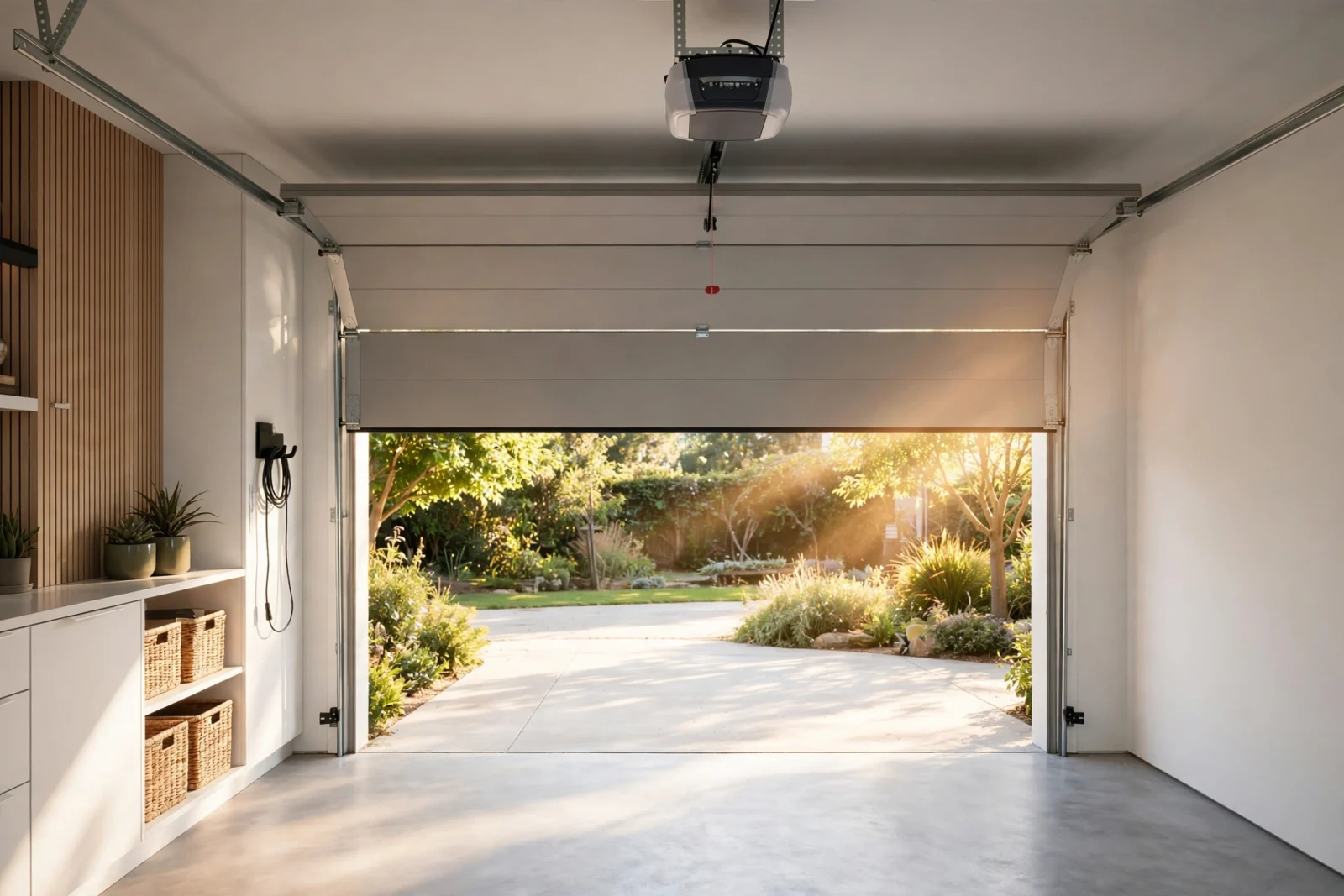
The best smart garage door opener for most homes in 2026 is the Chamberlain B6753T. It combines a quiet belt drive, a built-in camera, battery backup, and the myQ app in one package for around $400. If you want to keep your current opener, the Meross Smart WiFi Garage Door Opener kit adds app control for a fraction of the price.
A smart garage door opener lets you open, close, and check your garage door from your phone, get alerts when it opens, and set schedules so it never stays open all night. Below are the five best options for 2026, plus how to pick the right drive type, motor size, and smart platform for your home.
How to Choose a Smart Garage Door Opener
Before comparing models, it helps to understand the four decisions that matter most. Get these right and almost any reputable opener will serve you well for a decade or more.
Belt Drive vs Chain Drive
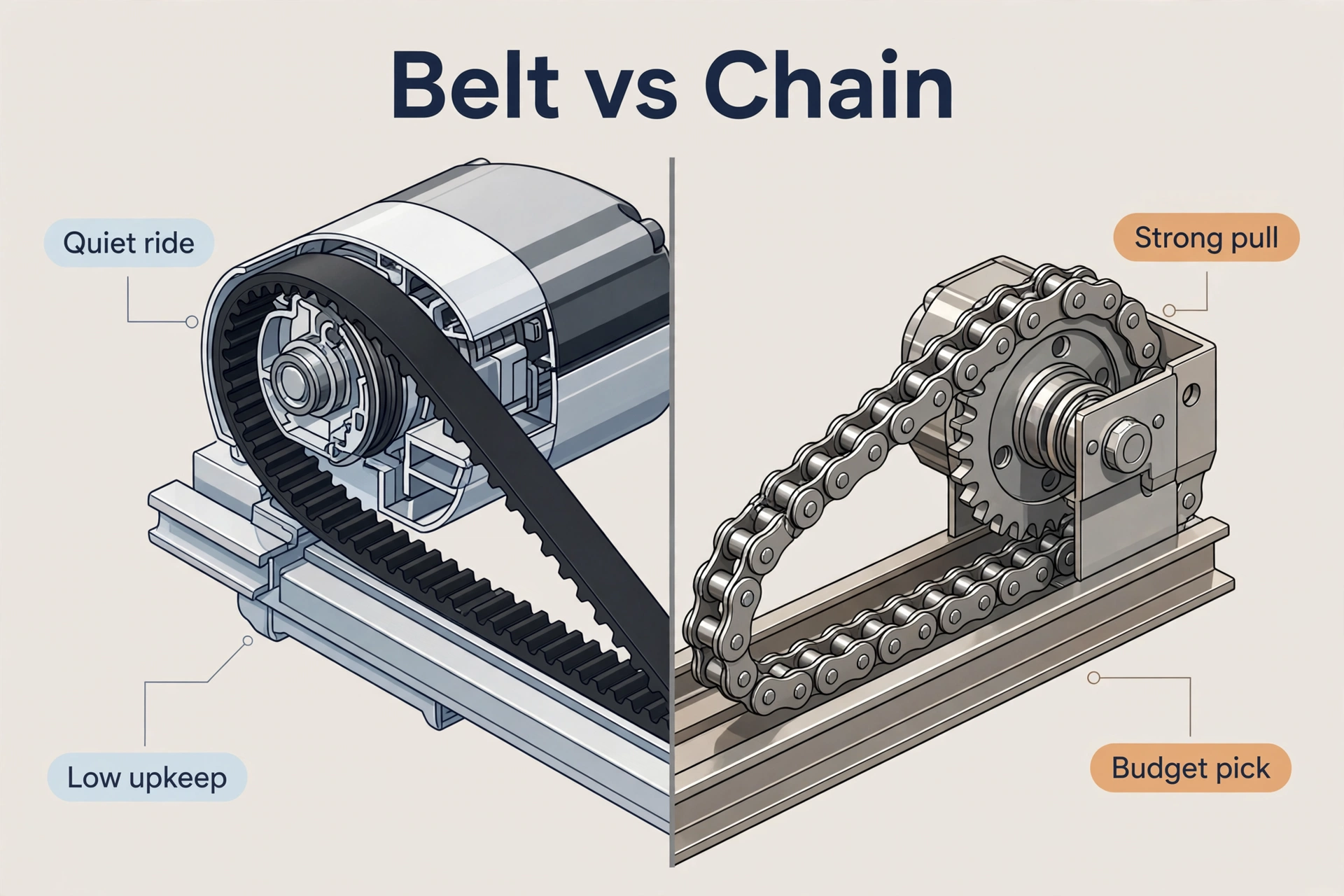
The drive is the mechanism that moves your door along the rail, and it is the biggest factor in noise.
- Belt drive: A steel-reinforced rubber belt pulls the trolley. It is noticeably quieter and smoother, which matters if a bedroom sits above or next to the garage. Most smart openers in 2026 use belt drives.
- Chain drive: A metal chain does the pulling. It is louder and vibrates more, but it is cheaper and handles heavy doors well. Fine for detached garages.
- Screw drive and wall-mount (jackshaft): Screw drives are rare now. Wall-mount openers attach beside the door instead of on the ceiling, freeing overhead space for storage. They are premium-priced but excellent for high or obstructed ceilings.
For most attached garages, choose belt drive. The price difference over chain drive is small, and you will notice the quieter operation every single day.
Horsepower and Door Size
Residential openers are rated from 1/2 HP up to 1-1/4 HP (manufacturers sometimes write this as “HPc” or “horsepower comparable”). Match the motor to your door:
- 1/2 HP: Enough for a standard single-car sectional door (up to about 8 feet wide, lightweight).
- 3/4 HP: The sweet spot for most double-car doors and heavier insulated doors.
- 1-1/4 HP: For oversized, wooden, or carriage-style doors. More power also means less strain and a longer motor life on a normal door.
If your door is 8 feet tall instead of the standard 7, check that the opener supports an extension kit. Many models need a separate rail extension for taller doors.
Smart Features That Actually Matter
Every “smart” opener has an app, but the useful features go beyond remote open and close:
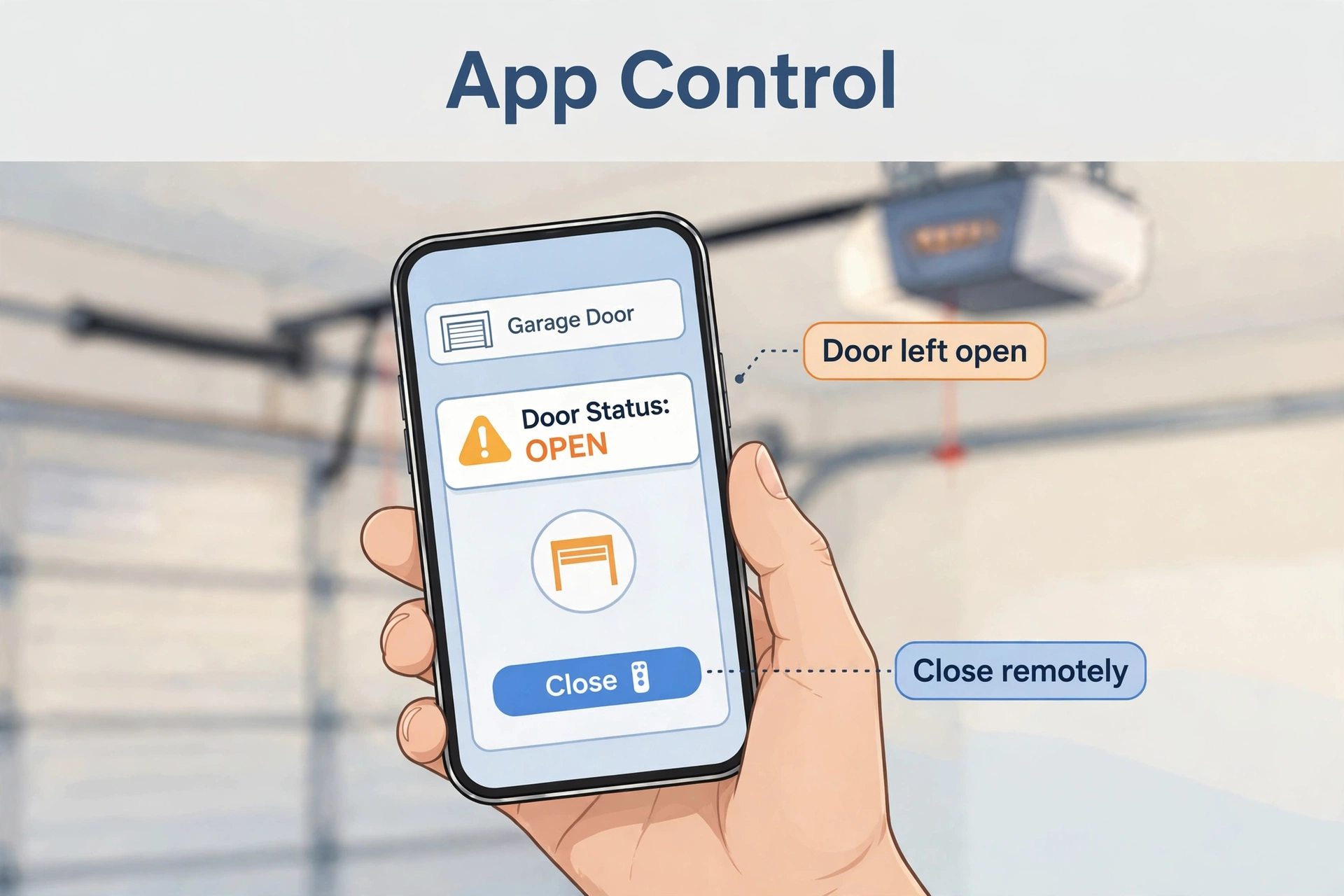
- Real-time alerts: A phone notification the moment the door opens or closes. This is the feature owners use most.
- Auto-close schedules: Set the door to close itself at, say, 10 PM every night. It ends the “did I leave the garage open?” worry for good.
- Built-in camera: Some premium models include a camera in the motor unit, so you can see the garage interior and get video clips of activity. For the driveway and front door, pair it with a video doorbell with no subscription — full entryway coverage with no monthly fees.
- Battery backup: Lets the opener run during a power outage. Required by law in California and genuinely useful everywhere else.
- Voice and platform support: Check compatibility with the assistants you actually use. Support varies a lot between brands, and it changes over time, so verify on the manufacturer’s page before you buy.
- Guest and delivery access: Temporary PINs or scheduled access for family, cleaners, or in-garage package delivery.
An Honest Note on myQ and Third-Party Integrations
Chamberlain’s myQ is the most common smart platform on garage door openers, and its app is solid. However, Chamberlain has restricted third-party access to myQ over the past couple of years, which broke some Home Assistant, Alexa, and Google Home integrations that used to work through unofficial paths.
What this means for you: if deep integration with Home Assistant or voice routines is a must-have, check current compatibility for the exact model before buying, and lean toward openers with native support for your platform (for example, Meross works directly with Apple HomeKit, Alexa, and Google Assistant). If you mainly want reliable app control and alerts, myQ is perfectly fine.
Full Replacement vs a Retrofit Controller
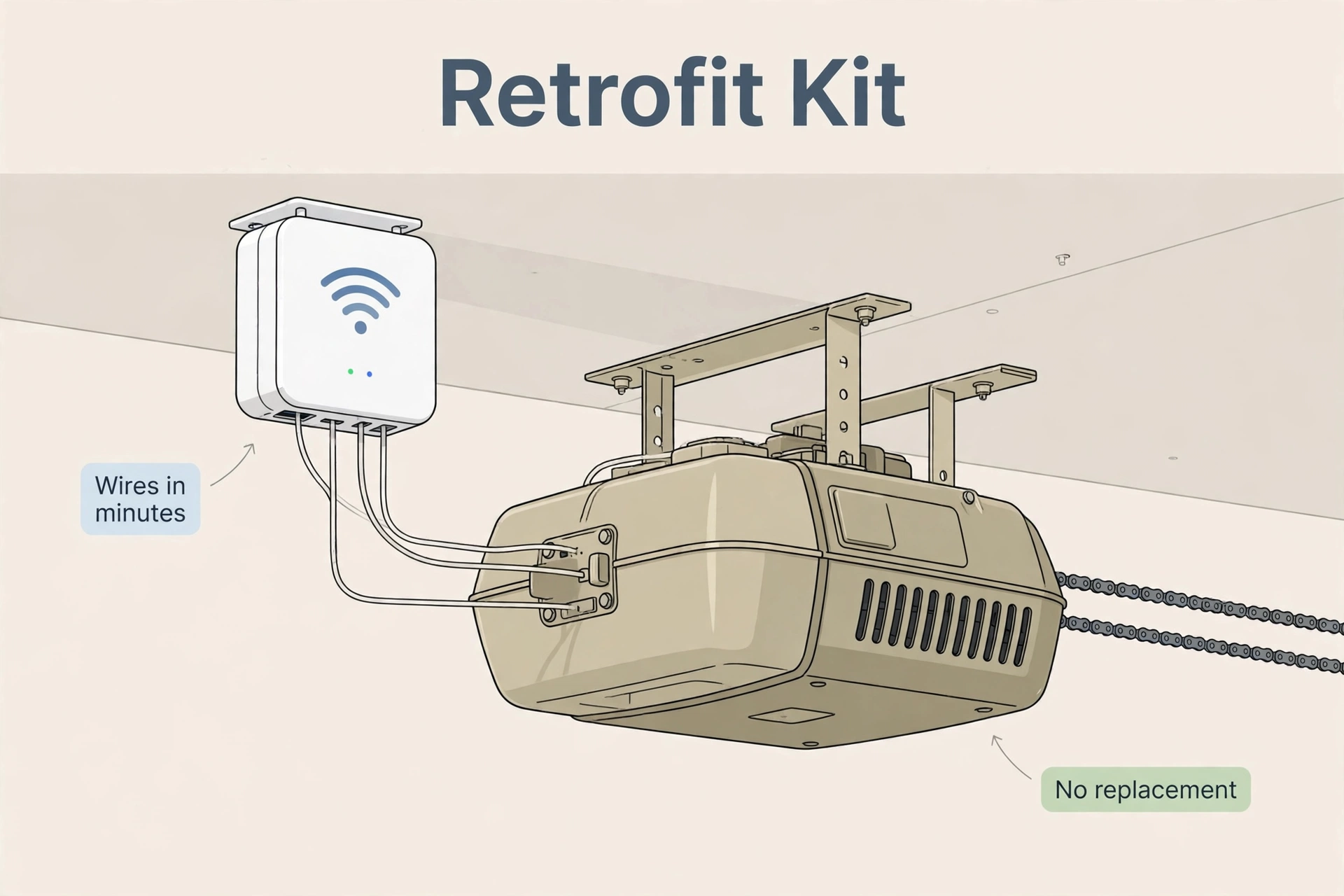
You do not always need a new opener. If your current opener is under 10 years old and runs fine, a retrofit smart controller (a small WiFi device that wires into your existing opener) adds app control, alerts, and voice support for a fraction of the cost. Two of the five picks below are retrofit options. Replace the whole unit only if the opener is old, loud, unreliable, or missing safety features like battery backup.
The 5 Best Smart Garage Door Openers for 2026
1. Chamberlain B6753T — Best Overall
The Chamberlain B6753T is the best smart garage door opener for most people because it gets every major thing right in one box: an ultra-quiet belt drive, a built-in 1080p camera with a wide view of the garage, battery backup, and the myQ app with schedules and real-time alerts. Its 1-1/4 HPc motor handles heavy insulated and double doors without strain.
The integrated camera is the standout. It streams live video of the garage interior and records motion events, which is genuinely useful for checking whether a package arrived or the kids got home. The trade-off is that video history beyond live view typically needs a subscription — many owners skip it and store security camera footage locally instead, so factor that into the long-term cost.
Installation is a standard DIY weekend job if you are comfortable with basic tools and a ladder; the rail comes in pieces that snap together. Expect to pay around $400, and check the current price because it moves with seasonal sales.
Best for: Most homeowners who want the complete package — quiet, camera, backup power, and a polished app.
Watch out for: myQ’s third-party integration limits (see the note above); camera video history usually needs a subscription.
2. Genie QuietLift Connect — Best Quiet Value
The Genie QuietLift Connect is the pick for anyone whose bedroom or living room sits above the garage. Its belt drive is among the quietest in its price class, and it pairs that with built-in WiFi, Alexa and Google Assistant support, and a wireless keypad in the box. Setup is straightforward, with pre-programmed remotes and a snap-together rail that most DIYers finish in an afternoon.
It does not have a built-in camera or battery backup, which is how it stays affordable. If those matter to you, step up to the Chamberlain. But for quiet, reliable smart control at a mid-range price, it is hard to beat. Note that 8-foot doors need a separate extension kit, so measure your door height before ordering.
Best for: Attached garages where noise matters, at a fair price.
Watch out for: No camera, no battery backup; extension kit needed for 8-foot doors; WiFi setup can be fiddly if the garage has a weak signal.
3. LiftMaster 87504-267 — Best Premium Pick
LiftMaster and Chamberlain are sister brands under the same parent company, with LiftMaster aimed at the pro-installer market and built to a heavier duty standard. The 87504-267 is its flagship smart opener: 1-1/4 HP, steel-reinforced belt drive, battery backup, myQ, and some of the best security hardware in the business (rolling codes, PosiLock anti-theft).
This is the opener to buy for heavy wooden or carriage-house doors, for households that cycle the door many times a day, or for anyone who simply wants the most durable unit available. It typically costs around $450 to $500 plus professional installation, which LiftMaster dealers usually recommend.
Best for: Heavy doors, high daily use, and maximum durability.
Watch out for: Premium price; professional installation usually expected; same myQ third-party limits as Chamberlain.
4. Meross Smart WiFi Garage Door Opener — Best Retrofit Kit
If your existing opener works fine, the Meross kit is the smartest money you can spend. It is a small WiFi controller plus a door sensor that wires into almost any opener made after 1993 (over 200 brands supported). You get app control, open/close alerts, schedules, and voice control through Apple HomeKit, Alexa, and Google Assistant — the broadest native platform support of any pick here.
Installation takes about 20 to 30 minutes: mount the sensor on the door, wire two leads to the opener’s wall-button terminals, and join it to your 2.4 GHz WiFi. The kit usually costs well under $100, which makes it the obvious first step before replacing a working opener. Just make sure your garage has a solid WiFi signal, since the controller needs a stable 2.4 GHz connection.
Best for: Adding smarts to a working opener on a budget, especially Apple HomeKit households.
Watch out for: Needs decent WiFi in the garage; does not add a camera or battery backup; verify compatibility with your opener model first.
5. NEXX NXG-200 — Best Retrofit Controller With Geofencing
The NEXX NXG-200 is the other retrofit option, and its killer feature is geofencing: the door can open automatically as you drive up and close after you leave, with no button presses. It also supports Alexa and Google Assistant voice control and works with most existing openers.
Geofencing sounds like a gimmick until you use it with a car full of groceries in the rain. The NXG-200 handles it reliably once the phone app’s location permissions are set correctly, which is the one setup step people stumble on. Like the Meross, it is affordable (around $100 or less — check the current price) and installs in under half an hour.
Best for: Hands-free arrival and departure automation on your current opener.
Watch out for: Geofencing depends on your phone’s location settings; no camera or backup power.
Table: The 5 best smart garage door openers compared (2026)
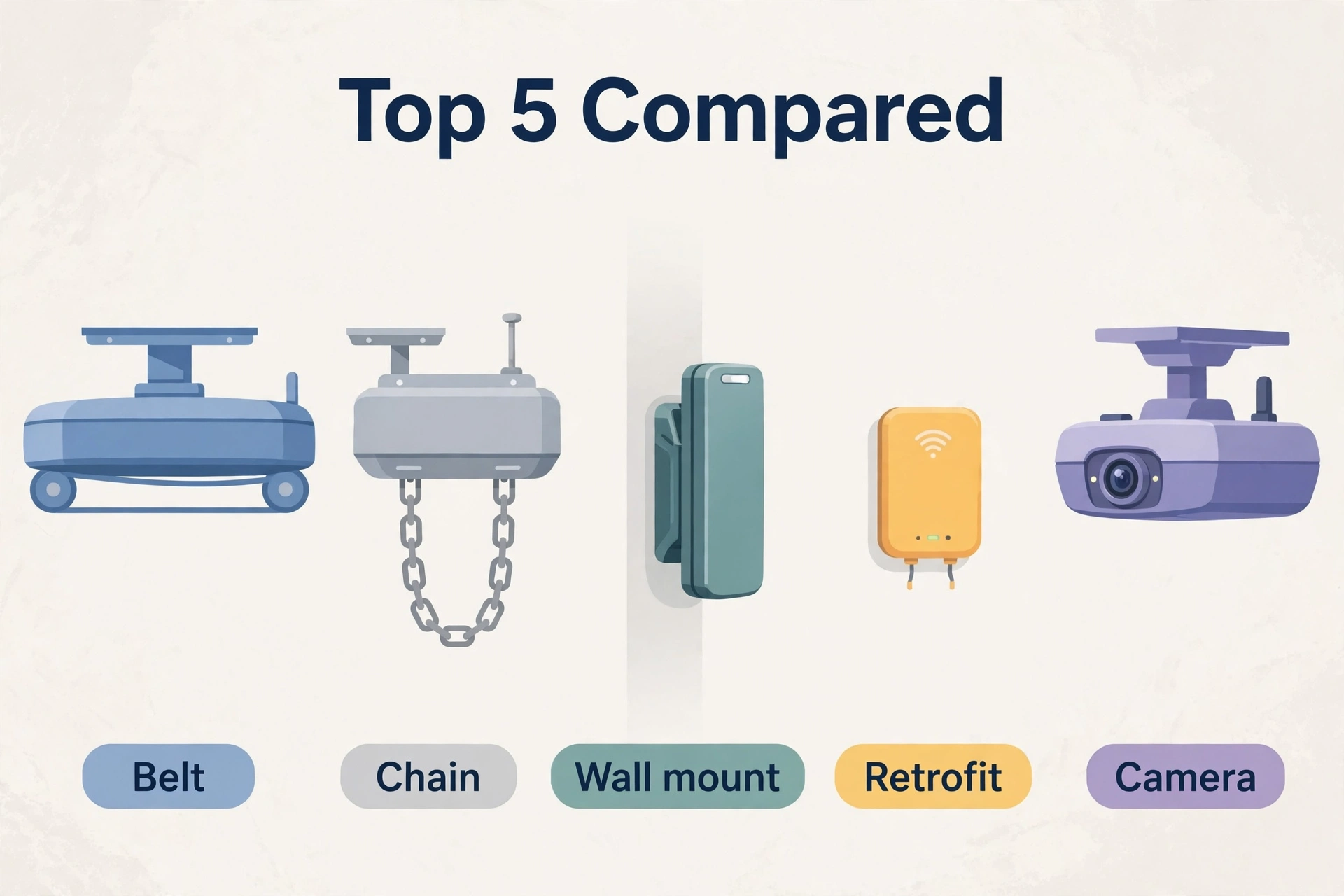
| Feature | Chamberlain B6753T | Genie QuietLift Connect | LiftMaster 87504-267 | Meross WiFi Kit | NEXX NXG-200 |
|---|---|---|---|---|---|
| Type | Full opener | Full opener | Full opener | Retrofit kit | Retrofit controller |
| Drive | Belt | Belt | Belt | Uses existing | Uses existing |
| Motor | 1-1/4 HPc | 3/4 HPc | 1-1/4 HP | N/A | N/A |
| Camera | Yes, built in | No | Optional models | No | No |
| Battery backup | Yes | No | Yes | No | No |
| Voice assistants | Google, limited Alexa | Alexa, Google | Google, limited Alexa | HomeKit, Alexa, Google | Alexa, Google |
| Standout feature | Camera + backup | Quiet value | Heavy-duty build | Cheapest upgrade | Geofencing |
| Price range | Around $400 | Mid-range | $450–$500 | Under $100 | Around $100 |
Installation and Safety Tips
A garage door is the heaviest moving object in most homes, so respect it during installation:
- Never touch the torsion spring. The spring above the door stores enough energy to cause serious injury. Openers do not require spring work — if your spring needs attention, call a pro.
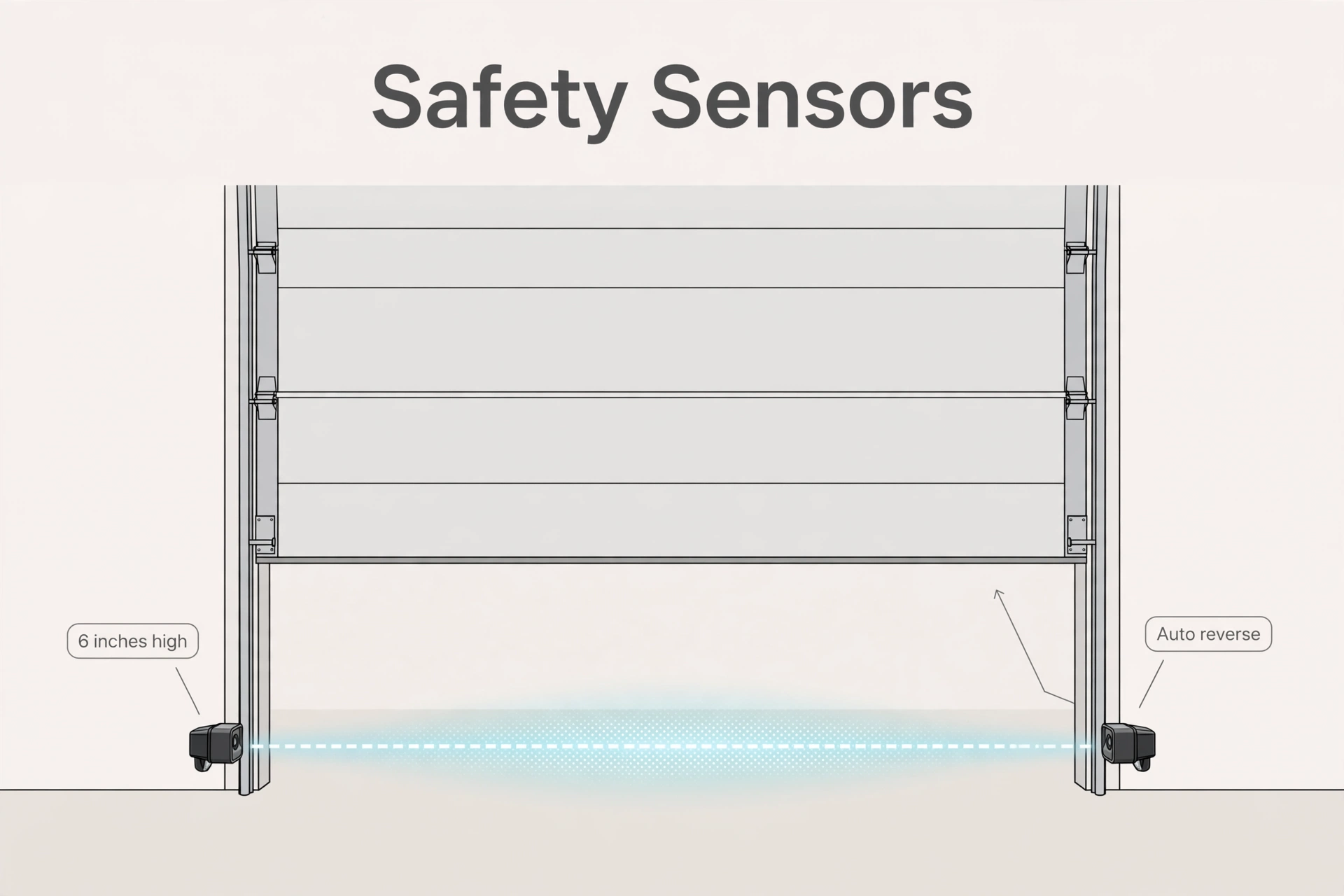
- Test the safety reversal. After installation, place a 2×4 flat on the ground under the door and close it. The door must reverse on contact. Test the photo-eye sensors monthly by waving an object through the beam while closing.
- Secure the wall control. Mount it at least 5 feet high so small children cannot reach it, and never let kids play with remotes.
- Use a strong, unique password for the opener’s app account and turn on two-factor authentication if offered. A garage door deserves the same account security as your email.
- Check WiFi strength in the garage first. Walk out there with your phone and run a speed test. Smart features die with a weak signal — a cheap access point or extender fixes it.
- Keep the manual release working. Know where the red emergency cord is and test it once a year, so a power outage (without battery backup) never traps your car.
- Cover the garage exterior with cameras. The garage is a common break-in point — the best security cameras with local storage watch it around the clock with no subscription.
Frequently Asked Questions
Can I make my old garage door opener smart without replacing it?
Yes. Retrofit kits like the Meross Smart WiFi Garage Door Opener or the NEXX NXG-200 wire into most openers made after 1993 and add app control, alerts, schedules, and voice support for well under $100. Replace the whole unit only if the opener is old, loud, or unreliable.
Do smart garage door openers work during a power outage?
Only models with battery backup keep working when the power is out — for example, the Chamberlain B6753T and LiftMaster 87504-267. Without backup power, use the manual release cord to operate the door by hand until power returns.
Is myQ compatible with Alexa and Google Home?
myQ works with Google Assistant on most models, but native Alexa support is limited or absent, and Chamberlain has restricted unofficial third-party integrations in recent years. If voice control through a specific assistant is essential, verify current compatibility for your exact model, or choose an opener with native support like Meross or Genie.
Belt drive or chain drive — which is better?
Belt drive is quieter and smoother, making it the better choice for attached garages. Chain drive is louder but cheaper and perfectly fine for detached garages. The price gap is small enough that most buyers should choose belt drive.
How long does a garage door opener last?
A quality opener lasts 10 to 15 years with basic maintenance: lubricate the rail and rollers yearly, test the safety reversal monthly, and replace the remote batteries when range drops. Heavy daily use shortens life, which is where a higher-horsepower pro-grade unit pays off.
Can one app control two garage doors?
Yes. Most smart platforms, including myQ, Meross, and NEXX, let you add multiple doors or controllers to one account and name each door separately. For two doors on one opener brand, check whether you need one controller per door or a single hub that handles both.
Conclusion
The best smart garage door opener in 2026 is the Chamberlain B6753T for most homes — quiet belt drive, camera, battery backup, and a polished app in one package. If your current opener still runs well, save your money and add the Meross retrofit kit instead; it delivers 90% of the smart experience for under $100. And if hands-free geofencing is what you really want, the NEXX NXG-200 is the one to get.
Whichever you choose, pair it with good entryway security — a video doorbell watching the driveway and local camera storage turn the garage from a weak point into one of the best-monitored spots in your home.
