

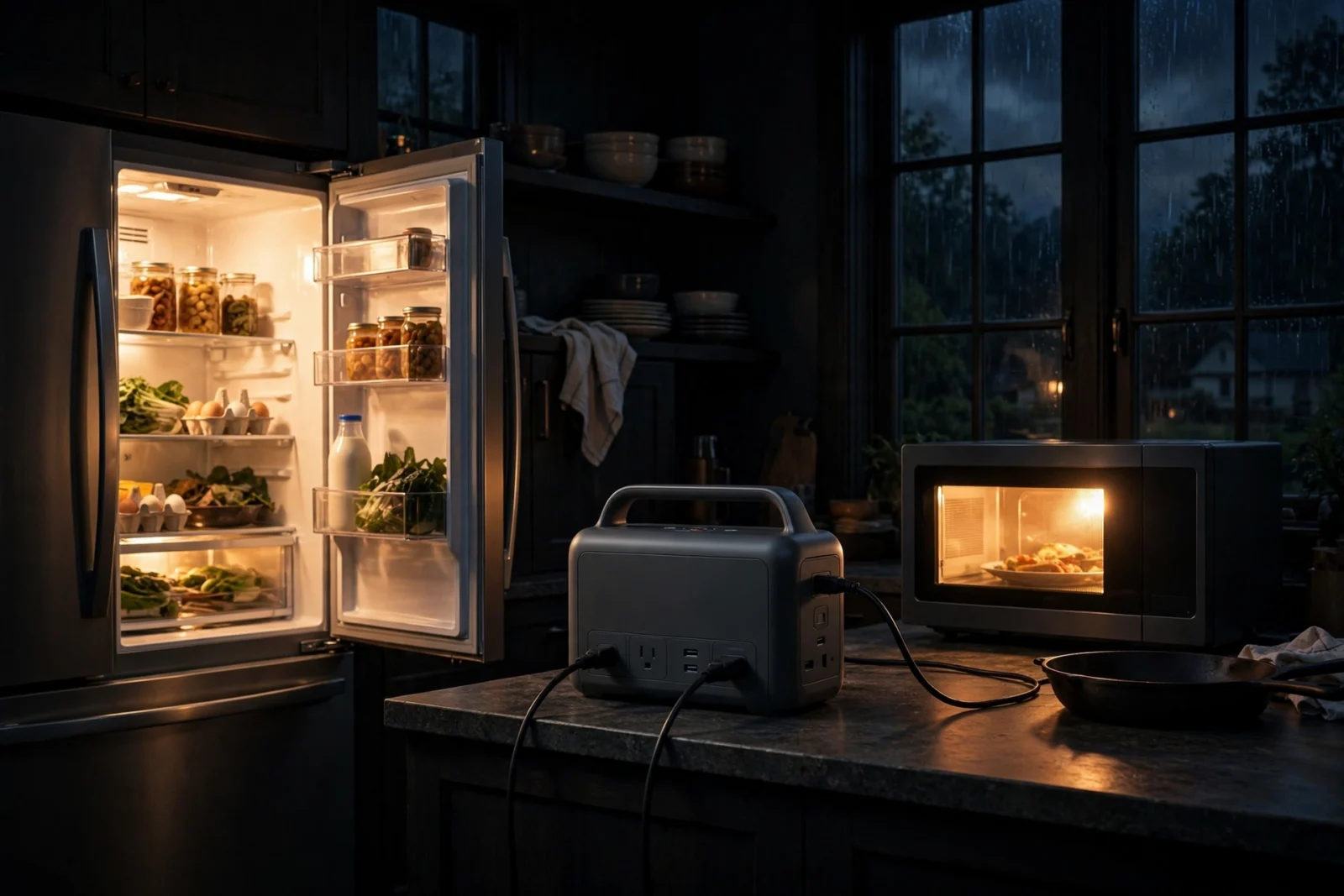
A portable power station 2000W rating means it can deliver 2,000 watts of continuous AC power — enough to run a full-size fridge, a microwave, power tools, or a TV plus laptop plus lights at the same time. It is the sweet spot for home backup: strong enough for real appliances, still portable enough to carry. But the watt number alone does not tell you how long anything runs — for that you need the battery capacity too. This guide explains what 2,000W can and cannot do, how long it lasts, how to measure your real needs, and whether you need it.
What Does 2000W Mean on a Power Station?
Watts measure power — the rate at which a device consumes electricity. However, a 2,000W continuous rating means the station’s inverter can sustain 2,000 watts of load indefinitely (until the battery runs out). Most 2,000W stations also handle a higher surge/peak — often 3,000–4,000W for a few seconds — to start motors and compressors.
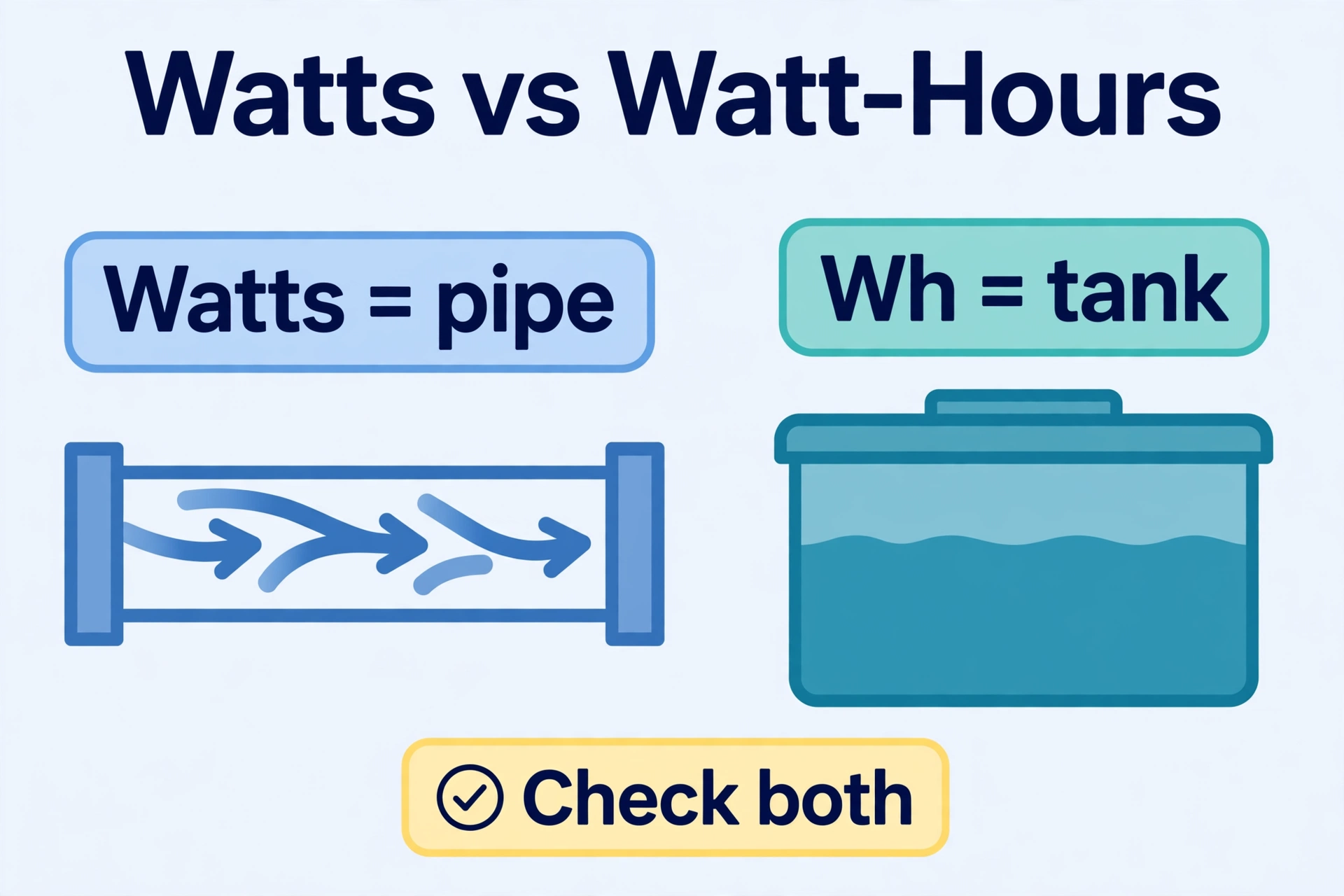
This is different from capacity (watt-hours, Wh), which measures stored energy. For example, think of it this way: watts are the size of the pipe, watt-hours are the size of the tank. In addition, a 2,000W / 1,024Wh station can run big loads, but only for about half an hour at full tilt. In addition, a 2,000W / 2,048Wh station runs the same loads twice as long.
When shopping, always check both numbers. A “2000W” headline with a tiny battery is a sprinter — impressive, but out of breath quickly. The ideal home backup unit pairs the 2,000W output with at least 1,024Wh of capacity, giving you both muscle and meaningful runtime in one box.
2000W Surge vs Continuous: Why Both Matter
Every 2000W station lists two numbers: continuous (what it sustains indefinitely) and surge/peak (what it handles for seconds). Both matter because motors misbehave at startup.
A refrigerator compressor might draw 150W while running but spike to 800–1,200W for a split second when it kicks on. A circular saw can surge to double its rated draw. If the surge exceeds the station’s peak rating, the overload protection trips and everything shuts off. In fact, even though the “running” watts were fine. This is why experienced buyers check the surge figure first and the continuous figure second.
Most 2000W stations offer 3,000–4,000W surge, which covers normal appliance startups comfortably. The spec to fear is a station advertising “2000W” with no surge rating at all — it suggests a weak inverter that may trip on the first fridge cycle. Always confirm both numbers before buying.
What Can a 2000W Power Station Run?
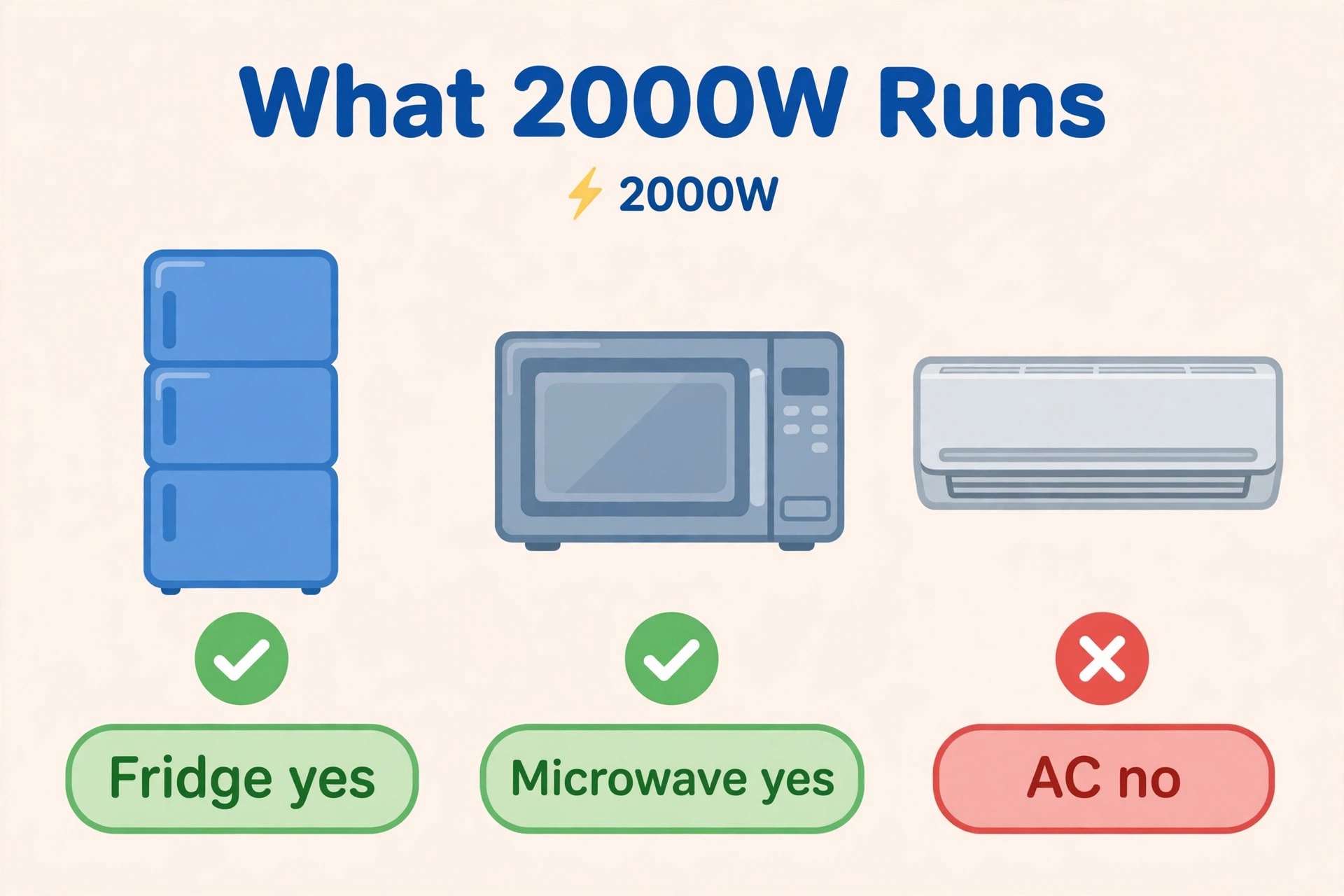
Two thousand watts covers nearly every normal household device except the true heavyweights (central AC, electric stoves, electric water heaters). Furthermore, here is what fits:
Table 1: Typical appliance wattages vs a 2000W station
| Appliance | Typical Watts | Runs on 2000W? |
|---|---|---|
| Full-size refrigerator | 100–200W | Yes, easily |
| Microwave | 800–1,200W | Yes |
| TV (50-inch LED) | 100–150W | Yes, easily |
| Laptop + monitor | 100–150W | Yes, easily |
| Coffee maker | 800–1,200W | Yes |
| Box fan | 50–100W | Yes, easily |
| Power drill / circular saw | 600–1,500W | Yes |
| Space heater (low) | 750–1,500W | Yes, on low |
| Hair dryer | 1,200–1,800W | Yes, barely |
| Electric kettle | 1,500W | Yes |
| Central air conditioner | 3,000–5,000W | No |
| Electric stove / oven | 2,000–5,000W | No (too much) |
The practical takeaway: a 2,000W station runs any one big appliance plus a handful of small ones simultaneously. Fridge (150W) + microwave (1,000W) + TV (120W) + router (15W) = ~1,285W — comfortable. Add a space heater on high and you will trip the overload protection, so heat is the one category to plan around carefully.
2000W Output vs Battery Capacity: Don’t Confuse Them
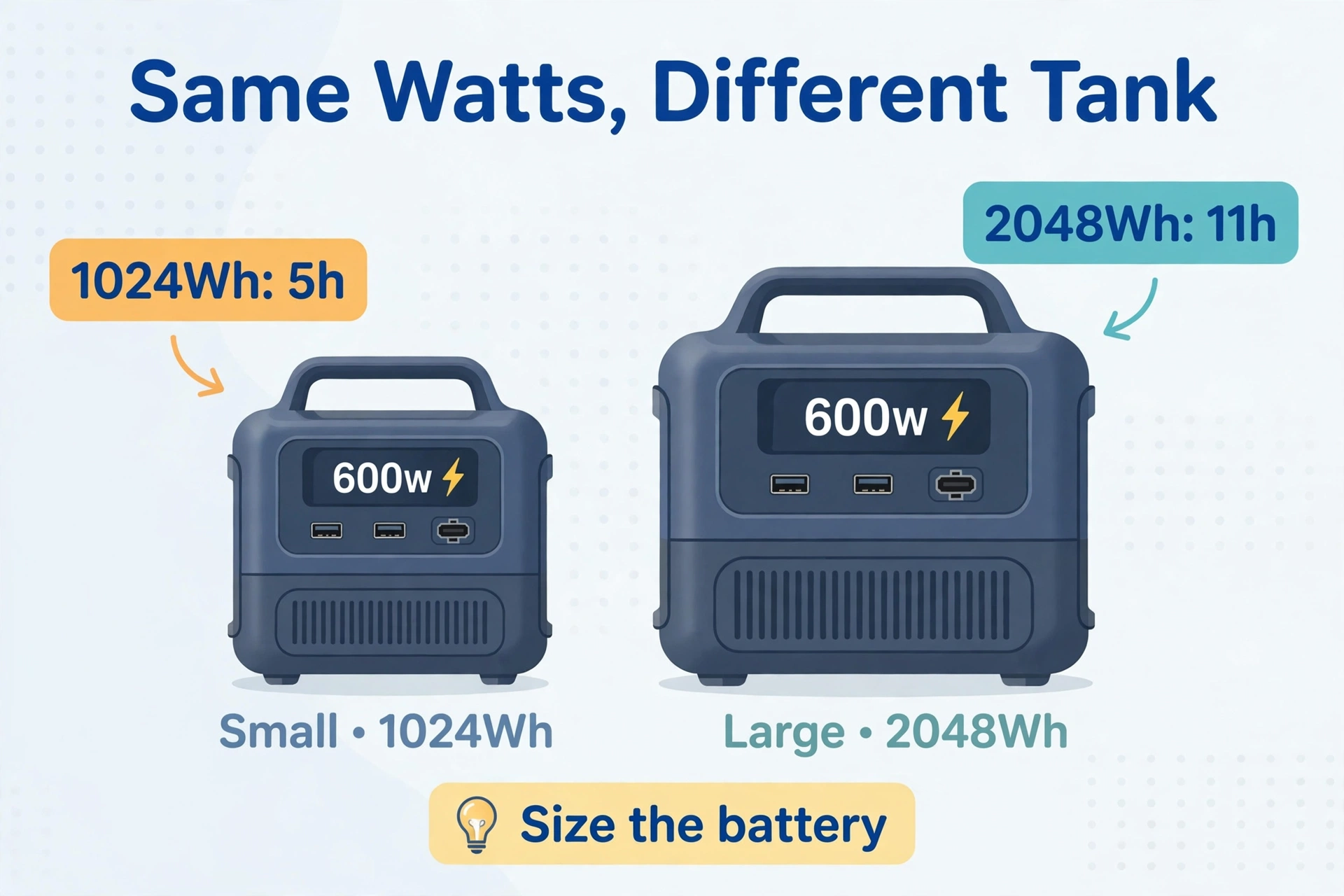
This is the #1 misunderstanding in power station shopping. Moreover, sellers advertise the big watt number; buyers assume it means long runtime. Also, it does not.
Table 2: Same 2000W output, very different runtimes
| Station Example | Output | Capacity | Fridge Runtime* |
|---|---|---|---|
| Compact 2000W unit | 2,000W | 1,024Wh | ~5–6 hours |
| Mid-size 2000W unit | 2,000W | 2,048Wh | ~11–12 hours |
| EGO Nexus (2 batteries) | 2,000W | ~420Wh | ~2–3 hours |
| EGO Nexus (4 batteries) | 2,000W | ~840Wh | ~5–6 hours |
*Fridge at ~150W average with compressor cycling; real-world varies.
Rule: watts decide what you can run; watt-hours decide how long. For outage backup, capacity matters more than output once you clear the 1,500W threshold — because a fridge that runs 12 hours beats a microwave you use for 5 minutes.
How Long Will a 2000W Power Station Last?
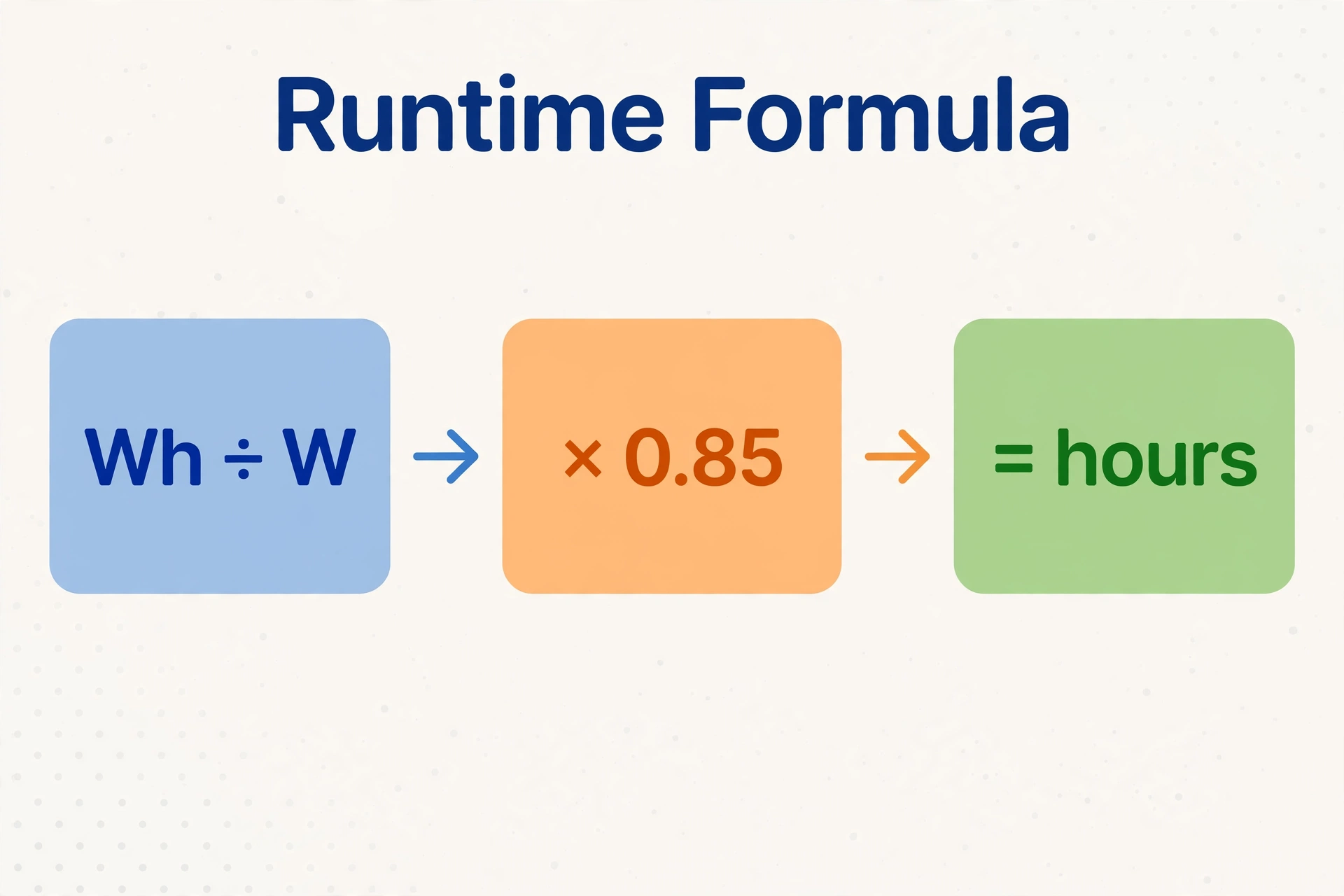
Use the runtime formula: capacity (Wh) ÷ load (W) × 0.85 (the 0.85 accounts for inverter losses).
Examples with a 2,048Wh / 2,000W station:
- Essentials only (fridge 150W + router 15W + lights 30W = 195W): 2,048 ÷ 195 × 0.85 ≈ 9 hours
- Working from home (laptop 65W + monitor 30W + router 15W + lights 20W = 130W): ≈ 13 hours
- Cooking dinner (microwave 1,000W for 10 min + fridge cycling): the microwave alone drains ~170Wh per 10 minutes — barely a dent
- Full tilt (2,000W continuous): 2,048 ÷ 2,000 × 0.85 ≈ 52 minutes
That last line is the reality check: at maximum output, even a big station empties in under an hour. The winning strategy is running essentials continuously and big appliances in short bursts.
How to Measure Your Actual Power Needs
Guessing your loads is how people buy the wrong station. Measure instead — it takes one evening:
- Read the labels. Every appliance has a wattage on its nameplate or manual. Write down your must-run devices.
- Use a plug-in meter (like a Kill A Watt, ~$30) for the real numbers. A “150W” fridge might average 90W with cycling — or spike to 800W on startup. The meter shows the truth over 24 hours.
- Add only simultaneous loads. You will not run the microwave, hair dryer, and circular saw at the same moment. Total the realistic worst-case combo, then add 20% headroom.
- Convert to watt-hours for runtime: watts × hours of use per day. A 150W fridge running 8 compressor-hours daily needs 1,200Wh.
Most households discover their true essential load is 200–400W — far below what they feared. That measurement is worth more than any review when choosing between 1,000W, 1,500W, and 2,000W models.
Popular 2000W-Class Power Stations
Several current models hit the 2,000W mark. All specs below are manufacturer-published:
- EGO Nexus PST3042 — 2,000W continuous / 3,000W peak, runs on 1–4 swappable EGO 56V batteries. Unique because capacity grows with your battery collection. See EGO’s official Nexus page for kits.
- Anker SOLIX C1000 Gen 2 — 2,000W continuous with 1,024Wh built in. Compact high-output pick for tools and kitchen loads.
- EcoFlow DELTA 3 Max Plus — 2,048Wh class with 2,400W+ output headroom for the heaviest backup scenarios.
- BLUETTI Elite 200 V2 — 2,600W-class output with over 2kWh capacity for multi-day outages.
Prices shift with sales and bundles — check the official store pages rather than trusting any single quoted price.
Do You Actually Need 2000W?
Be honest about your loads before paying for watts you will not use:
Table 3: Do you need 2000W?
| Your Situation | Verdict | Why |
|---|---|---|
| Phones, laptops, lights, router | No — 500–800W is enough | Small loads, save money and weight |
| + full-size fridge | 1,000–1,500W is enough | Fridge surges are brief |
| + microwave / coffee maker | Yes — 2,000W recommended | Heating appliances need headroom |
| + power tools / workshop | Yes — 2,000W minimum | Tools surge hard on startup |
| Whole-home backup | No — you need a fixed system | Portable units cannot do this |
The most common buyer regret is oversizing: a 70-pound 2,000W unit gathering dust when a 25-pound 1,000W station would have covered every actual outage. Buy for your measured loads, not your imagined ones.
2000W Backup for a Smart Home
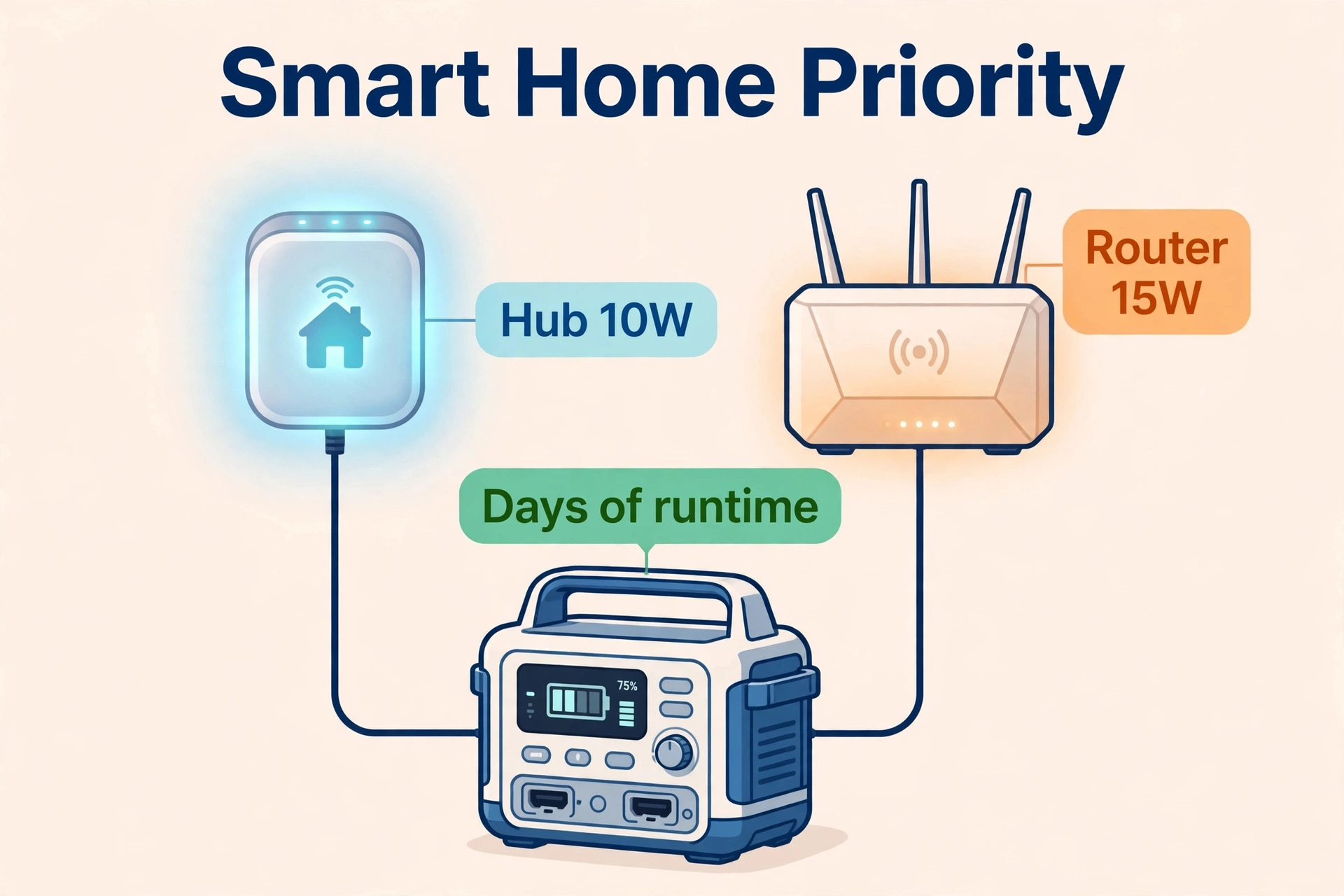
Furthermore, two thousand watts is generous for smart home essentials — which is exactly why it is a great fit. First, your critical loads are tiny: a router (~15W), a Home Assistant hub (~10W), and cameras (~25W) total under 60W. On a 2,000W station, those run for days, not hours.
The headroom is what you are really buying: the ability to also run the fridge, microwave dinner, and keep lights on without juggling plugs. If you install Home Assistant on a Raspberry Pi 5, put the Pi and router on UPS outlets so automations survive the switchover, and see our best mini PC for Home Assistant guide if your setup is beefier.
For security continuity, cameras with local storage keep recording through the outage, and our home security upgrade guide shows how to layer it all. A 2,000W station means your security posture does not degrade one bit when the grid fails.
Safety Tips for 2000W Stations
- Ventilation matters. 2,000W of inverted power generates real heat. Keep vents clear and never run the station inside a closed cabinet or under blankets.
- Respect the overload. If the station trips, something drew too much. Unplug the heaviest device before resetting — repeatedly forcing resets stresses the inverter.
- One high-draw device at a time. Microwave or kettle or space heater — never two together on a 2000W unit.
- Keep it dry. Most stations are not waterproof. Garage or covered patio during rain is fine; open yard in a storm is not.
- Store at partial charge (50–80%) in a cool place, and top up every few months. A neglected battery is the #1 cause of “my station died in storage.”
2000W Station Buying Checklist
Run through this before you pay:
Table 4: 2000W buying checklist
| Check | What You Want | Red Flag |
|---|---|---|
| Continuous output | 2,000W (verified in specs) | “Peak 2000W” only — no continuous rating |
| Surge rating | 3,000W+ | No surge figure listed |
| Capacity | 1,024Wh+ (2,048Wh for outages) | Under 500Wh behind a 2000W headline |
| Battery chemistry | LiFePO4, 3,000+ cycles | Unspecified chemistry |
| Waveform | Pure sine wave | “Modified sine wave” |
| Solar input | 400W+ | No solar input at all |
| Weight | You can lift it comfortably | Over 60 lbs with no wheels/handle |
| Warranty | 3–5 years | 1 year or less |
Frequently Asked Questions
What can I run on a 2000W portable power station?
Nearly all normal household devices: fridges, microwaves, TVs, laptops, coffee makers, power tools, and fans. You cannot run central AC, electric stoves, or electric water heaters — those need 3,000W+ and a fixed backup system.
How long will a 2000W power station run a fridge?
It depends on battery capacity, not the 2000W rating. A 1,024Wh station runs a 150W fridge ~5–6 hours; a 2,048Wh station ~11–12 hours. Use: Wh ÷ watts × 0.85 for a realistic estimate.
Can a 2000W power station run a microwave?
Yes. Most microwaves draw 800–1,200W, well within 2,000W continuous. Ten minutes of microwaving uses roughly 150–200Wh — a small fraction of a 1–2kWh battery. It is one of the best uses of a 2000W station.
Is 2000W enough for home backup?
For essentials plus one big appliance at a time, yes. It covers the realistic outage scenario: fridge cold, food hot, lights on, devices charged, internet up. It is not whole-home backup — that requires a permanently installed system.
What is the difference between 2000W and 2000Wh?
2000W is power (how much it can deliver at once); 2000Wh is energy (how much it stores). A 2000W/1000Wh station runs big loads briefly; a 1000W/2000Wh station runs smaller loads for a long time. Check both numbers before buying.
Can I charge a 2000W power station with solar panels?
Yes, if it has a solar input — most do. Match panel wattage to the station’s max solar input (commonly 400–1,000W). With 800W of panels in good sun, a 2kWh station refills in about 3 hours while also powering daytime loads.
Final Thoughts
A 2000W portable power station is the home backup sweet spot: enough muscle for microwaves and tools, enough restraint to stay portable. Remember the golden rule — watts choose what runs, watt-hours choose how long — and size the battery for your outage history, not just the headline number. Measure your real loads with a plug-in meter before buying, keep one high-draw appliance at a time on the station, and put your smart home essentials on it first. Do that, and the next blackout will be the quietest emergency you have ever slept through.
