Short answer: you can, but you shouldn’t. A GoPro or any other action camera technically records video inside a car — but it’s missing the three things that make a dash cam a dash cam: loop recording that never fills the card, a heat-proof supercapacitor instead of a swelling-prone battery, and automatic start/stop with the ignition. Without those three, an action camera is an unreliable witness. It overheats. It dies mid-drive. It misses the moment that matters. This guide breaks down the dash cam vs action camera differences honestly — including the narrow situations where an action camera genuinely works.
Why People Ask This Question
It’s a fair question, honestly. You already own a GoPro. It shoots gorgeous 4K video that makes your road trips look like car commercials. So why on earth would you buy another camera? The logic feels airtight — right up until you understand what a dash cam actually does all day. The boring stuff. The stuff an action camera was never designed for.
Think of it this way. An action camera is built for sessions: you switch it on, record an hour of mountain biking, switch it off, go home. A dash cam is built for permanence: every drive recorded, old footage overwritten on its own, summer heat baking the windshield for years without blinking — and it starts rolling before you’ve even thought about it. Those are completely different engineering problems. And the resolution number on the spec sheet? Tells you nothing about any of them. Nothing at all.
The Three Decisive Differences
1. Loop recording
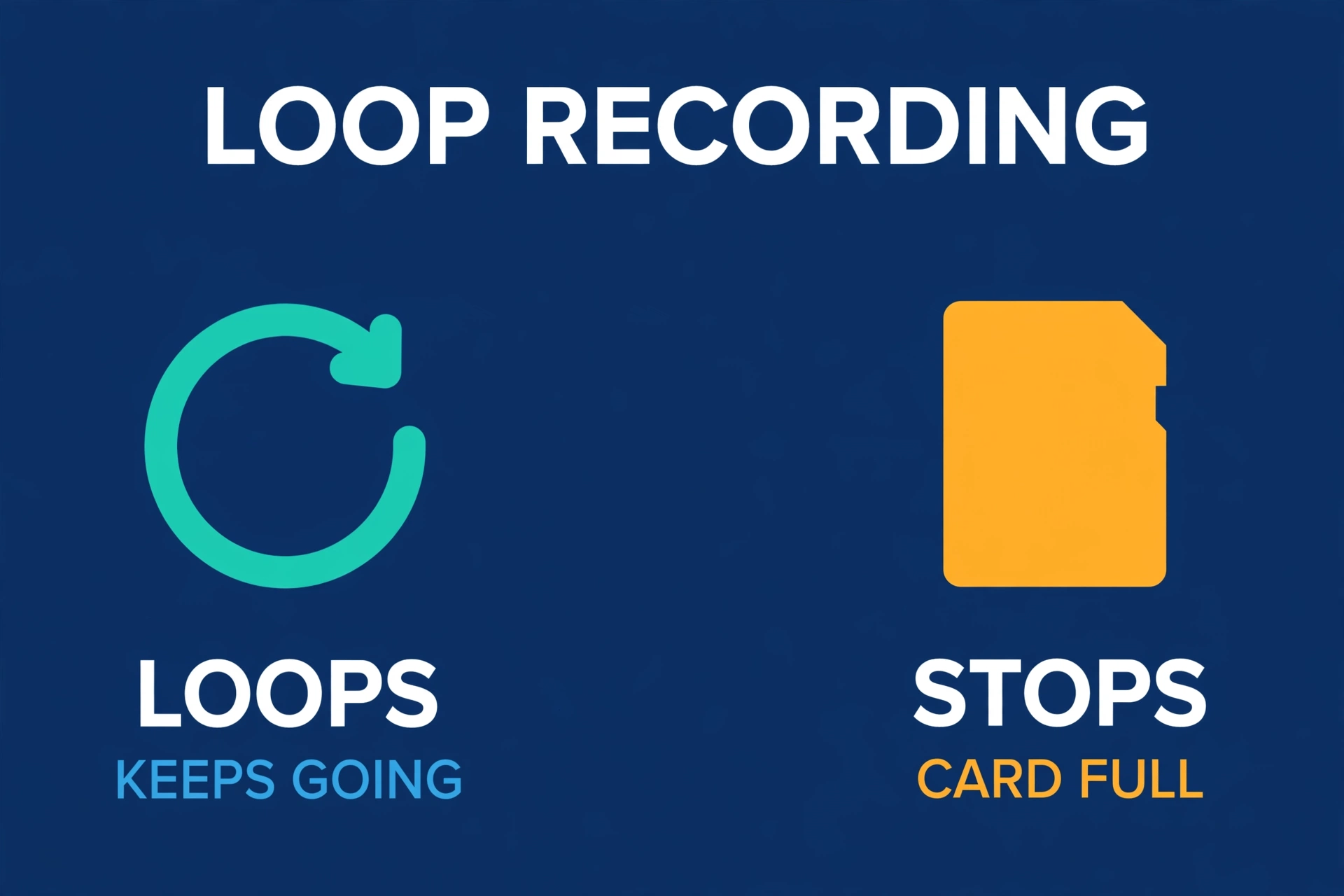
A dash cam records in a continuous loop. Card fills up? The oldest unlocked footage gets overwritten automatically. You never touch it. Never think about it. The camera is simply always ready — that’s the whole point of the thing. An action camera records until the card is full. Then it stops. Full stop. Missed the moment because the card filled up on Tuesday? That’s not a malfunction. That’s just how action cameras work. They were never asked to do otherwise.
Now, some action cameras do bury a looping mode somewhere in the settings. But it’s an afterthought — short loop lengths, no G-sensor file locking, no parking-mode integration. A checkbox feature, not a design philosophy.
2. Supercapacitor vs battery
This is the big one. The dealbreaker. Action cameras run on lithium batteries, and lithium batteries absolutely despise sustained heat. A windshield in summer is one of the hottest spots in your entire car — cabin temperatures climb way past what phone-grade batteries tolerate. The result is the classic action-camera-as-dash-cam story, and it plays out the same way every time: works great for a month, then starts shutting down out of nowhere, then the battery swells.
And a swollen battery in a windshield-mounted camera isn’t just annoying. It’s a safety issue — a genuine one. Dash cams solved this problem years ago with supercapacitors, which shrug off exactly the heat that kills batteries. No action camera offers this. None. Because no action camera is designed to live on a windshield.
3. Automatic operation
A dash cam starts recording when the car starts and stops when the car stops. Install it once, then forget it exists — that’s the dream, and it’s also the reality. An action camera needs you to press record before every single drive. And to actually remember to do it. Human memory is the weakest link in any safety system ever built. The drive you forget to hit record? Statistically, that’s the drive you needed it.
Now throw parking mode into the mix and the gap becomes a chasm. A hardwired dash cam stands guard over your parked car for hours — door dings, hit-and-runs, the 2 AM parking lot. An action camera running on a dying battery guards absolutely nothing once you walk away. Our guide to what parking mode on a dash cam is shows exactly what you’re giving up.
Dash Cam vs Action Camera: Full Comparison
Table: Dash cam vs action camera for driving use
| Feature | Dedicated dash cam | Action camera (e.g. GoPro) |
|---|---|---|
| Loop recording | Yes, automatic and seamless | No (or crude loop mode) |
| Heat tolerance | Supercapacitor — built for windshields | Lithium battery — overheats, swells |
| Auto start/stop with ignition | Yes | No — manual every drive |
| Parking mode | Yes (with hardwire kit) | No |
| G-sensor event locking | Yes | No |
| GPS speed/location stamp | Common | Rare / via accessories |
| Video quality (daylight) | Very good | Excellent |
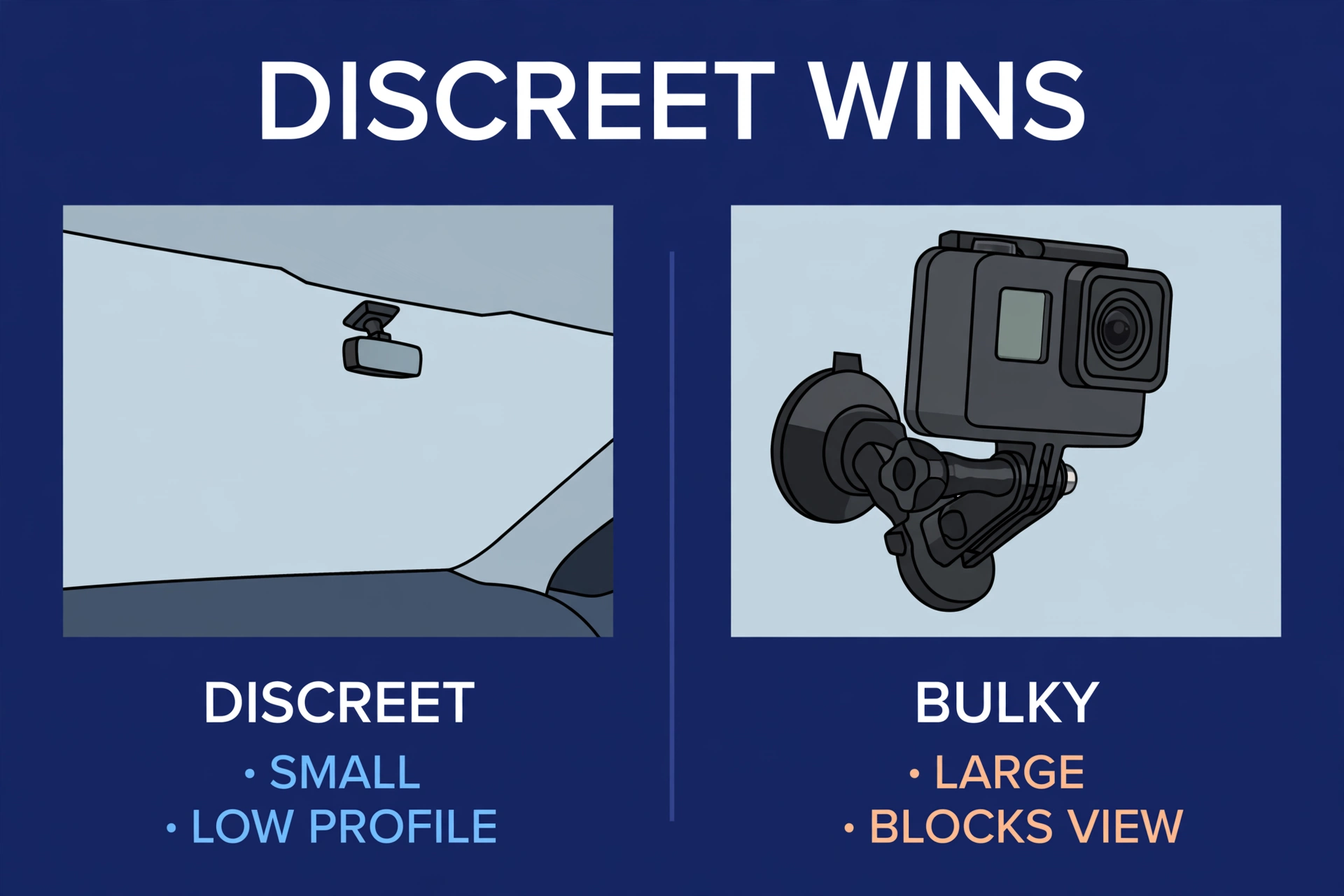
| Discreetness | Designed to disappear | Bulky, obvious |
| Price for the job | Lower (purpose-built) | Higher (paying for features you will not use) |
Look at that table again. Go on, really look. The action camera wins exactly one row — daylight video quality — and loses everything that makes a dash cam dependable. Beautiful footage of nothing (because the camera was off, overheated, or full) is worth precisely nothing.
What Actually Happens If You Try It
Let’s walk through the typical action-camera-as-dash-cam experiment. Thousands of drivers run it every year, and the script barely varies.
The first week feels like a victory. However, everything works. The footage looks fantastic — better than a dash cam’s, even. You feel clever for saving the money. Maybe you tell a friend about your brilliant hack.
Then comes the first properly hot day, maybe three weeks in. For example, the camera shuts down mid-drive with an overheating warning. You miss an entire commute. You tell yourself it was a fluke — freak weather, surely. It wasn’t.
By month two, a subtler failure creeps in: you forget to press record twice in one week. In addition, nothing happens either time — no crash, no incident, no drama. Furthermore, which teaches you the worst possible lesson: that forgetting is harmless. It’s not. You’re just getting lucky, and luck is not a safety strategy.
Month three brings the double hit. Moreover, the card fills up during a long drive and recording stops silently — no warning you’ll actually notice. Or the battery, cooked by two months of windshield heat, now lasts 40 minutes instead of two hours. Either way, the camera is quietly failing at its one job.
And then month four delivers the punchline. Also, someone backs into your parked car. The action camera was in the glove box — because you got tired of the daily record-button ritual weeks ago. No footage. Of course. There never is, when it counts.
This isn’t hypothetical — it’s the composite of countless forum threads, and the details repeat with eerie consistency. Here’s the nasty part: the action camera doesn’t fail dramatically. It fails gradually and quietly. Which is worse, because you keep on trusting it right up until the day you need it.
The Narrow Cases Where an Action Camera Works
Fairness demands the exceptions. Because they exist. An action camera is a reasonable temporary dash cam — emphasis on temporary — in a handful of situations.
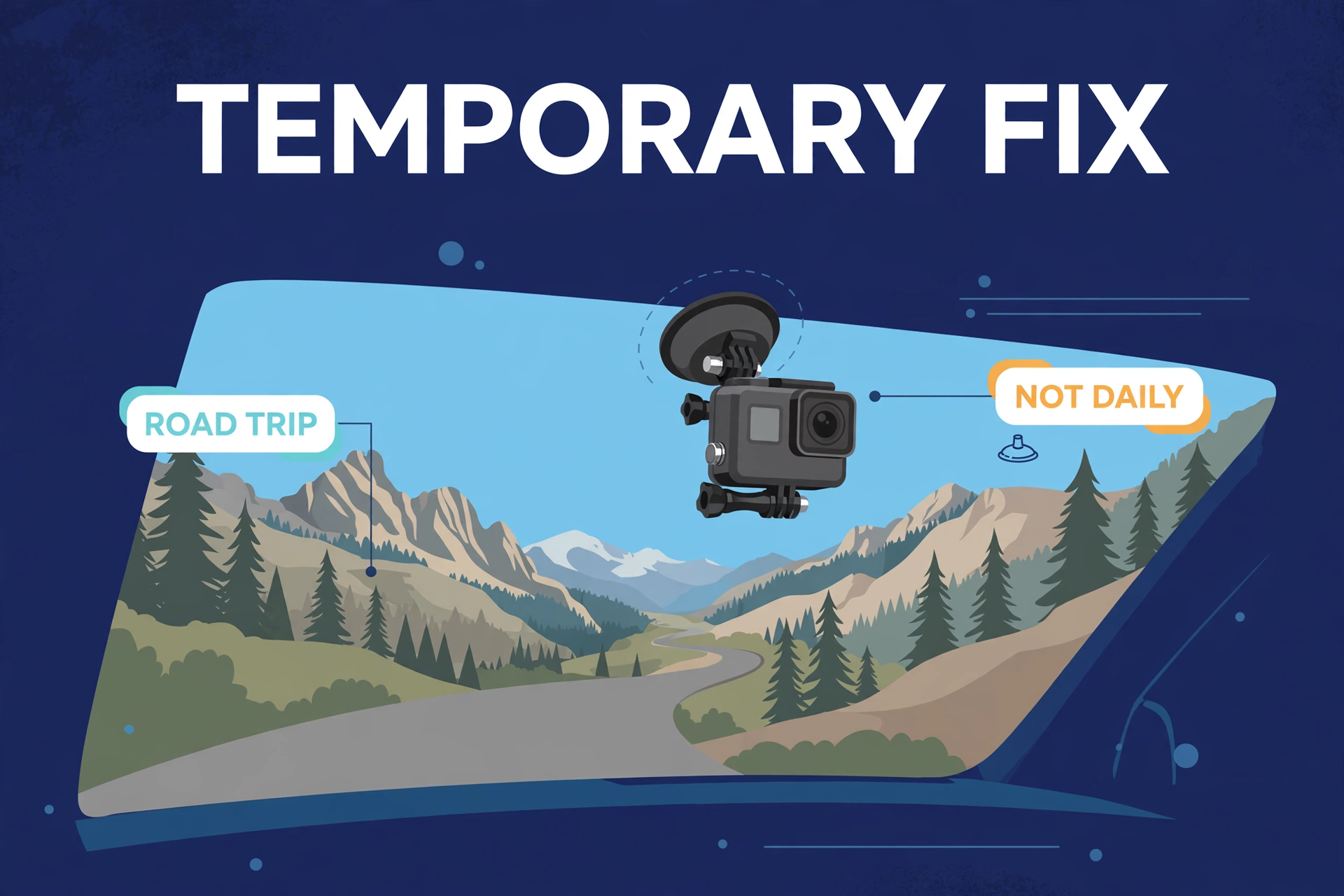
Road trip weekend, for instance. First, you want scenic footage, not evidence. However, flip it to loop mode, keep it charged, enjoy the views rolling past. For example, just don’t mistake it for protection — it’s a souvenir camera that weekend, nothing more.
Or maybe you’re testing whether you even want a dash cam. Second, a week with the GoPro on the windshield shows you what the footage looks like and whether you’ll actually bother using it. Totally legitimate experiment. Then go buy the real thing — the experiment did its job.
Another fair use: you need a second angle for one specific drive. Finally, towing something unusual. A scenic route you want to remember properly. Documenting a move. Here the action camera’s superior stabilization and quality genuinely shine — it’s doing what it was built to do.
And the one semi-permanent case: it’s winter, the car is garaged, temperatures stay mild. Meanwhile, that dodges the heat problem entirely. Even here, though, the manual-record problem doesn’t go away.
See the pattern? Short-term. Supervised. Mild weather. The moment the job becomes “every drive, all year, without thinking about it” — the action camera is the wrong tool.
GoPro-Specific Notes
Since GoPro is the action camera most people actually own, a few specifics are worth spelling out.
In addition, looping mode exists on recent GoPros, but it’s limited — short intervals, handy for not filling the card during one long recording. What it is not: a substitute for true dash cam loop logic with event protection. In fact, different animal entirely.
Overheating is well documented. As a result, goPros are notorious for heat shutdowns even in normal action use — strapped to a helmet in the sun, they’ll tap out. In contrast, stick one on a windshield in summer and it’s not a question of if. It’s when, and how often.
Moreover, battery swelling is a known issue across the action camera category with sustained heat exposure. Similarly, pulling the battery and running on USB power helps — plenty of people try this workaround. But then any power interruption corrupts the file being written, which is the exact problem dash cam supercapacitors were built to solve. Also, you’re trading one failure mode for another.
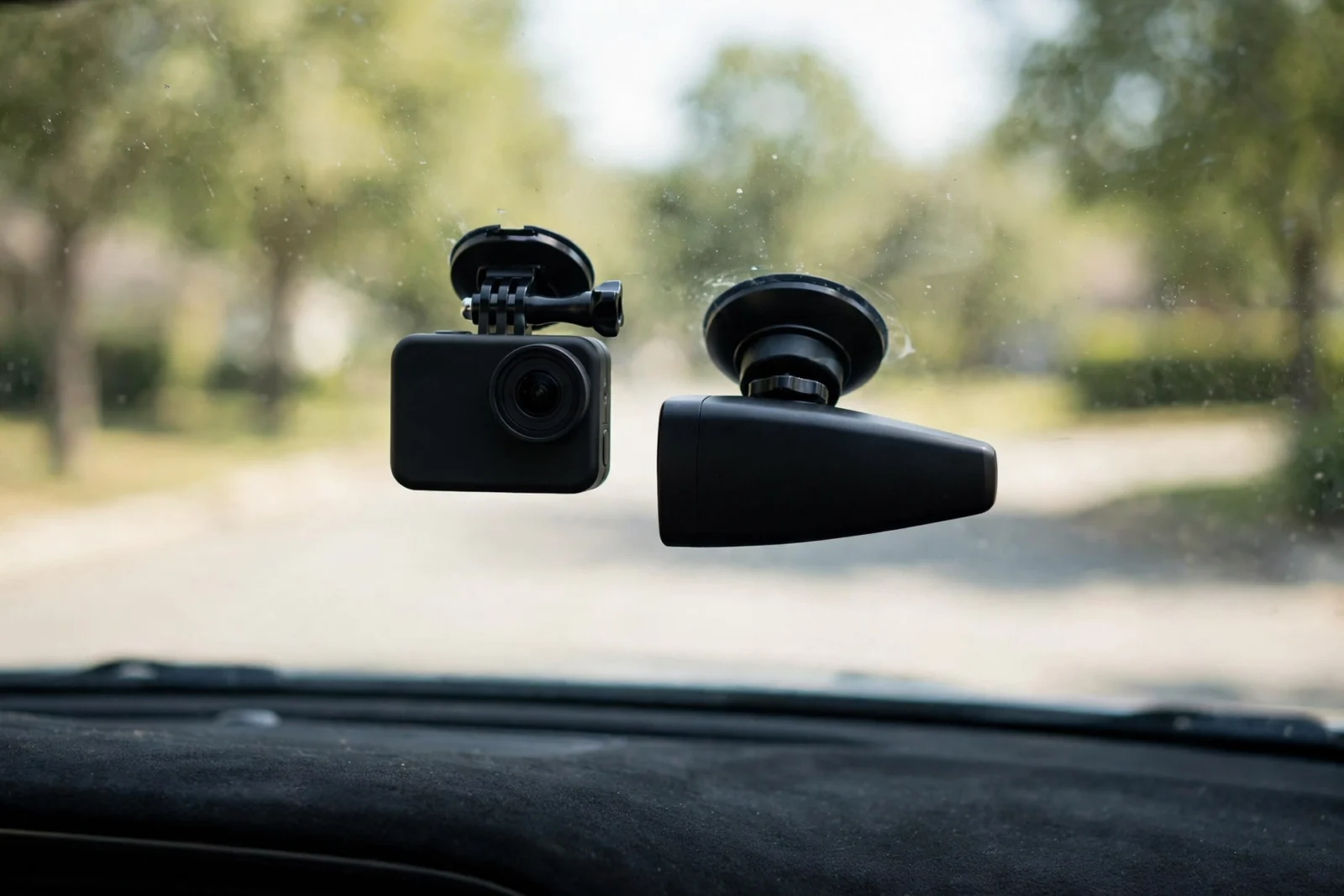
And the rest of the checklist: no parking mode, GPS stamping is clumsy. In addition, the whole mount ecosystem is built for helmets and handlebars — not discreet windshield installs. Specifically, a GoPro on a windshield looks like exactly what it is: a visitor.
None of this is a knock on GoPro, to be clear. It’s a superb action camera — genuinely one of the great little gadgets of the last decade. It’s simply engineered for a different job. For the job of daily driving evidence, compare purpose-built options in our best front and rear dash cam roundup instead.
The Cost Argument, Dismantled
“But I already own it, so it’s free!” Not quite. Let’s actually do this math.
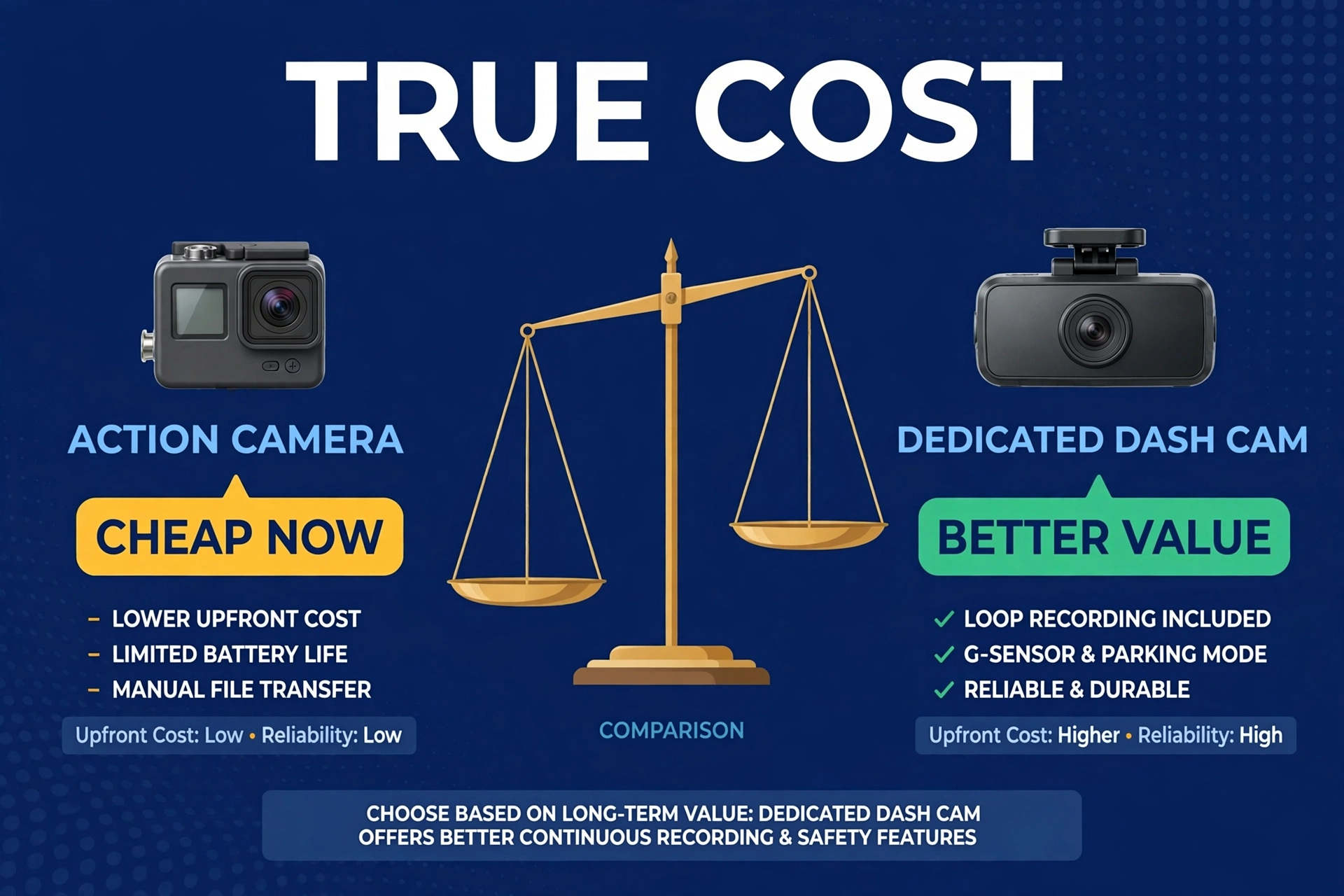
Running a roughly $300–400 action camera as a dash cam means risking a roughly $300–400 camera to avoid buying a roughly $100–200 dash cam. However, read that again. For example, heat damage to the battery. In addition, a swollen cell wrecking the housing. Months of daily heat cycles grinding down a precision device. Action cameras aren’t priced for disposable use — they’re premium gadgets, and you’re spending one’s lifespan to do a cheap camera’s job. Check current street prices before deciding; both categories shift with sales and new model releases.
Meanwhile a basic but real dash cam costs less than the action camera you already own and does the job better in every reliability dimension that matters. Furthermore, the economics only work if you value the action camera at zero. You shouldn’t. It’s worth hundreds — which is exactly why it shouldn’t be baking on your windshield.
And if 4K quality is the real attraction? Good news: 4K dash cams exist at mainstream prices now — loop recording, supercapacitors, and parking mode included. Our best 4K dash cam guide covers how to get genuine 4K without the action-camera compromises. Best of both worlds, no hack required.
Common Mistakes in This Debate
A few traps people fall into, over and over. Let’s clear them out.
Judging by daylight footage alone. Moreover, every camera looks good at noon — every single one. Also, reliability gets decided at 3 PM in August, when the windshield is a furnace, and at 3 AM in a parking lot, when nobody’s watching. First, judge cameras there, not at golden hour.
Assuming “4K” means “better evidence.” A 4K action camera that was off, overheated, or full captured less evidence than a 1080P dash cam that was actually running. First, reliability beats resolution. Second, every time. This isn’t close.
Forgetting the card. Finally, action cameras don’t manage storage for you — nobody’s coming to clean up. Meanwhile, the day the card fills is the day your luck runs out, and you won’t get a warning that matters.
Mounting it permanently anyway. A permanent action-cam install gets all of the heat damage with none of the dash cam benefits. Worst of both worlds. If it lives on the windshield, it should be a dash cam. That’s the rule.
Dash Cam vs Action Camera FAQs
Can I use my GoPro as a dash cam permanently?
Technically yes, practically no — and the “practically” is doing all the work in that sentence. Heat shutdowns, battery swelling, manual recording every single drive, and no parking mode make it unreliable as a permanent solution. It works fine as a temporary measure — a road trip, a test week. But not as a set-and-forget safety device. Those are different jobs.
Does a GoPro have loop recording?
Recent models have a looping video mode, but it’s a basic loop without the dash cam essentials: no G-sensor event locking, no buffered parking clips, no automatic file protection. It keeps the card from filling; it doesn’t protect the moments that matter. And the moments that matter are the entire point.
Will using a GoPro as a dash cam damage it?
It can — genuinely. Sustained windshield heat degrades lithium batteries faster than normal use, and swelling batteries are a documented issue, not a rumor. Running on USB power without the battery avoids swelling but risks corrupted files on power loss. Either way, you’re spending a premium camera’s lifespan to do a cheap camera’s job. Bad trade.
What about other action cameras — DJI, Insta360?
Same story, different logo. The limitations are categorical, not brand-specific: batteries instead of supercapacitors, manual operation, no parking mode, no event locking. No action camera is engineered for permanent windshield duty — because that’s not what action cameras are for.
Is a phone a better dash cam alternative than a GoPro?
Marginally — and only with a dash cam app that adds loop recording. But phones overheat on windshields too, they tie up your device, and they die on long drives. A dedicated dash cam remains cheaper than any flagship phone and better at the job than any of them. The phone has one job already. Let it do that.
What is the cheapest real dash cam worth buying?
You don’t need to spend much to beat an action camera at this job — that’s the beautiful part. A basic single-channel dash cam from a reputable brand — supercapacitor, loop recording, done — outperforms any action camera on reliability. Our is a dash cam worth it guide breaks down the real cost math, and it’s friendlier than you’d think.
Keep the GoPro for the adventures it was made for — the trails, the slopes, the road trips you’ll actually watch again. And let a purpose-built dash cam handle the boring, vital job: watching every ordinary drive, day after day, without being asked. Nevertheless, each camera is excellent at its own job and mediocre at the other’s. Use them accordingly.