


How to Retrofit Existing Blinds with a Smart Motor
Yes, you can retrofit blinds smart motor kits onto most existing blinds — without replacing them. If your blinds have a bead chain, a tilt wand, or a roller tube with a chain drive, there is a motor made to fit them. Most retrofits install in 5 to 15 minutes with no drilling, cost $50 to $240 per window, and connect to Home Assistant, Alexa, or Google Home for schedules and voice control. Here is how to pick the right motor, check the fit, install it, and set it up.
Can You Retrofit a Smart Motor on Your Existing Blinds?
For most windows, the answer is yes. You do not need to throw away perfectly good blinds to get motorized shades. Retrofit motors attach to the control mechanism your blinds already have and do the turning for you.
The catch is fit. Retrofit motors are built around three specific mechanisms: bead chains (looped cords), tilt wands (the twist rod on venetian blinds), and roller tubes (the round barrel inside roller shades). If your blinds use one of these, a retrofit smart motor will almost certainly work. If they do not, you are probably looking at full replacement — we will cover the exceptions in a moment.
A retrofit is much cheaper than buying new motorized blinds. Where a new motorized roller shade can cost $150 to $400 per window, a retrofit motor typically runs $50 to $240. If you already like your blinds, there is no reason to replace them. And if you are still deciding between retrofitting and buying new, our guide to the best motorized blinds compares both paths in detail.
The 3 Retrofit Blind Smart Motor Types
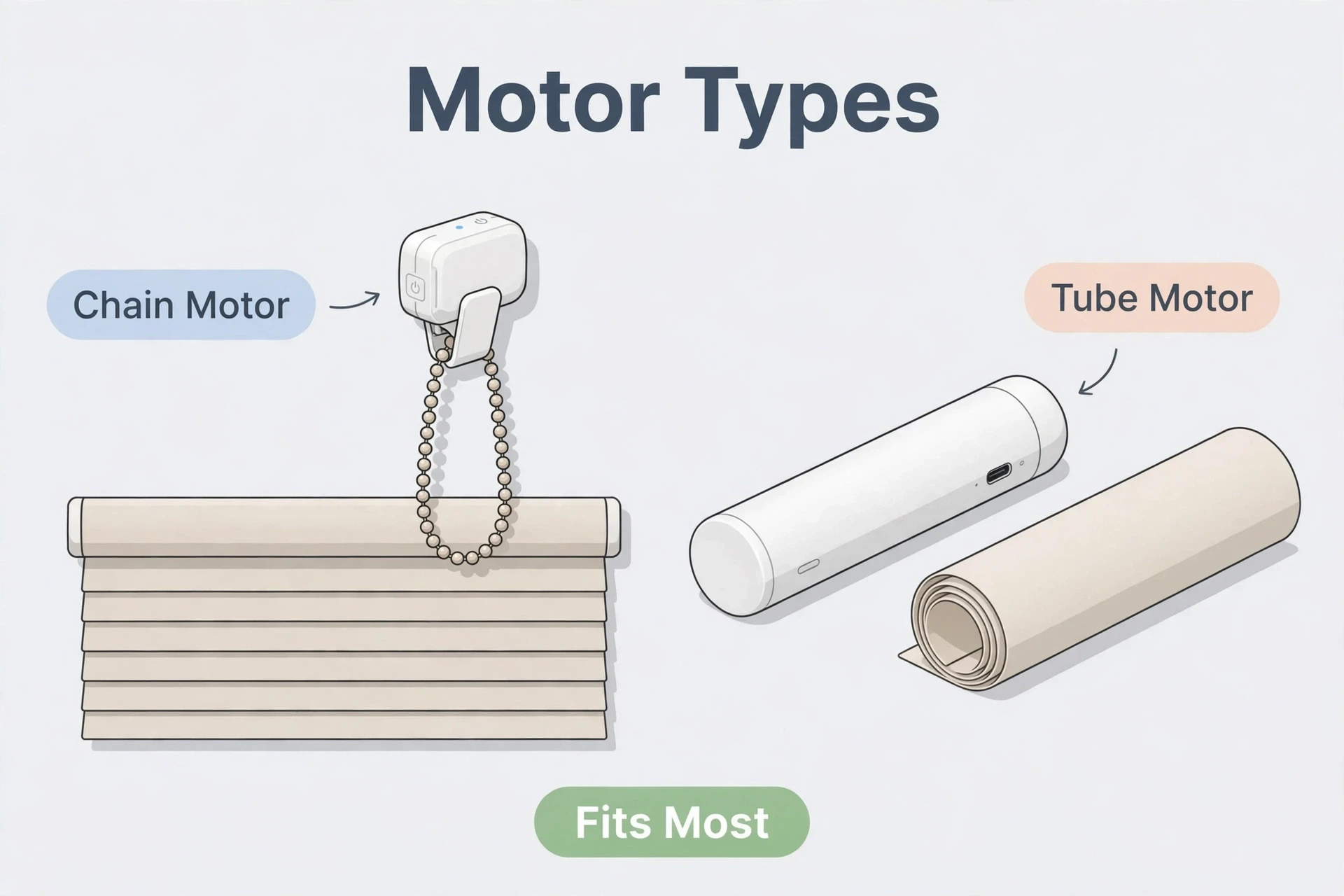
Everything on the market falls into three buckets. Find which mechanism your blinds use, and you have found your motor type.
1. Bead-Chain Motors (Roller Shades, Roman Shades, Some Vertical Blinds)
These are small boxes that mount on the wall or window frame next to your shade and pull the bead chain loop for you. They are the most popular retrofit option because bead chains are everywhere — roller shades, Roman shades, and many vertical blinds all use them.
The best-known examples are the SOMA Smart Shades 3 (currently $159 on sale from $199, per SOMA’s official store) and the RYSE SmartShade (around $150–$170). They run over Bluetooth and pair with a hub for voice control and remote access. Installation takes about three minutes: stick or screw the unit to the wall beside the shade, loop your chain around its internal gear, and calibrate the top and bottom positions in the app.
2. Tilt-Wand Motors (Venetian / Horizontal Slat Blinds)
If your blinds have the twist rod (tilt wand) that opens and closes the slats, a tilt motor clips right onto it. The SwitchBot Blind Tilt is the go-to here — it lists at $69.99 (frequently on sale under $60) and installs in about two minutes with no tools.
It clips onto the rotary bar, runs on an included solar panel with a built-in 2000mAh rechargeable battery, and tilts slats to the nearest 2 degrees. It is quiet too — rated at or below 35 dB, which is softer than a whisper. The one limitation: it tilts the slats only. It cannot raise or lower the whole blind.
3. Roller-Tube Motors (Inside the Blind Itself)
These replace the chain-drive mechanism inside your roller blind’s tube. You pull out the existing chain drive from the end of the tube, slide the tubular motor in, and click the blind back into its brackets. Kits like these typically cost $60 to $150 per window, plus a remote or hub.
The motor hides inside the tube — nothing hangs off the side, and the whole shade raises and lowers like a factory motorized blind. It takes a little more work than a clip-on motor (about 15 minutes, and you need the blind down off its brackets), but the result is invisible.
Blinds That Can’t Be Retrofitted (Check Before You Buy)
Not everything is retrofittable. Run through this list honestly before spending money:
- Cordless blinds with no chain, wand, or accessible tube. If there is literally nothing for a motor to grab, there is nothing to automate. Push-up/pull-down cellular shades usually fall here.
- Plantation shutters. Shutters have no continuous drive mechanism, and no mainstream retrofit motor fits them. Custom installations exist but start at hundreds of dollars per window.
- Top-down/bottom-up cellular shades. The two-cord system and tension mechanisms do not play well with chain or tube motors.
- Very heavy or very wide blinds. Bead-chain motors have weight limits — RYSE, for example, is rated for shades up to 9 x 9 ft or 10 lbs. Measure your blind’s weight if it is large.
- Blinds shorter than the motor unit. Clip-on motors are a few inches tall; a narrow bathroom blind may not have room for one.
- Chains with a connector block. Some bead chains have a plastic connector link that can jam the motor’s gear. SOMA includes a replacement chain in the box for exactly this reason — plan to swap it.
- Tilt wands outside the diameter range. The SwitchBot Blind Tilt fits tilt rods between 6.2mm and 12mm. Measure your wand with calipers or a ruler before ordering.
What to Measure Before You Buy a Retrofit Motor
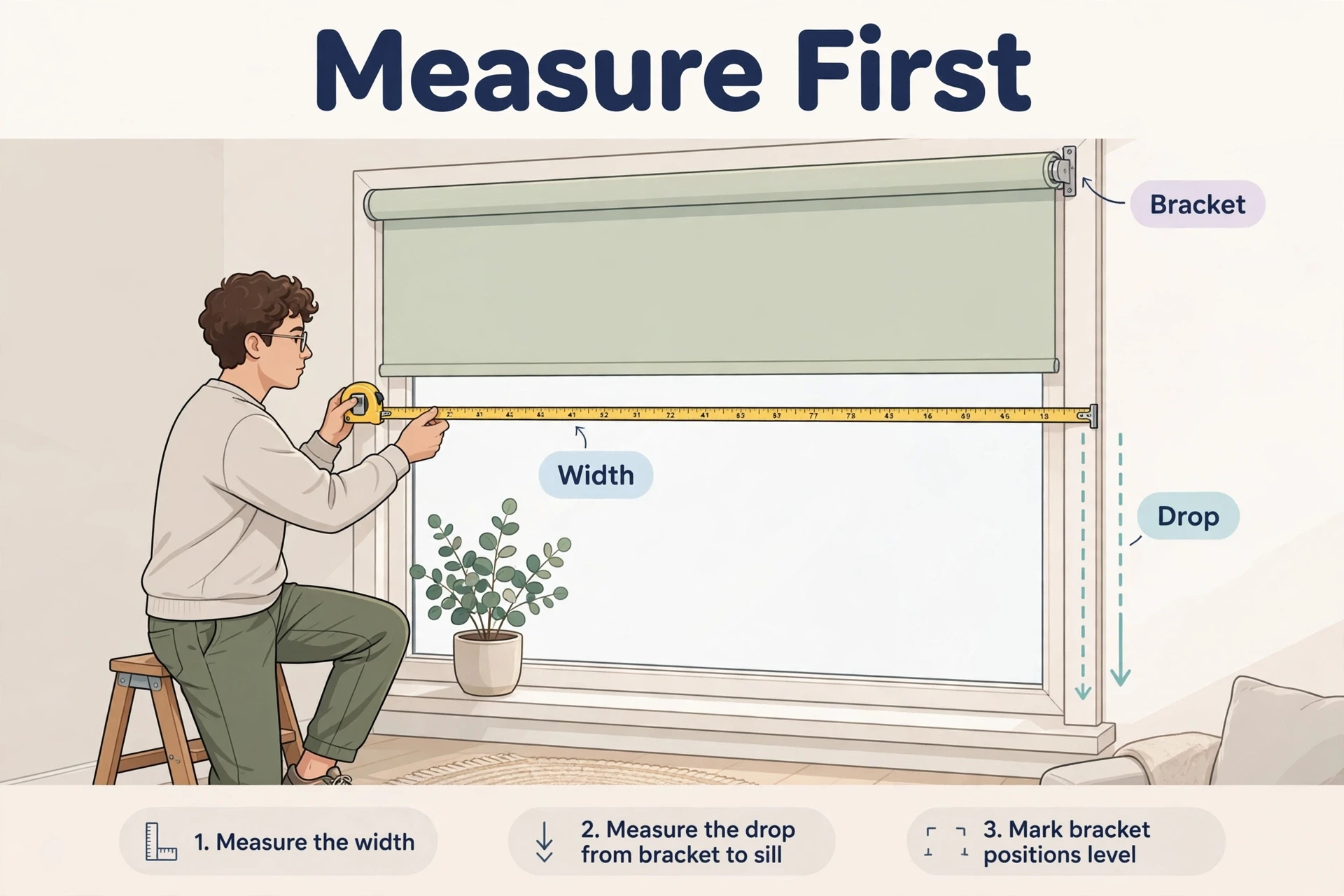
Five minutes with a tape measure saves you a return. Work through these in order:
- Identify your blind’s control mechanism. Bead chain loop, tilt wand, pull cord, or roller tube with chain drive? This decides the motor type.
- Measure the bead size or chain type. Bead-chain motors ship with swappable gearwheels for standard beads, small beads, and non-beaded cords. Note which you have; most boxes include all three.
- Measure the tilt rod diameter. For tilt-wand motors, confirm the rod is between 6.2mm and 12mm.
- Measure the roller tube diameter. For tube motors, the tube’s inner diameter (commonly 25mm to 45mm) must match the motor. Pop off the chain drive end cap and measure inside the tube.
- Check the mounting space. Clip-on and chain motors sit beside the shade on the wall or window frame. Confirm you have a few inches of flat surface and that the unit will not block the window from opening.
- Weigh large blinds. If your shade is wider than about 6 feet or feels heavy, weigh it on a bathroom scale and compare against the motor’s rated lift capacity.
Tools You Need for a Smart Motor Retrofit
One of the best things about retrofit kits is the tiny tool list. For most installs you need:
- A tape measure (for the measurements above)
- A small Phillips screwdriver (some brackets use one or two screws; many use adhesive)
- A step stool or ladder for tall windows
- A smartphone with the motor’s app installed
- Rubbing alcohol and a cloth (to prep the surface for adhesive-mounted units)
- Optional: a drill, only if you prefer screwing a bracket into the frame instead of using adhesive
That is it for clip-on and chain motors. Tube motors add one more step — removing the blind from its brackets — but no extra tools.
How to Install a Retrofit Blind Motor (Step by Step)
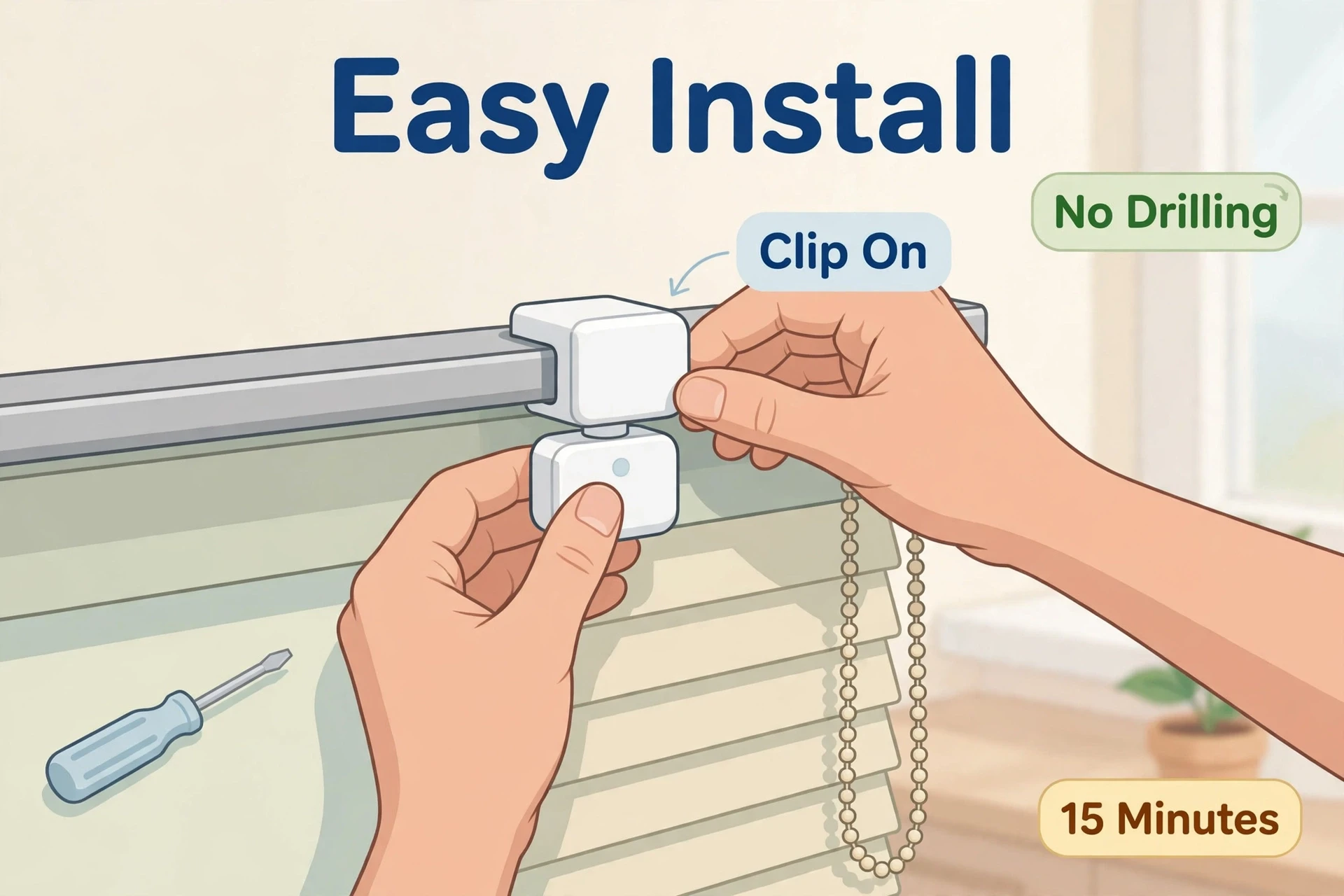
The flow is the same across motor types. Here is the process for a bead-chain motor, the most common retrofit:
- Charge or power the motor first. Plug it in via USB (or wire it up if using the AC adapter) and let it charge fully before mounting. A half-charged battery mid-calibration is annoying.
- Mount the unit beside the shade. Hold it next to the bead chain loop where it can pull straight down. Use the included bracket and screws, or the adhesive strips after cleaning the surface with alcohol. The chain should run vertically through the motor without twisting.
- Loop the chain around the motor gear. Open the front cover, seat the bead chain in the gearwheel grooves, and close the cover. Pick the right gearwheel for your bead size first — swapping it later means re-doing this step.
- Install the companion app and pair over Bluetooth. All the major retrofit motors pair via Bluetooth first, even if they later talk to a hub. Follow the app’s pairing prompt; keep your phone within a few feet of the motor.
- Set the open and closed positions. Run the shade fully up, tap “set upper limit,” then run it fully down and tap “set lower limit.” This is the most important step — bad limits mean the motor strains against the brackets or leaves the shade half-open.
- Test a full cycle. Open and close twice. Listen for grinding or slipping. If the chain slips, the wrong gearwheel is installed or the chain has a connector block snagging — fix it now, not later.
- Add the solar panel (optional). Stick it on the window glass inside the frame and plug it into the motor. This is what turns a “charge every few months” device into a “never think about it” device.
For tube motors, the flow is: take the blind down, pull the chain drive out of the tube, slide the motor in, remount the blind, then pair and set limits. For tilt-wand motors, it is even simpler: clip it onto the wand, pair, and set the tilt range.
Calibrating and Pairing with Home Assistant, Alexa, and Google
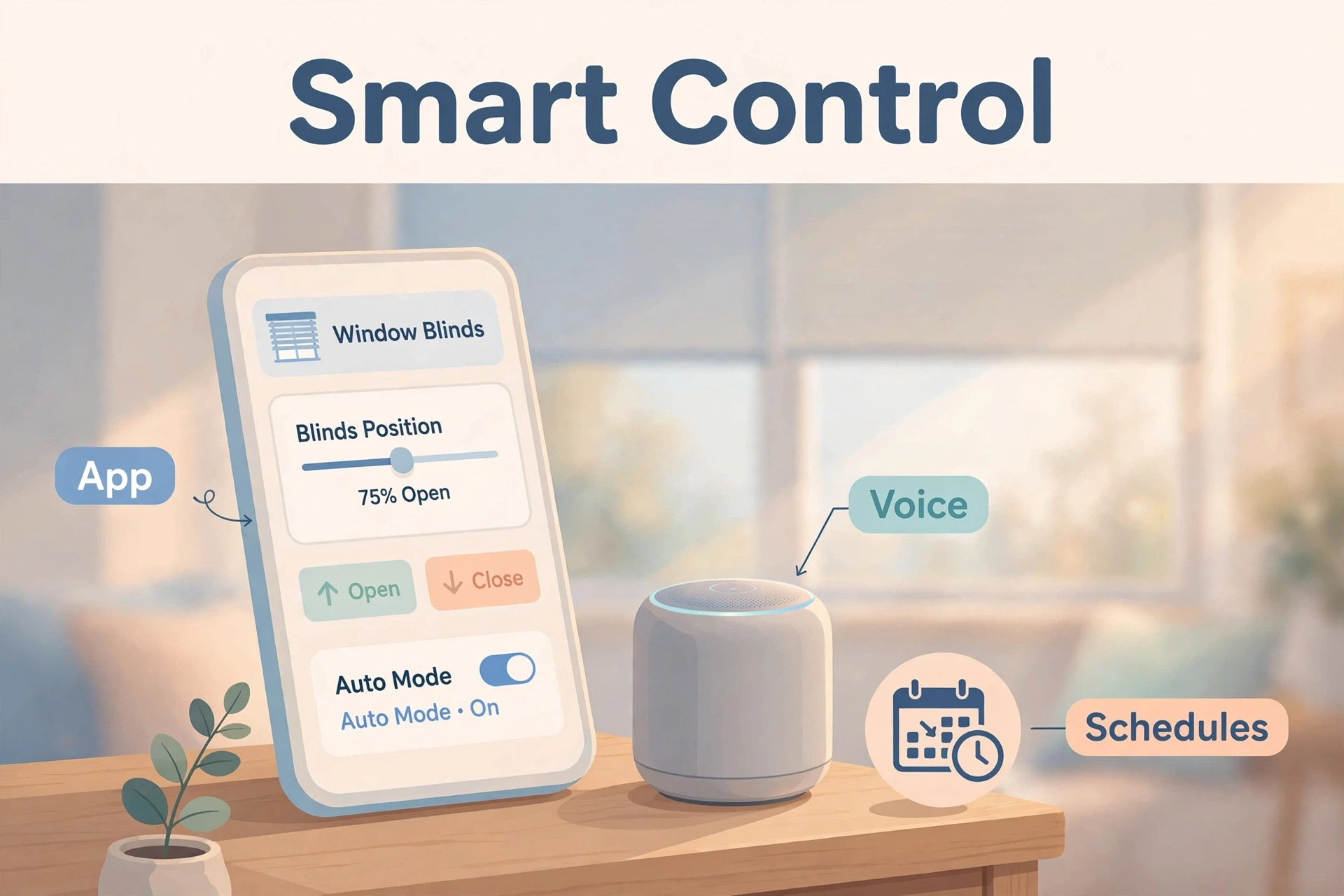
Home Assistant
Home Assistant has a native SOMA integration that talks to Smart Shades and Tilt motors over Bluetooth — if your HA server has Bluetooth (a Raspberry Pi 4/5 does), no hub is needed. SwitchBot devices pair through the SwitchBot Bluetooth integration or the SwitchBot Hub 2 with Matter support. RYSE works via its SmartBridge’s HomeKit exposure, which Home Assistant can adopt as a HomeKit device.
Once in HA, add the shades to automations: open at sunrise, close when the room’s light sensor drops below a threshold, or tilt closed during peak afternoon heat. If you want shades that react to actual brightness instead of just the clock, read our guide on lux thresholds for smart lighting — the same sensor logic applies to blind automations.
Alexa and Google Home
Out of the box, most retrofit motors speak Bluetooth only. For voice control you need the vendor’s hub: SOMA Connect U1, SwitchBot Hub Mini or Hub 2, or the RYSE SmartBridge. Each hub exposes your shades to Alexa and Google Home, unlocking commands like “Alexa, close the living room blinds” and routine integration.
The hubs also give you remote access — control the blinds from anywhere — and grouping, so one command moves every shade in a room. Budget roughly $40 to $70 for the hub on top of the motor cost. For hands-on local control without reaching for your phone, a wireless smart button mounted by the door makes a great physical trigger for your blind scenes.
Solar Panels and Battery Life: What to Expect
Battery life is the number-one anxiety with retrofit motors, and the good news is it is mostly a solved problem now.
- Bead-chain motors: SOMA’s Smart Shades 3 runs up to 6 months on its built-in lithium battery with typical daily use. RYSE’s optional BatteryPack lasts 3 to 6 months per charge.
- Tilt-wand motors: The SwitchBot Blind Tilt claims around 10 months on battery alone, and effectively indefinite life with its included solar panel in a sunny window.
- Solar add-ons: SOMA sells a dedicated solar panel for $39 that mounts on the window glass and trickle-charges the motor. With decent daylight, most users never plug the motor in again.
Real-world life depends on cycle count — a shade moving twice a day outlasts one adjusting every 15 minutes on a light sensor. If your window gets direct sun, always add the solar panel — it is the cheapest upgrade in the whole setup and eliminates charging chores. Pair your automations with smart lighting scenes for a full room setup; our comparison of Lutron Serena vs SmartWings covers how factory-built motorized shades handle the same power question.
Retrofit vs Replacement: Cost Comparison
Retrofit motor costs vs buying new motorized blinds, per window (prices checked 2026-10-02)
| Motor type | Typical price per window | Hub needed for voice control | Raise/lower or tilt only |
|---|---|---|---|
| Bead-chain retrofit (SOMA, RYSE) | $150–$240 (motor + optional battery/solar) | $40–$70 extra | Raise and lower |
| Tilt-wand retrofit (SwitchBot Blind Tilt) | $54–$70 (solar panel included) | $40–$70 extra | Tilt only |
| Roller-tube retrofit motor | $60–$150 (plus remote or hub) | Varies by brand | Raise and lower |
| New motorized roller blind | $150–$400 | Often included | Raise and lower |
The math is simple: if your blinds are in good shape, retrofitting one window costs roughly what a single cheap new motorized blind would — and you keep the blinds you already like. Across a whole house, savings multiply fast.
Retrofit Blinds Smart Motor FAQs
Will a retrofit smart motor work with my blinds?
If your blinds have a bead chain loop, a tilt wand, or a roller tube with a chain drive, almost certainly yes. The main exceptions are cordless blinds with no accessible mechanism, plantation shutters, top-down/bottom-up cellular shades, and very heavy blinds that exceed the motor’s lift rating. Check the compatibility list above and measure before ordering.
Should I choose battery or wired power?
Battery for almost everyone. Modern motors last 3 to 10 months per charge, and a $39 solar panel in a sunny window makes recharging disappear. Go wired only if the window gets almost no daylight and you hate charging things — or if the motor sits right next to an outlet anyway.
How noisy are retrofit blind motors?
Quieter than you expect. The SwitchBot Blind Tilt is rated at or below 35 dB — softer than a whisper. Bead-chain and tube motors are similarly quiet at low speed, producing a soft hum you will hear in a silent bedroom but not notice with normal background noise. If the motor grinds or clicks, the chain is misaligned or the limits are wrong — fix the fit, not the motor.
Is retrofitting blinds rental-friendly?
Mostly yes, and it is one of the best smart upgrades a renter can make. Bead-chain and tilt-wand motors mount with adhesive strips — no drilling, no damage, fully removable at move-out. Tube motors need the blind taken down and put back, which is fine if the blinds are yours but check your lease before touching landlord-installed ones. Keep the original chain drive in a drawer so you can restore everything in minutes.
Do I need a hub, or will the app be enough?
The app alone is enough for schedules and control while you are home on Bluetooth range. You need the vendor’s hub if you want voice control (Alexa, Google Home), remote access from outside the house, sunrise/sunset automations, or multi-room grouping. If any of those matter to you — and they probably will — budget for the hub from day one.
