

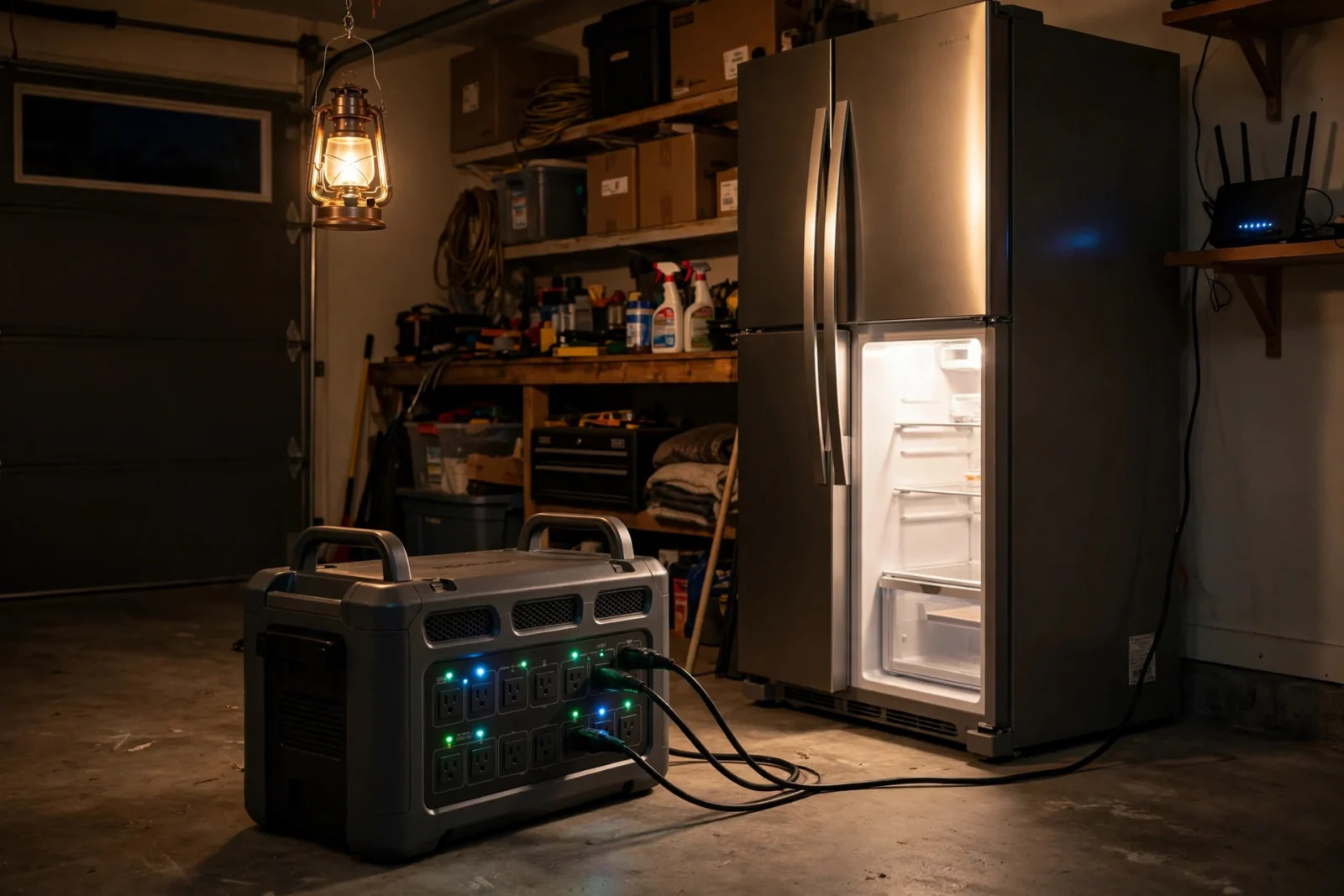
The EcoFlow DELTA 2 Max is a 2,048Wh LiFePO4 portable power station with 2,400W of AC output, and it is one of the strongest 2kWh-class stations you can buy in 2026. The short verdict: if you want serious home backup that can also travel, this is the unit to beat — it charges faster than nearly everything in its class, runs heavy appliances with room to spare, and expands to 6kWh when one box is not enough. It typically sells for around $1,000–$1,500 — check current price. The trade-off is weight: at about 50 pounds it is portable in the “carry it to the car” sense, not the “carry it down the trail” sense. This review covers the specs, real-world runtimes, charging, honest drawbacks, and how it compares to Jackery.
EcoFlow DELTA 2 Max: Key Specs
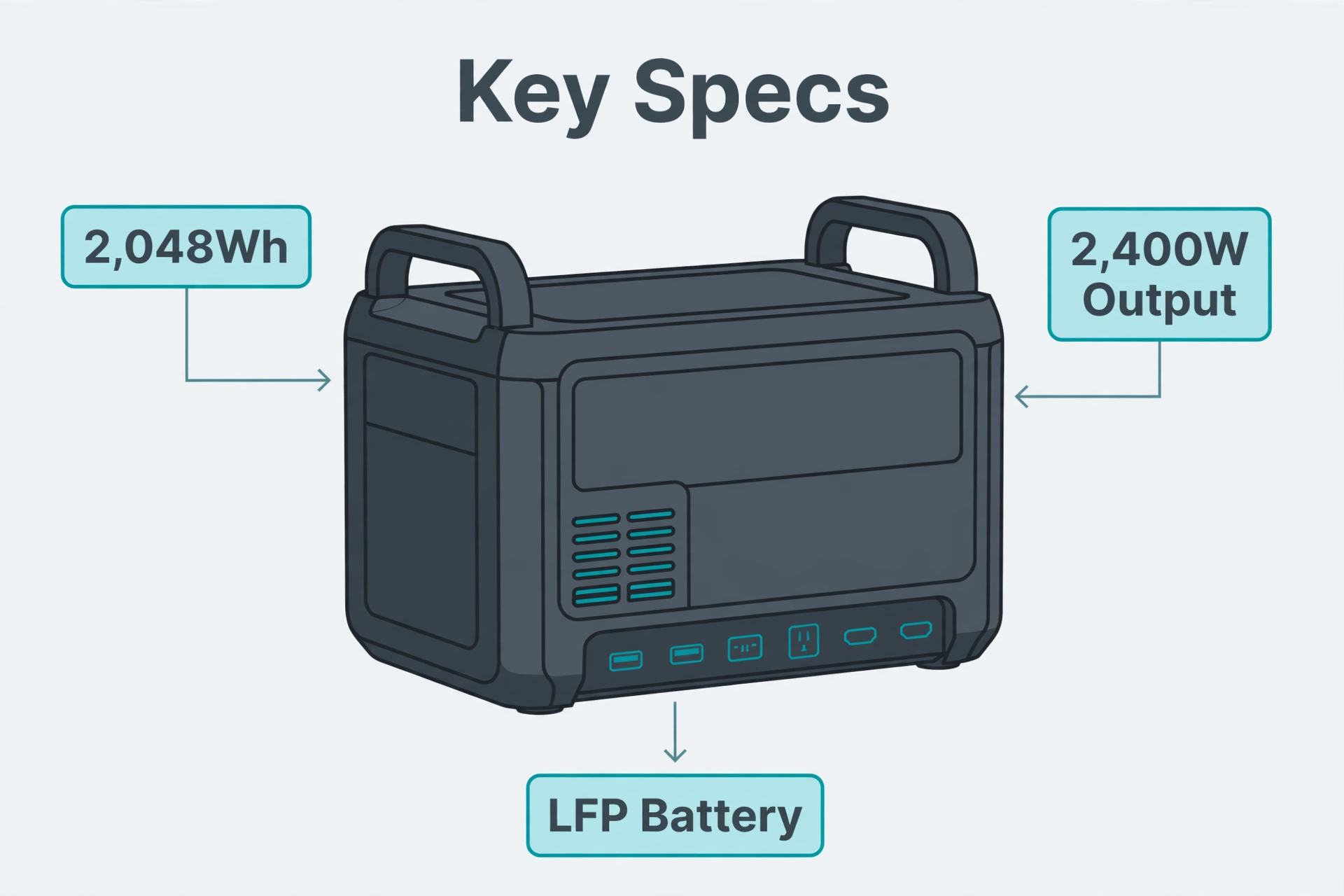
Facts first. These are EcoFlow’s published specifications, and every claim in this review traces back to them.
Table: EcoFlow DELTA 2 Max specifications
| Feature | Specification |
|---|---|
| Capacity | 2,048Wh (expandable to 6,144Wh) |
| Battery chemistry | LFP (LiFePO4) |
| Cycle life | 3,000 cycles to 80%+ capacity |
| AC output | 2,400W continuous, 4,800W surge (6 outlets) |
| X-Boost output | Up to 3,400W for heavy loads |
| USB ports | 2× USB-C 100W, 2× USB-A fast charge, 2× USB-A |
| DC outputs | Car port 12.6V/10A + 2× DC5521 |
| AC charging | X-Stream fast charge, ~80 minutes to full |
| Solar input | 1,000W max (dual MPPT, 500W + 500W) |
| EPS switchover | 30ms |
| App control | Yes, Wi-Fi + Bluetooth |
| Weight | ~50 lbs (23 kg) |
| Warranty | 5 years |
Two numbers define this machine: 2,048Wh of storage and 2,400W of output. That combination puts it a full class above 1kWh stations — it does not just run longer, it runs bigger things.
What the DELTA 2 Max Gets Right
2,400W Output With X-Boost Headroom
Most 2kWh stations top out at 2,000–2,200W. The DELTA 2 Max pushes 2,400W continuous with a 4,800W surge rating, and X-Boost mode stretches that to 3,400W for stubborn resistive loads like heaters and kettles. In practice, this means you stop thinking about what you can plug in: a full-size fridge, a microwave, a coffee maker, and a laptop can all run at once without the inverter breaking a sweat. For home backup, that headroom is the difference between “essentials only” and “normal life, minus the grid.”
The Fastest Charging in Its Class
EcoFlow’s X-Stream AC charging refills the 2,048Wh battery in about 80 minutes from a wall outlet — roughly twice as fast as most rivals. Combine AC and solar inputs and EcoFlow rates 0–80% in about 43 minutes. Speed matters most when the sky is falling: storm warnings rarely give you a full day to prepare, and a station that goes from empty to useful in under an hour is a genuinely different product from one that needs all afternoon.
1,000W of Dual Solar Input
Two independent MPPT solar inputs accept up to 1,000W combined — double what most 1kWh stations allow. With a kilowatt of panels, a full solar refill takes roughly 2–4 hours of strong sun. The dual inputs are also practical: you can run two different panel setups (say, a roof array and a portable panel) without them dragging each other down, since each MPPT optimizes independently.
Expandable to 6kWh
Unlike many competitors, the DELTA 2 Max accepts up to two Smart Extra Batteries, stretching total capacity to 6,144Wh. That turns a portable station into a modular home backup system: buy the base unit now, add batteries later as budget allows or as outages teach you what you actually need. Expandability is the single best hedge against buying the wrong size.
Fifteen Outputs and a Grown-Up App
Six AC outlets, four USB-A ports, two 100W USB-C ports, a car port, and two DC5521 barrel outputs mean you will not be juggling power strips. The EcoFlow app handles the rest: real-time input/output wattage, per-port control, charge-speed limits to protect battery longevity, and firmware updates. It is one of the better power-station apps — genuinely useful rather than a checkbox feature.
EcoFlow DELTA 2 Max: What It Can Run
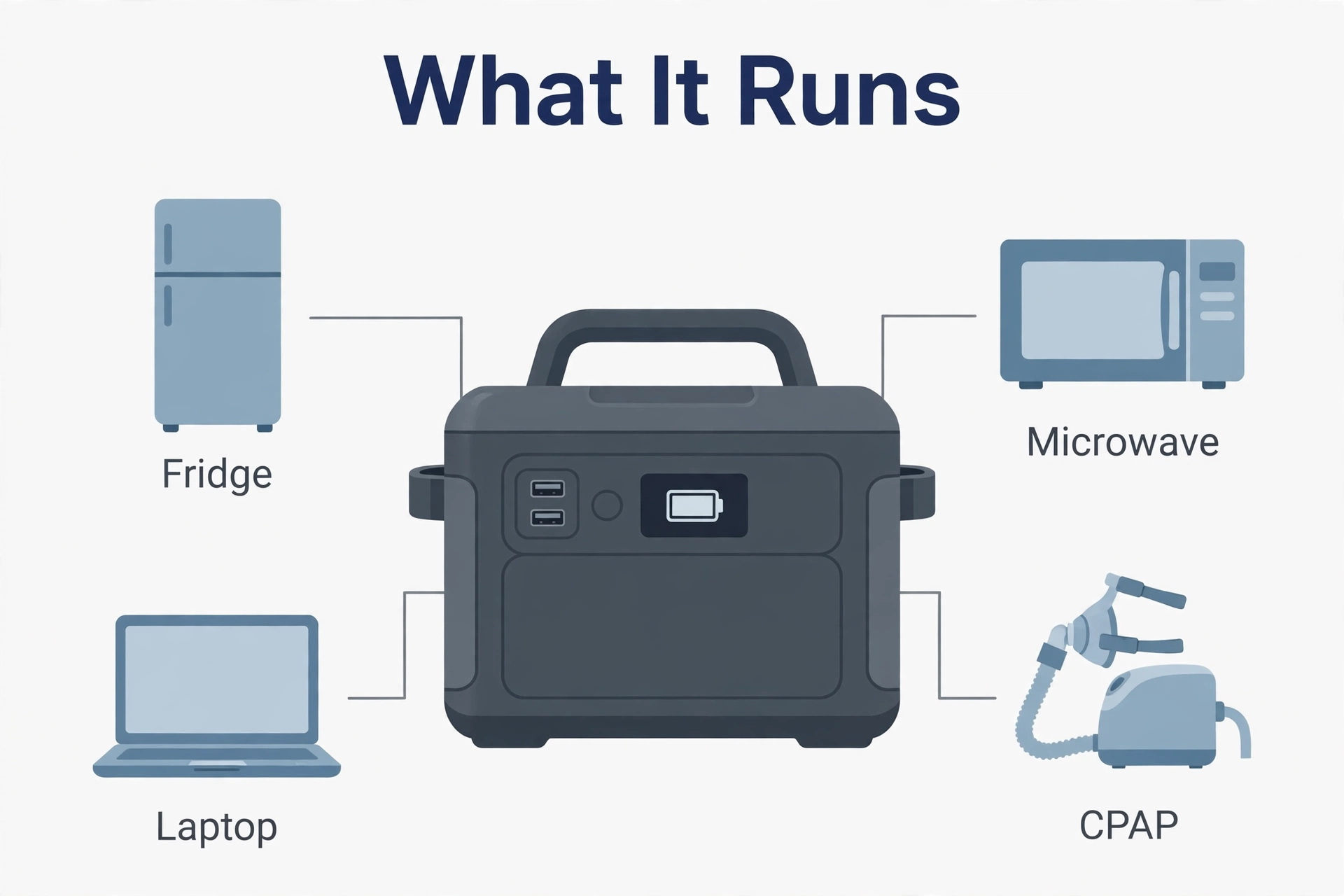
With roughly 2,048Wh of storage, usable energy after inverter losses lands around 1,700–1,750Wh. The table below translates that into practical runtimes — estimates built from EcoFlow’s published figures and standard efficiency math, not lab tests.
Table: Estimated runtimes on a full charge
| Device | Typical Draw | Estimated Runtime |
|---|---|---|
| Full-size refrigerator | ~150W (cycling) | ~10–12 hours |
| Portable 12V fridge | ~60W | ~28 hours |
| Microwave | ~1,160W | ~85–90 minutes |
| Electric kettle | ~1,200W | ~80 minutes of boiling |
| Coffee maker | ~550W | ~3 hours |
| Space heater | ~1,500W | ~1 hour |
| Laptop | ~60W | ~25 full charges |
| CPAP (no humidifier) | ~40W | ~35+ hours |
| Wi-Fi router | ~10W | ~7 days |
| Phone | ~15Wh per charge | ~100+ charges |
The takeaway: a full day of normal household essentials, or two to three days if you are disciplined about the big heating loads. Add one extra battery and multi-day outages stop being scary.
Charging: Pick Your Speed
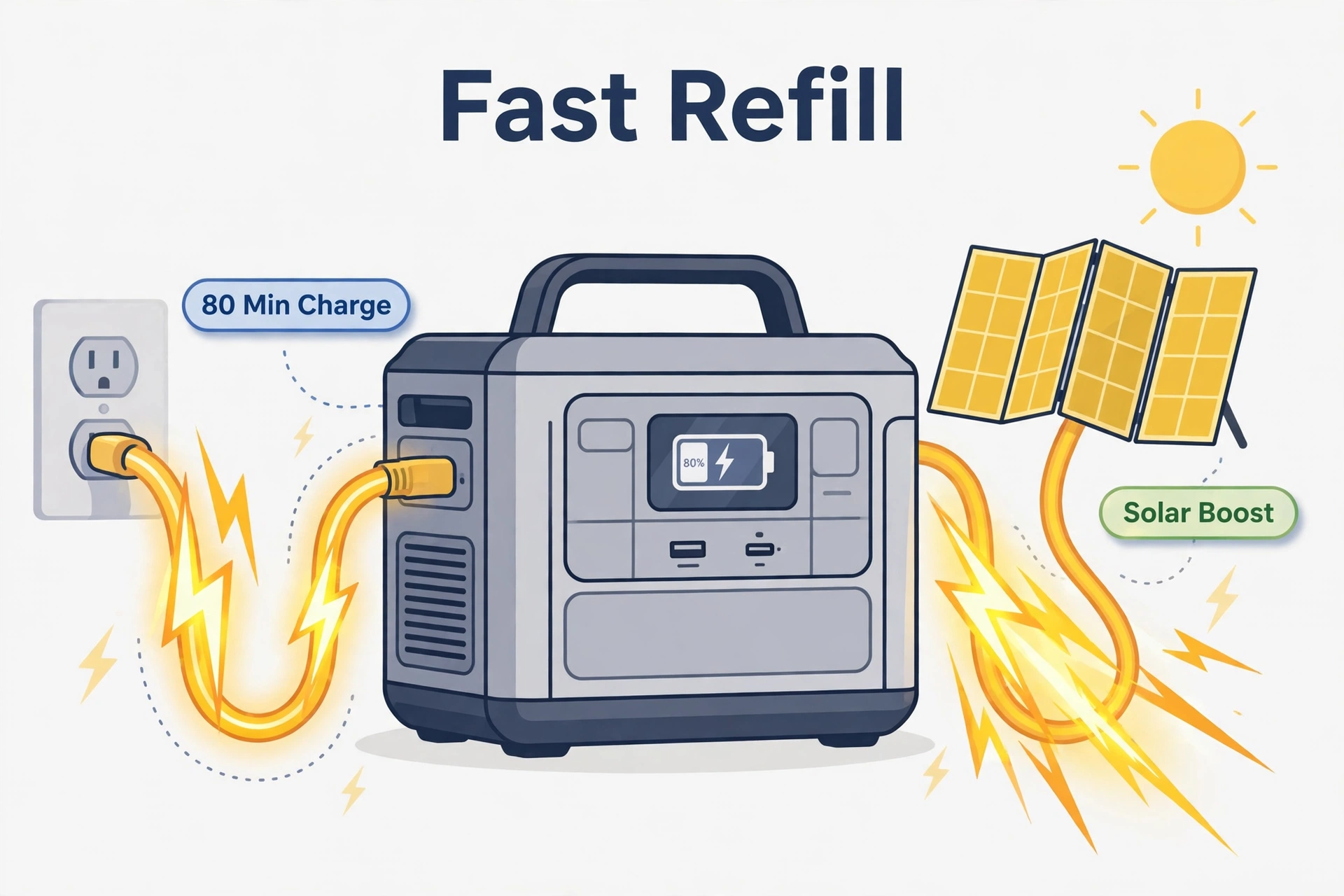
Wall Outlet: About 80 Minutes
X-Stream charging pulls up to 1,800W from the wall, taking the DELTA 2 Max from empty to full in roughly 80 minutes. If that speed worries you for battery health, the app lets you cap the charge rate — a thoughtful touch that trades a little speed for a little longevity on days when you are not in a hurry.
Solar: Up to 1,000W
The dual 500W MPPT inputs handle serious panel arrays. EcoFlow’s own 400W rigid or portable panels pair naturally, and two of them nearly max out the input. Expect a full solar refill in one good day. As always with solar, real output depends on sun angle, clouds, and temperature — rated wattage is a midday-clear-sky number.
Car and Alternator: The Slow Lane
Standard 12V car charging is a trickle — fine for maintaining charge on a road trip, not for refilling. EcoFlow’s 800W Alternator Charger accessory changes the math dramatically for van lifers and overlanders, refilling the station several times faster while driving. If your plan involves wheels, budget for it.
The Smart Home Angle: Partial Home Backup
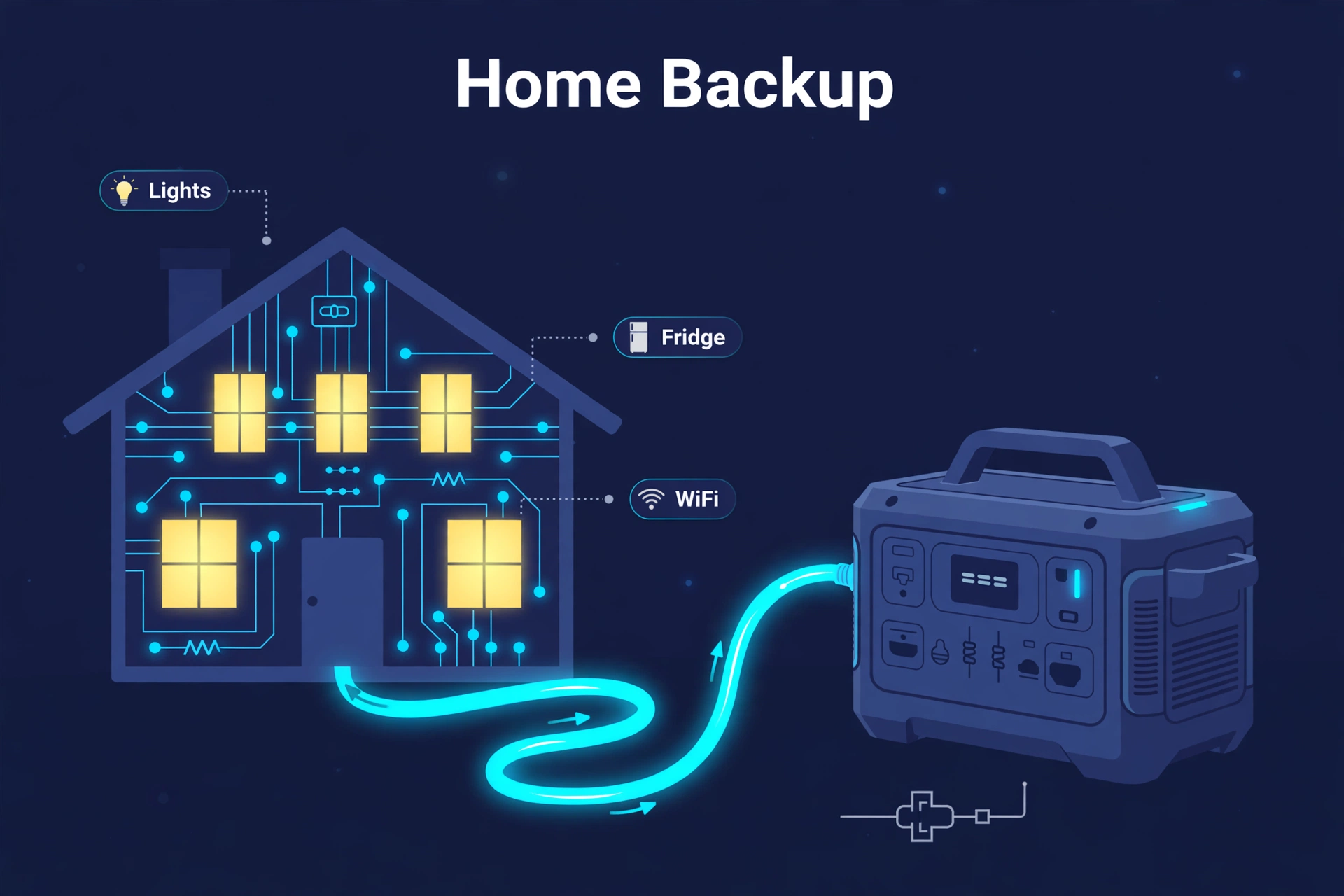
For smart home owners, the DELTA 2 Max’s 30ms EPS (emergency power supply) mode is the feature to understand. Plug your network stack and critical gear into the station, plug the station into the wall, and a grid failure switches you to battery in 30 milliseconds — fast enough that routers, hubs, and most computers never drop. Your cameras keep recording locally, your sensors keep reporting, and your automations keep running.
For bigger ambitions, an electrician can wire the DELTA 2 Max into a manual transfer switch to back up dedicated home circuits — the standard playbook for partial-home backup. At 2,400W it covers a fridge, lights, network gear, and device charging simultaneously; add the extra batteries and you are covering full evenings. This is the use case where the 2kWh class earns its price: not camping convenience, but a house that shrugs at outages.
What Could Be Better
Honest drawbacks, because the price demands honesty. First is weight: at about 50 pounds, the DELTA 2 Max is a two-hand carry and a commitment to move. It lives in a garage, utility room, or SUV trunk — it does not go hiking. Second, the fans are audible under heavy loads. EcoFlow has improved fan curves over the years, but push 2,000W+ on a hot day and you will hear it. Do not plan to sleep next to it while it runs a space heater.
Third, X-Boost deserves a caution: it works by lowering voltage to run overpowered resistive loads, which is fine for heaters and kettles but not ideal for sensitive electronics or motors. Treat the 2,400W continuous rating as the real limit for anything you care about, and X-Boost as a bonus for dumb heating elements. Fourth, the app and firmware are excellent when updated — and mildly annoying when an update is pending at the worst moment. Keep firmware current on your schedule, not the storm’s.
DELTA 2 Max vs Jackery Explorer 2000 v2
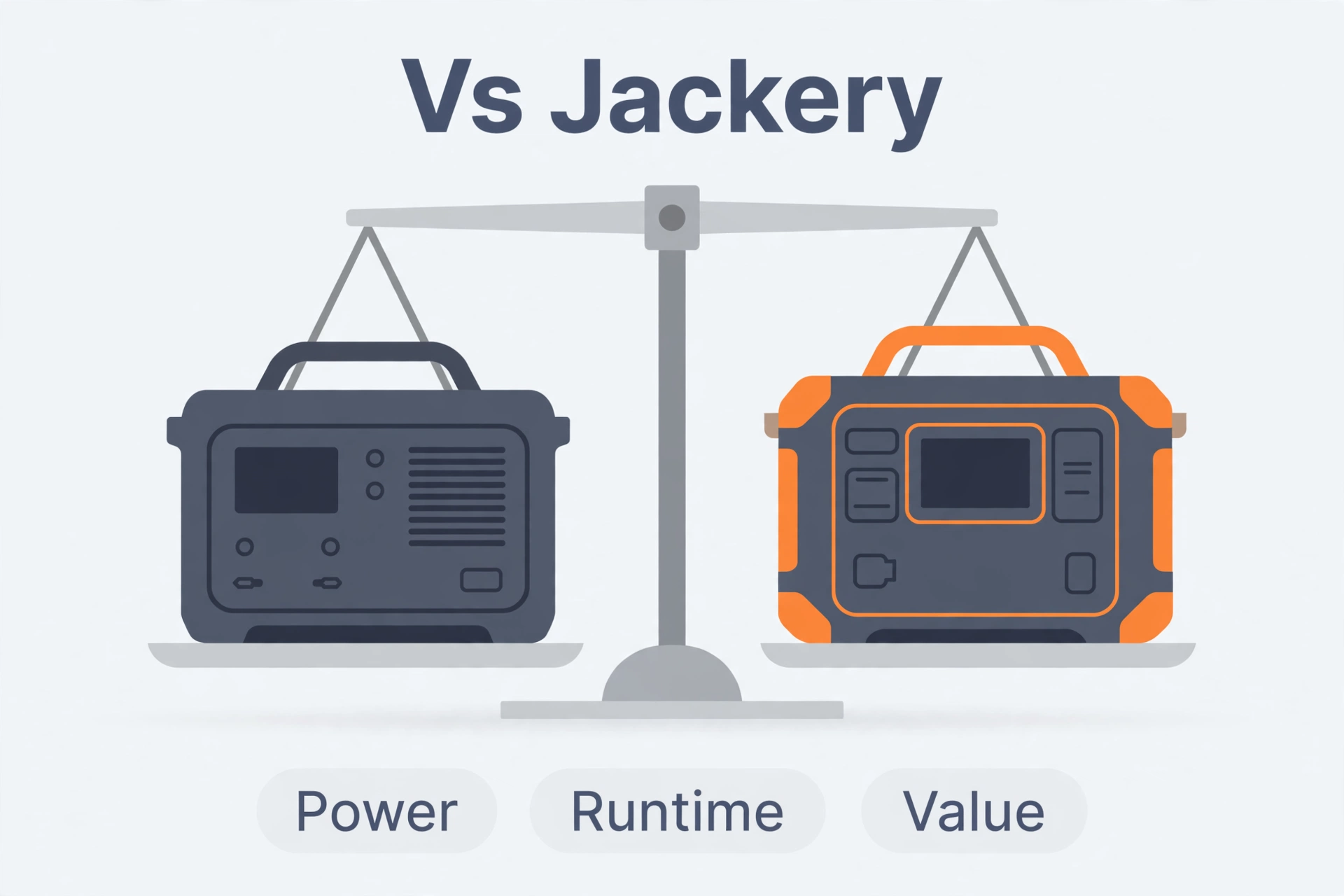
Jackery’s closest answer is the Explorer 2000 v2: 2,042Wh, 2,200W output, LiFePO4. Here is the head-to-head.
Table: DELTA 2 Max vs Jackery Explorer 2000 v2
| Feature | EcoFlow DELTA 2 Max | Jackery Explorer 2000 v2 |
|---|---|---|
| Capacity | 2,048Wh | 2,042Wh |
| AC output | 2,400W (3,400W X-Boost) | 2,200W (4,400W surge) |
| Battery | LFP, 3,000 cycles to 80% | LiFePO4, 4,000 cycles to 70% |
| AC charge time | ~80 minutes | ~2 hours |
| Solar input | 1,000W (dual MPPT) | 800W |
| Expandable | Yes, to 6,144Wh | No |
| Weight | ~50 lbs | ~39.5 lbs |
EcoFlow wins on output, charging speed, solar input, and expandability; Jackery wins on weight and cycle-life rating, and usually on sale price. If the station needs to move often, the Jackery’s 10-pound advantage is real — see our Jackery portable power station lineup guide for the full family. If it mostly stays put and you want maximum capability per dollar, the DELTA 2 Max takes it.
Who Should Buy It — and Who Should Skip It
Buy it for home backup, RV life, or off-grid cabins
This is a home-backup machine first and a portable station second. Homeowners in outage-prone areas get a modular system that starts at 2kWh and grows; RVers get a silent generator replacement that runs the microwave and air conditioner without a fuel can; cabin owners get a solar-charged power core. At around $1,000–$1,500 — check current price — it is the 2kWh value leader from a major brand.
Skip it if you need true portability
Fifty pounds is not a backpacking weight, and it is barely a “carry to the campsite” weight. If your adventures involve carrying power more than a few dozen feet, a 1kWh station like the Jackery Explorer 1000 v2 at half the weight serves you better for half the money.
Also consider the whole field before committing — our best portable power station roundup compares every major option side by side.
Frequently Asked Questions
Is it worth the price?
For home backup buyers, yes. You get 2kWh of long-life LFP storage, 2,400W of output, the fastest charging in the class, and expandability to 6kWh — a combination no rival matches at this price. It is overkill if you only charge phones at camp, but for outage resilience it is the sweet spot of the EcoFlow range.
How long does the DELTA 2 Max battery last?
EcoFlow rates the LFP battery for 3,000 full cycles to 80%+ capacity, which works out to roughly 10 years of regular use. Real-world longevity also depends on heat, depth of discharge, and charge speed — using the app’s charge-rate limiter on non-urgent days is an easy way to baby it.
Can the DELTA 2 Max run an air conditioner?
A small portable or window AC (typically 800–1,200W running) is within the 2,400W output, and owners report running them successfully. Runtime is the constraint: a 1,000W AC drains the 2,048Wh battery in under two hours, so air conditioning is a “cool down the bedroom for the night” use case, not all-day cooling — unless you add extra batteries.
Can you expand the DELTA 2 Max later?
Yes. It supports up to two DELTA 2 Max Smart Extra Batteries for a total of 6,144Wh. You can buy the base unit now and add capacity later, which makes it easy to start with outage essentials and grow into whole-evening backup as budget allows.
DELTA 2 Max vs DELTA 2: which should I buy?
Buy the DELTA 2 (1,024Wh) if you camp or need light backup; buy the DELTA 2 Max if you are backing up a home. The Max doubles capacity, raises output from 1,800W to 2,400W, and adds expandability — but it also doubles the weight and costs significantly more. Match the machine to the mission.
The Verdict
The EcoFlow DELTA 2 Max is the 2kWh-class station to beat in 2026. It charges faster than its rivals, outputs more power, accepts more solar, and grows with extra batteries — all backed by a 5-year warranty from the biggest name in the category. Around $1,000–$1,500 — check current price — it is a serious investment, but it is priced like a tool, not a toy, because that is what it is. Just respect the 50 pounds: buy it for the home, the RV, or the cabin — not the backpack. Check the official EcoFlow DELTA 2 Max page for current pricing and bundle deals before you buy.
