

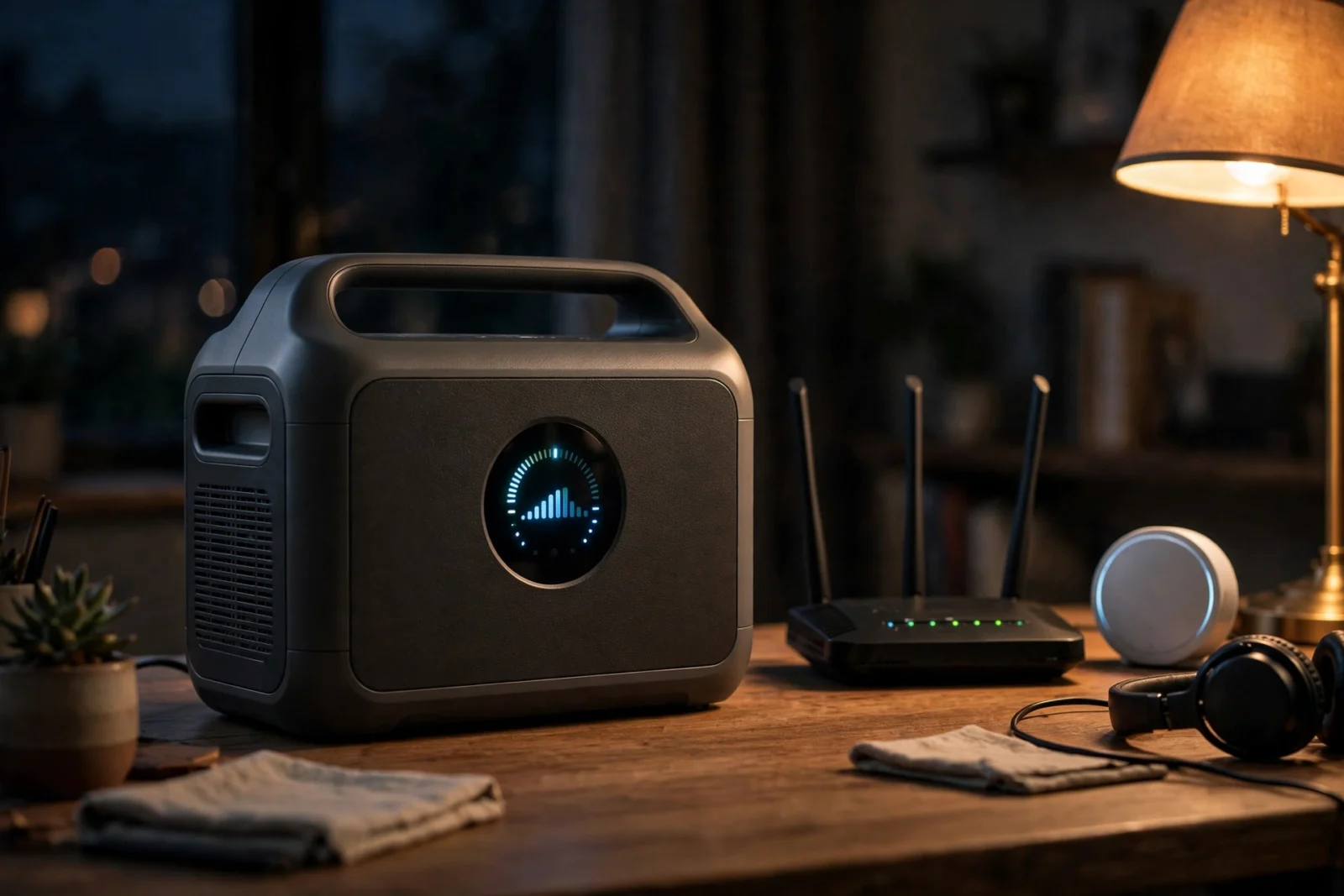
Best portable power station overall in 2026: the EcoFlow DELTA 3 (1,024Wh, 1,800W output) — it charges fast, works as a UPS for sensitive gear, and expands with extra batteries. Need something lighter? The Jackery Explorer 1000 v2 is the easiest to carry. Want maximum solar charging? The BLUETTI Elite 100 V2 leads there. This guide compares the top 5 so you can pick with confidence.
What Is a Portable Power Station?
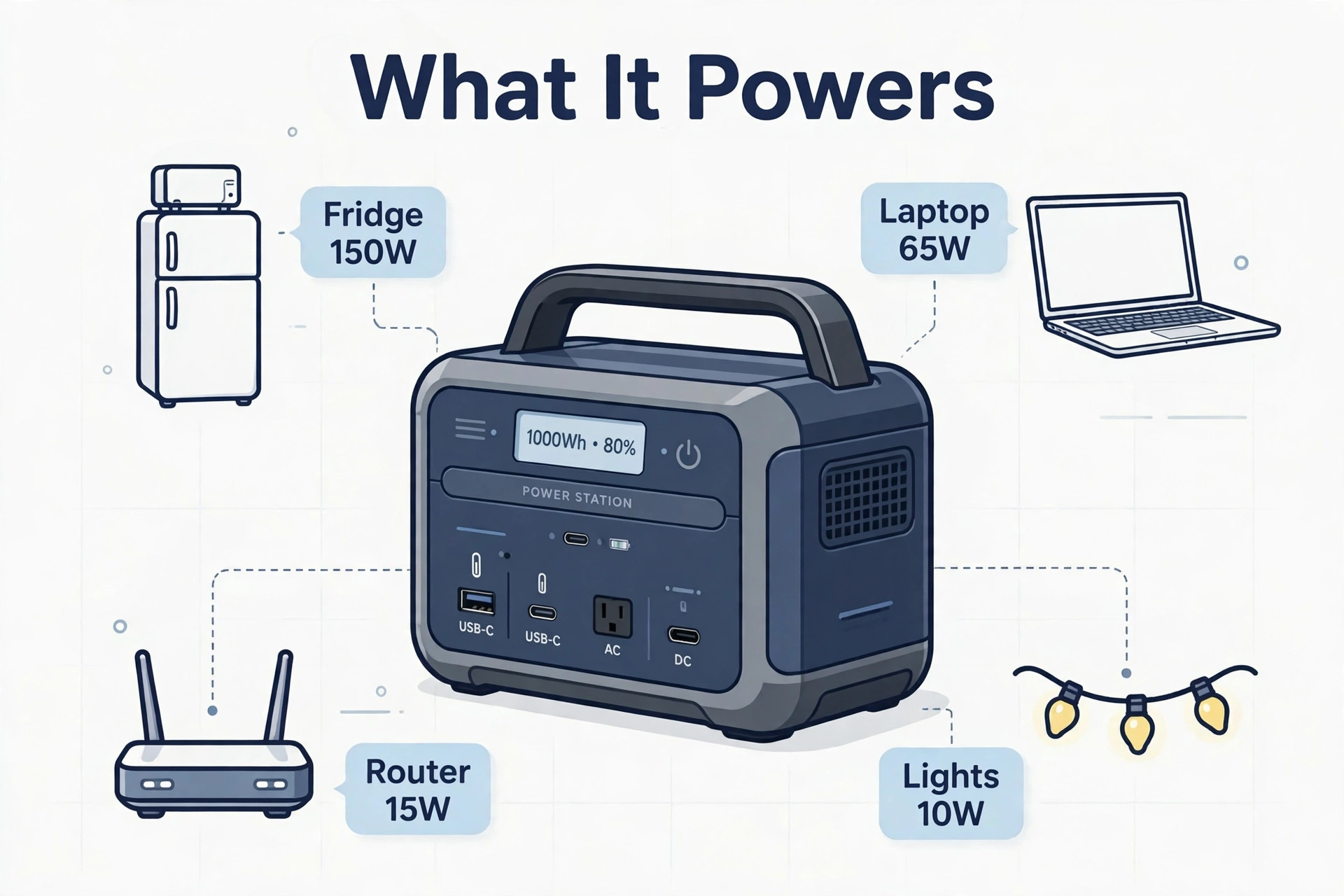
A portable power station is a big rechargeable battery with built-in AC outlets, USB ports, and an inverter — basically a silent, fume-free generator you can use indoors. You charge it from a wall outlet, car, or solar panels, then plug in your devices during a power outage, camping trip, or outdoor project.
Unlike gas generators, power stations make no noise, produce no exhaust, and need almost no maintenance. That is why they have become the go-to backup option for apartments, home offices, and anyone who needs clean power inside the house.
The two numbers that matter most are capacity (watt-hours, Wh — how much energy it stores) and output (watts, W — how much power it can deliver at once). A 1,000Wh station with 1,800W output can run a full-size fridge for several hours or charge a laptop ten times over.
How to Choose a Portable Power Station: 6 Key Factors
1. Capacity (Wh)
Capacity decides how long your devices run. For phone and laptop charging, 300–500Wh is enough. For home backup covering a fridge, router, and lights, aim for 1,000Wh or more. Bigger is not always better — it also means heavier and pricier.
2. Continuous Output (W)
Output decides what you can run. A 1,500W+ output handles microwaves, power tools, and most kitchen appliances. Under 1,000W limits you to electronics, lights, and small appliances. Check the wattage of your must-run devices first.
3. Battery Chemistry
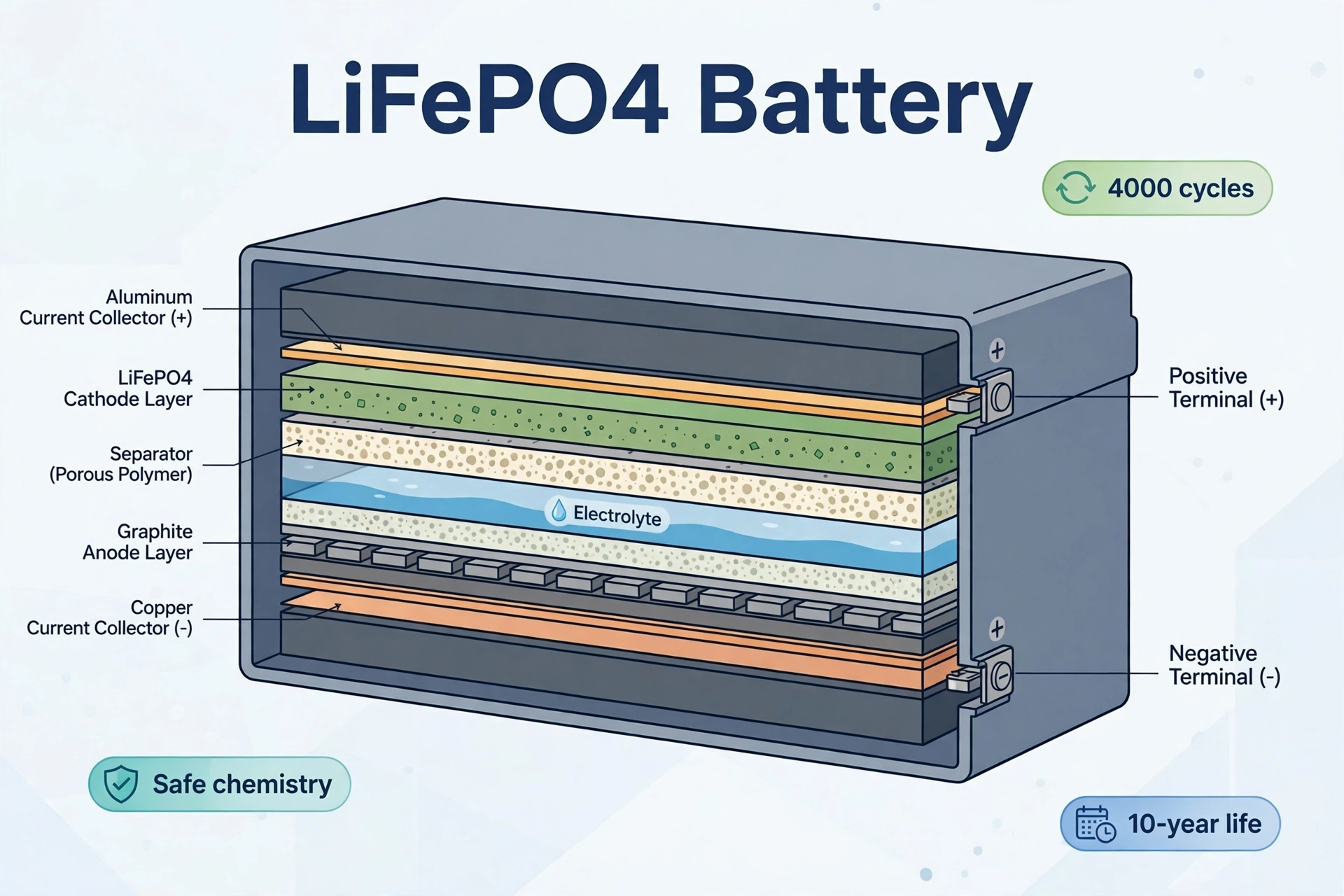
Look for LiFePO4 (lithium iron phosphate) batteries. They last 3,000–4,000 charge cycles — roughly 10 years of regular use — versus about 500–800 cycles for older lithium-ion designs. Most 2026 models from major brands now use LiFePO4.
4. Ports and Outlets
Count what you will actually plug in: AC outlets for household devices, USB-C for laptops and phones, USB-A for accessories, and a 12V car port for camping fridges. More ports mean fewer power strips.
5. UPS Mode
Some stations offer uninterruptible power supply (UPS) mode with switchover under 10–20 milliseconds. If the grid fails, connected devices keep running without rebooting — critical for a home server, Home Assistant hub, or CPAP machine.
6. Charging Speed and Solar Input
Fast wall charging (under 1.5 hours) matters when an outage is short and the grid flickers back. High solar input (500W+) matters for multi-day outages, letting panels refill the station while the sun is up.
The 5 Best Portable Power Stations in 2026
These picks reflect the current reviewer consensus and manufacturer-published specs for 2026. Our method: we compared capacity, continuous output, battery chemistry, UPS switchover speed, solar input, weight, and warranty across the leading 1kWh-class models, then cross-checked against multiple 2026 review roundups to confirm which units reviewers consistently recommend. Prices change often with sales and bundles, so check the official store pages for today’s price.
1. EcoFlow DELTA 3 — Best Overall
The DELTA 3 is the best all-rounder: 1,024Wh of LiFePO4 capacity, 1,800W of continuous AC output, and some of the fastest charging in its class — it can refill from a wall outlet remarkably quickly, which matters when an outage ends and you want the station ready for the next one. Its UPS mode switches in under 10 milliseconds, so a connected router or mini PC never notices a grid failure, and extra battery packs let you grow capacity later without buying a second station.
Best for: home backup, home offices, and anyone who wants one station that does everything well.
Keep in mind: expansion batteries add cost; it is not the lightest option in its class. See EcoFlow’s official DELTA 3 page for current bundles and specs.
2. Jackery Explorer 1000 v2 — Best for Portability
Jackery’s 1,070Wh / 1,500W unit is one of the lightest 1kWh-class stations you can buy, with simple plug-and-play operation and app monitoring. It is the easiest recommendation for first-time buyers and campers — there is almost no learning curve, and the lighter body means you will actually take it on trips instead of leaving it in the garage.
Best for: beginners, camping, and anyone who will actually carry the station around.
Keep in mind: 1,500W output cannot run the hungriest appliances; app features are simpler than EcoFlow’s.
3. BLUETTI Elite 100 V2 — Best for Solar and Off-Grid
With 1,024Wh, 1,800W output, and up to 1,000W of solar input, the Elite 100 V2 refills from panels faster than most rivals — in strong sun it can recover a full charge in roughly an hour of peak conditions with enough panels connected. Its ≤10ms UPS switchover also makes it a strong backup pick for keeping a home office or network rack online through brief grid drops.
Best for: off-grid cabins, RVs, and multi-day outages where solar refills matter.
Keep in mind: the companion app is functional but less polished than competitors’.
4. Anker SOLIX C1000 Gen 2 — Best High-Output Value
Anker’s second-generation C1000 packs 1,024Wh with a strong 2,000W continuous output in a compact body — enough for power tools, microwaves, and kitchen appliances that trip smaller stations. It is the value play for anyone whose backup plan includes high-draw equipment rather than just phones and laptops.
Best for: workshops, power tools, and high-draw appliances on a budget.
Keep in mind: fewer expansion options than EcoFlow’s ecosystem.
5. EGO Nexus PST3042 — Best for EGO Tool Owners
The Nexus is unique: instead of a built-in battery, it runs on up to four EGO 56V ARC Lithium batteries (two 7.5Ah included), delivering 2,000W continuous and 3,000W peak through three AC outlets. If you already own EGO lawn tools, your batteries just became a home backup system — and when a battery runs low, you swap a fresh one in seconds instead of waiting hours for a recharge.
Best for: EGO ecosystem owners and anyone who likes swappable batteries.
Keep in mind: total capacity depends on how many batteries you own; buying batteries separately adds up.
Table 1: Best portable power stations compared (2026)
| Model | Capacity | Continuous Output | Standout Strength | Best For |
|---|---|---|---|---|
| EcoFlow DELTA 3 | 1,024Wh | 1,800W | Fast charging, <10ms UPS, expandable | Best overall |
| Jackery Explorer 1000 v2 | 1,070Wh | 1,500W | Lightweight, simple to use | Portability |
| BLUETTI Elite 100 V2 | 1,024Wh | 1,800W | 1,000W solar input | Solar / off-grid |
| Anker SOLIX C1000 Gen 2 | 1,024Wh | 2,000W | High output, compact | Power tools |
| EGO Nexus PST3042 | ~420Wh (kit) | 2,000W | Swappable EGO batteries | EGO owners |
What Size Power Station Do You Need?
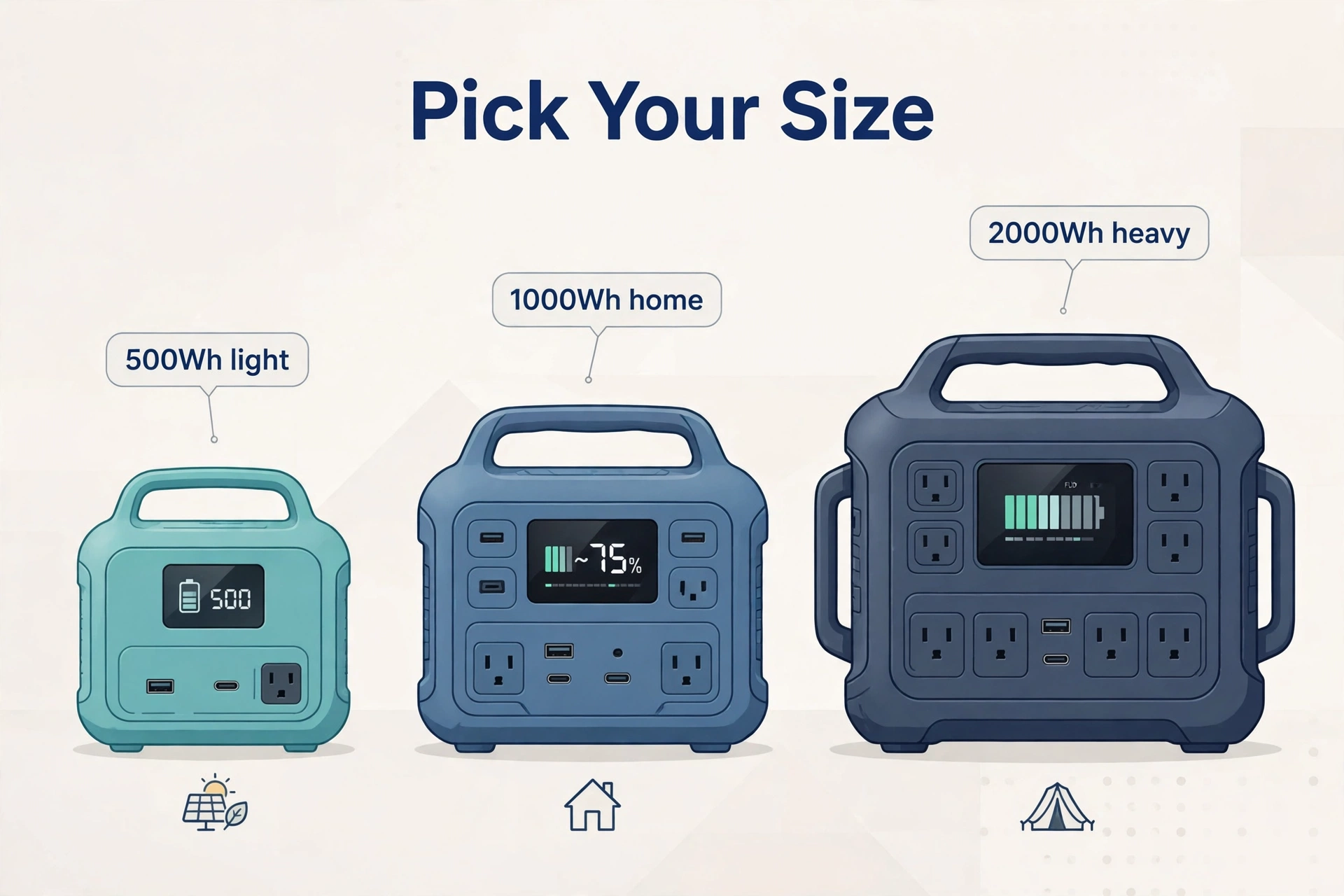
Match the station to your must-run devices. Add up the watts of everything you will run at the same time — that is your minimum output. Then estimate how long the outage might last — that sets your capacity.
Table 2: Sizing guide by use case
| Use Case | Typical Devices | Suggested Size |
|---|---|---|
| Phones + laptop | 2 phones, laptop, LED light | 300–500Wh / 300W+ |
| Home office backup | Laptop, monitor, router, lights | 500–1,000Wh / 800W+ |
| Essential home backup | Fridge, router, phones, lights | 1,000–1,500Wh / 1,500W+ |
| Heavy home backup | Fridge, microwave, TV, tools | 2,000Wh+ / 2,000W+ |
A common mistake is buying too small. A 500Wh station sounds like a lot until a fridge (150W) eats through it in about 3 hours. When in doubt, size up one tier — or choose an expandable model like the DELTA 3 that accepts extra batteries later.
Portable Power Station vs Gas Generator
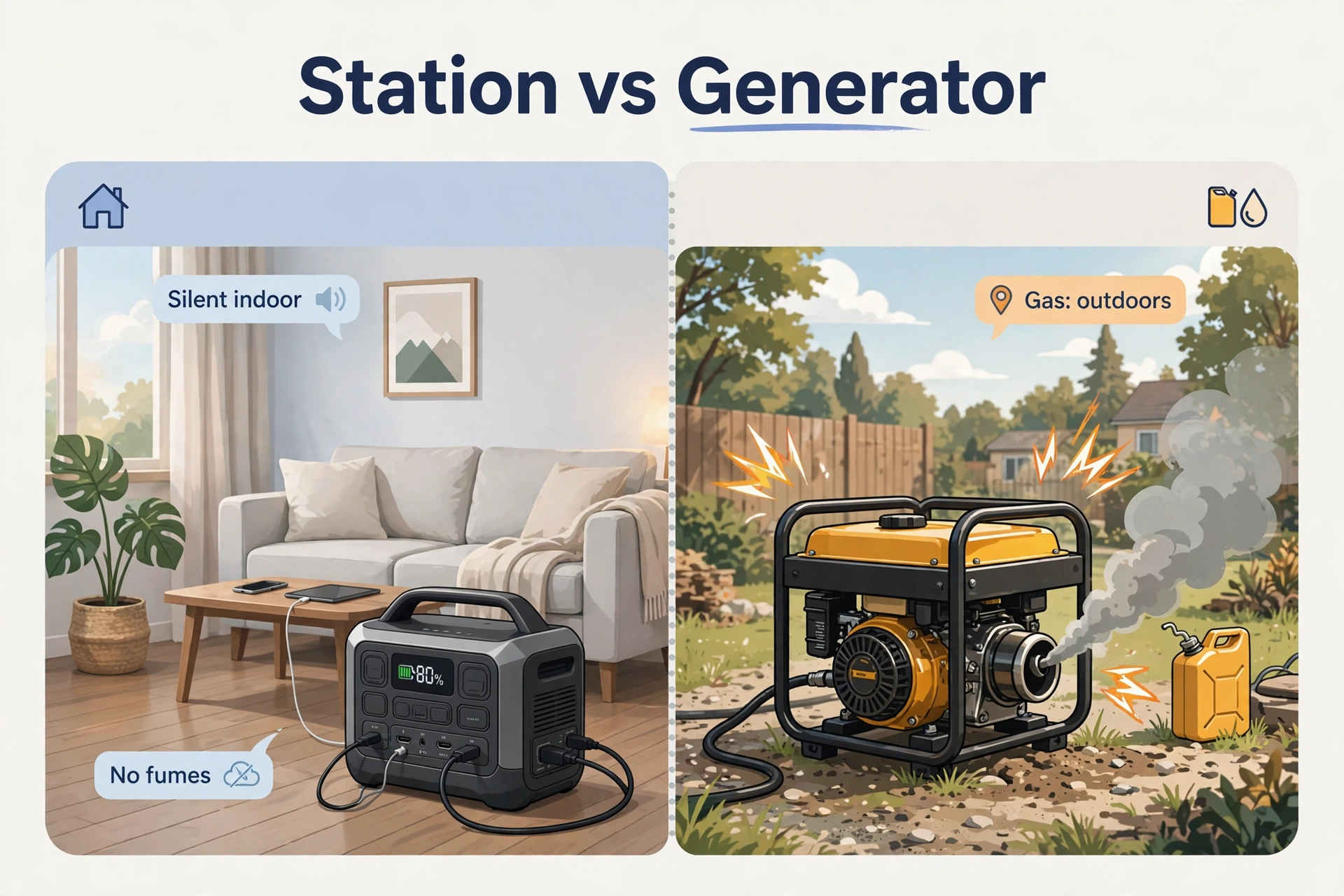
Table 3: Power station vs gas generator
| Feature | Portable Power Station | Gas Generator |
|---|---|---|
| Noise | Silent (no engine) | Loud (60–75 dB) |
| Indoor use | Safe — no fumes | Never — carbon monoxide risk |
| Fuel | Electricity / solar | Gasoline / propane |
| Maintenance | Almost none | Oil, filters, spark plugs |
| Runtime | Hours (limited by battery) | Hours to days (refuelable) |
| Best for | Apartments, short outages, indoor use | Multi-day outages, whole-home loads |
For most suburban outages (a few hours), a power station wins on convenience and safety. For week-long blackouts, a gas generator — or a large expandable power station with solar — is the realistic answer. Many prepared households keep both.
How to Make Your Power Station Last 10 Years
A LiFePO4 power station can serve you for a decade, but only if you treat the battery right. These five habits make the biggest difference:
- Store at 50–80% charge. Leaving a lithium battery at 100% for months stresses the cells. If storm season is over, discharge to about 60% before shelving it.
- Top up every 3–6 months. All batteries self-discharge slowly. A quick recharge twice a year keeps the battery management system calibrated and prevents deep discharge.
- Keep it cool and dry. Heat is the enemy of battery lifespan. A climate-controlled closet beats a hot garage every time.
- Do not drain to zero regularly. Occasional full discharges are fine, but repeatedly running to 0% shortens cycle life. Recharge when you hit 10–20%.
- Update the firmware. App-connected stations receive updates that improve charging curves and battery management — install them like phone updates.
Keep Your Smart Home Running in a Blackout
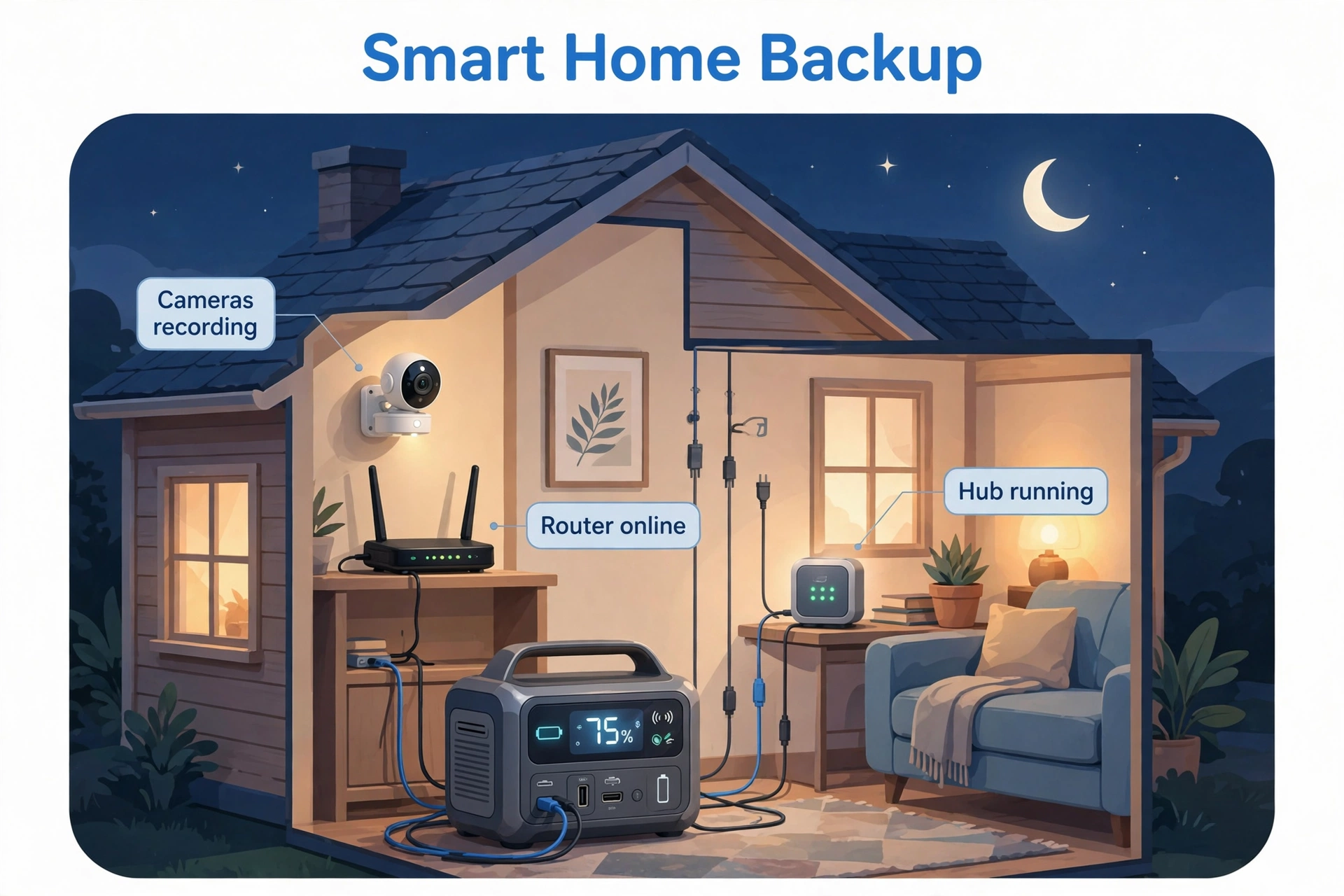
This is where a power station earns its place in a smart home. When the grid drops, your router, Home Assistant hub, cameras, and smart locks all die together — unless a power station bridges the gap.
A 1,000Wh-class station can keep a router (10–20W), a Raspberry Pi hub (5–15W), and several cameras running for well over 24 hours. If you install Home Assistant on a Raspberry Pi 5, put the Pi and your router on the station’s UPS outlets so automations never miss a beat — and consider our guide to the best mini PC for Home Assistant if your hub draws more power.
Security matters most during outages. Security cameras with local storage keep recording without the cloud, and our home security upgrade guide covers layering cameras, locks, and sensors. Plug the camera NVR or hub into the power station and your security stays online when the neighborhood goes dark.
Frequently Asked Questions
How long does a portable power station last during an outage?
Divide its watt-hour capacity by your total load in watts. A 1,024Wh station running a 200W load lasts roughly 5 hours (1,024 ÷ 200). In practice, expect 10–15% less due to inverter losses. For essentials only (fridge + router + lights ≈ 200W), a 1kWh station covers about 4–5 hours.
Can a portable power station run a refrigerator?
Yes. A full-size fridge draws roughly 100–200W while running, so any station with 1,000W+ output and 1,000Wh+ capacity handles it for several hours. Compressor startup surges are brief and well within most stations’ surge ratings.
Are portable power stations safe to use indoors?
Yes — that is their main advantage over gas generators. They produce no exhaust or carbon monoxide, so bedroom, office, or apartment use is safe. Keep vents clear and do not cover the unit while it charges or discharges.
How long do portable power station batteries last?
Modern LiFePO4 stations are rated for 3,000–4,000 full cycles, which translates to roughly 10 years of regular use before capacity noticeably degrades. Store at 50–80% charge in a cool place to maximize lifespan.
Can you charge a portable power station with solar panels?
Yes, if it has a solar (DC/PV) input — most 2026 models do. Match the panel wattage to the station’s max solar input. A 400W panel in good sun adds roughly 1,600–2,000Wh per day, enough to refill a 1kWh station daily during an extended outage.
What is the difference between a power station and a power bank?
Scale. A power bank (20,000mAh ≈ 74Wh) charges phones. A portable power station (500–2,000Wh+) runs AC appliances like fridges and microwaves through real wall-style outlets. Different tools for different jobs.
Final Thoughts
The best portable power station is the one sized for your actual needs: the EcoFlow DELTA 3 for most buyers, the Jackery Explorer 1000 v2 for portability, the BLUETTI Elite 100 V2 for solar, the Anker SOLIX C1000 Gen 2 for high-draw tools, and the EGO Nexus if you are invested in EGO batteries. Whichever you choose, size for your must-run devices, favor LiFePO4 chemistry for a decade of service, and keep your smart home essentials on UPS outlets — the next outage will feel like a non-event instead of an emergency.
