

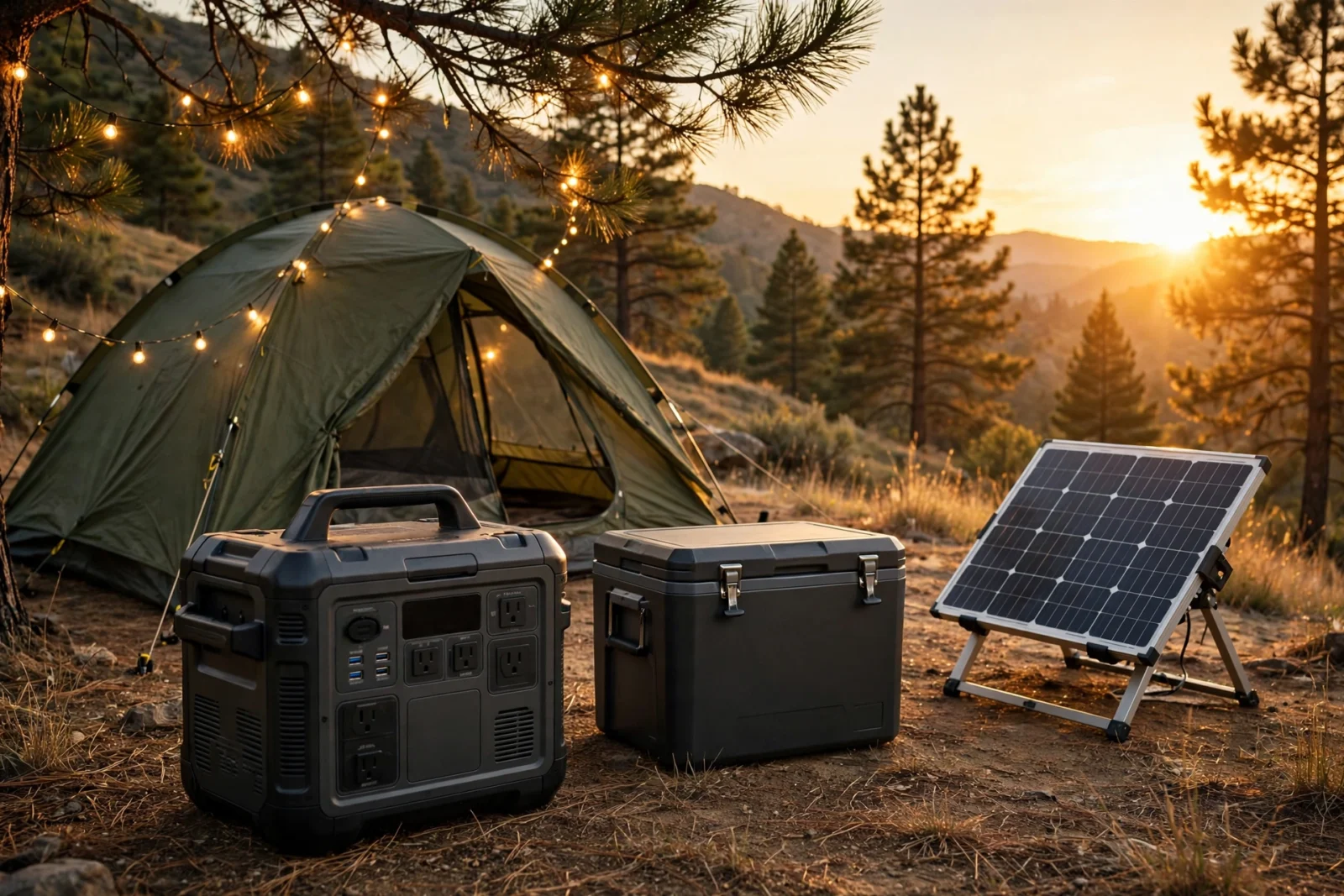
A portable power station camping setup comes down to three decisions: how much energy your gear needs per day, how big a battery covers it, and how you refill that battery at camp. For most campers, a 500–1000Wh station plus a 100–200W solar panel covers phones, lights, and a 12V fridge for a long weekend. The full setup weighs under 25 pounds, makes no noise, and needs no fuel. This guide walks you through sizing your loads, charging with solar, and the packing and safety habits that keep camp powered without drama.
Portable Power Station Camping: How Much Energy Do You Need?
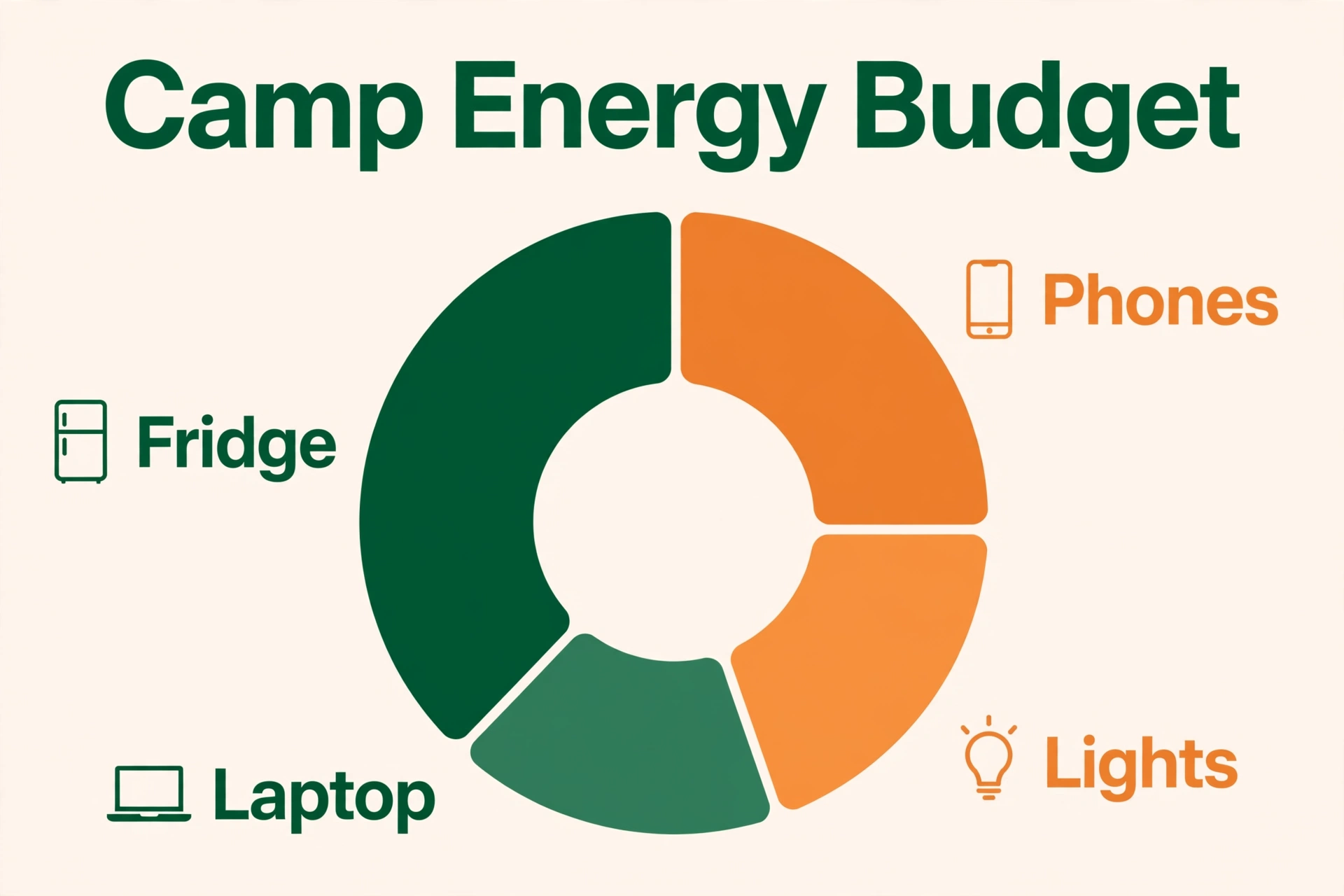
Start with the same simple math that governs every off-grid setup: add up what each device draws, multiply by hours of use, and you get your daily energy budget in watt-hours. Most camping kits land in a surprisingly narrow band.
A typical two-person camp runs a 12V fridge (about 480Wh per day at a 20W average), two phones (about 40Wh), a string of LED lights (about 75Wh over five evening hours), and a laptop or speaker top-up (about 100Wh). That totals roughly 700Wh per day. A family camp with a second fridge, a fan, and camera batteries pushes toward 1,000–1,200Wh. Almost nobody’s realistic camping budget exceeds 1,500Wh a day unless electric cooking is involved.
This is why the 500–1000Wh station class dominates camping: it covers one to two days of a normal kit on a single charge, and a solar panel stretches that indefinitely. Before buying anything, write down your own device list with honest hours — the five-minute version of this math beats every generic recommendation.
The Core Camping Loads, Sized
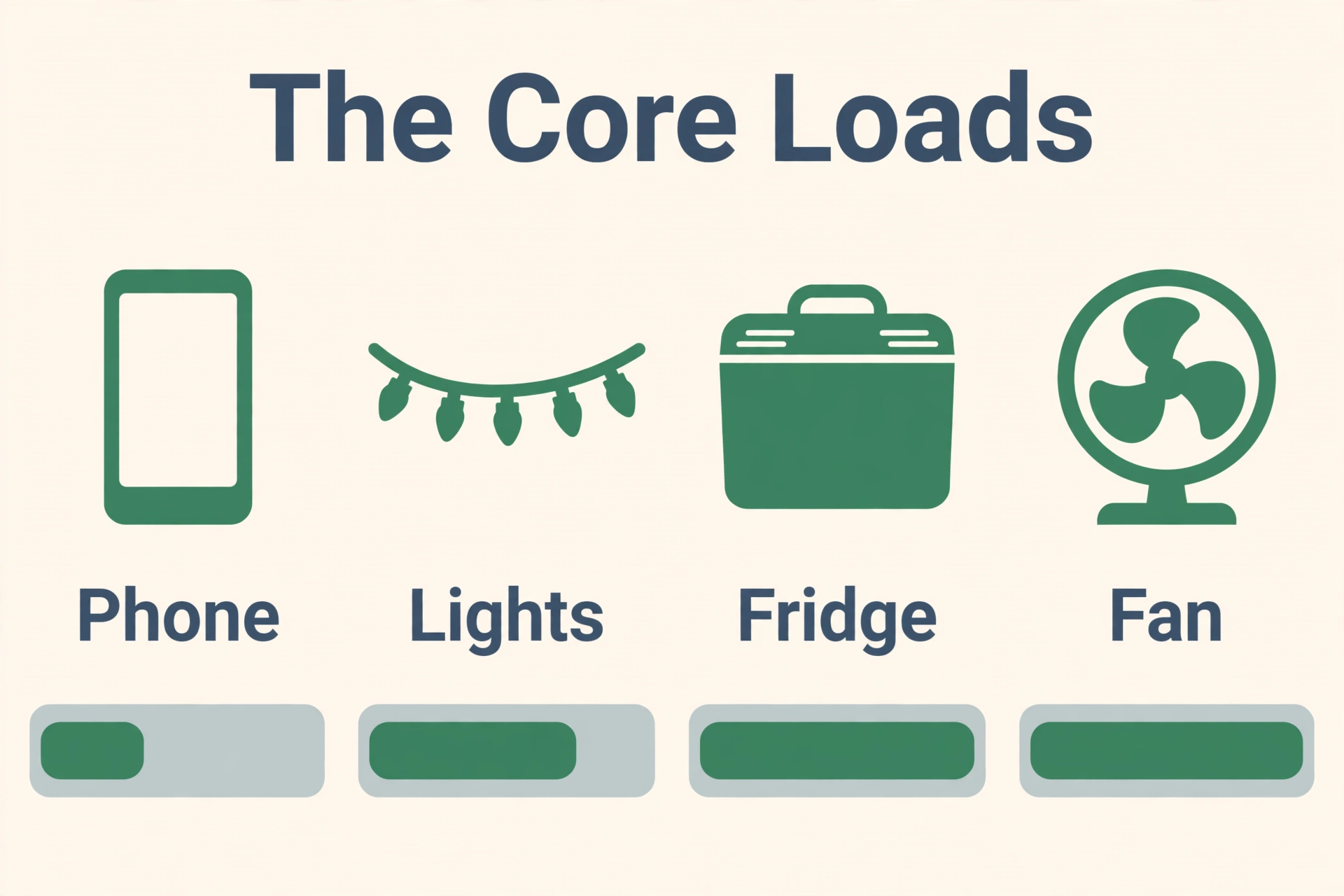
Four loads make up 90% of camping power use. Size for these and the rest takes care of itself.
Phones and small electronics. A phone battery holds 15–20Wh; a full charge from a power station costs about that plus small losses. Two phones charged daily for a four-day trip consume under 200Wh total — a rounding error on even a small station. Tablets, headlamps, and camera batteries live in the same trivial-draw category. Charge them during the day while solar is flowing and they cost you nothing from the battery’s overnight reserve.
Lights. LED camp lighting is almost free, energy-wise. A 10-watt string of lights running five hours uses 50Wh — about 5% of a 1,000Wh station. This is the load where old-timers still overthink: with LEDs, light generously. Run the awning lights, the tent lights, and the path markers. You will not notice it on the battery gauge.
The 12V fridge. This is the load that justifies the whole purchase. A 35–45 liter 12V compressor fridge draws 35–60 watts while running but cycles on and off, averaging 15–25 watts in mild weather — roughly 400–600Wh per day. In hot weather (35°C+), expect the average to climb toward 30–40 watts as the compressor works harder, so budget 700–900Wh for desert summer trips. Pre-chill the fridge at home on wall power and load it with already-cold food; a fridge cooling warm groceries burns far more energy than one maintaining cold ones.
Fans and comfort gear. A 12V or USB camp fan draws 5–25 watts depending on speed — an all-night fan at medium speed costs about 150–200Wh. Electric blankets (75–150W) are the hungriest common comfort item; one cold night on a blanket can consume 500Wh+, so treat it as a luxury load and size for it deliberately.
Table: Daily energy budget for a typical two-person camp
| Load | Daily energy | % of 1000Wh station | Priority |
|---|---|---|---|
| 12V fridge (mild weather) | ~480Wh | ~48% | Essential |
| Phones + small electronics | ~60Wh | ~6% | Essential |
| LED lights (5 hours) | ~75Wh | ~8% | Essential |
| Laptop/speaker top-ups | ~100Wh | ~10% | Nice to have |
| Camp fan (all night) | ~180Wh | ~18% | Comfort |
| Typical daily total | ~700–900Wh | ~70–90% |
Solar Recharging at Camp: Making It Last Indefinitely
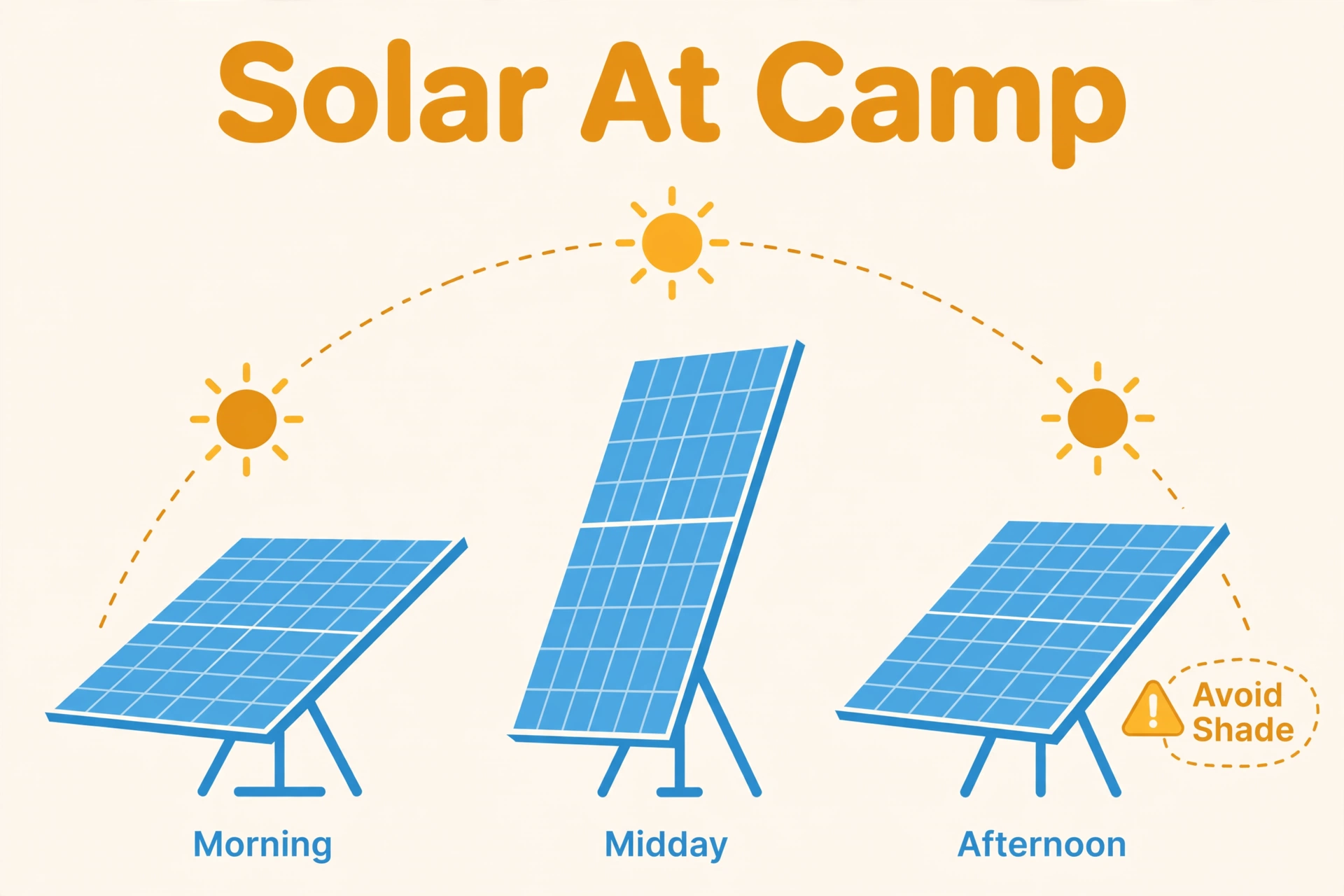
A station without a recharge plan is a countdown timer. Solar turns it into a system. The rule of thumb: your panel array should replace your daily burn during the sunny hours, with margin for imperfect conditions.
Panels are rated in lab conditions; in the field, expect 70–80% of the sticker wattage in good sun. A 200W panel therefore delivers roughly 140–160 real watts. Over six solid sun hours, that is about 850–950Wh — enough to cover the typical 700–900Wh daily budget above. For hotter trips with a harder-working fridge, or for forested sites with partial shade, a 200W panel is the practical minimum and 300–400W gives real comfort.
Placement matters more than most people expect. Angle the panel toward the sun and move it two or three times a day — morning east, midday flat-ish, afternoon west. Even partial shade from a branch can cut a panel’s output dramatically, so scout the sunny patch before you pitch the tent around it. And keep the station itself in the shade: batteries charge less efficiently when hot, and direct sun on a black box at camp is a fast track to thermal throttling.
You can run loads while solar flows in — the station nets the difference. A fridge drawing 20 watts against 150 watts of solar still banks 130 watts. Make daytime your heavy-use window: charge laptops, run the fan, top up everything while the sun pays for it, and let the battery coast through the night on lights and the fridge alone.
Picking the Right Station Size for Camping
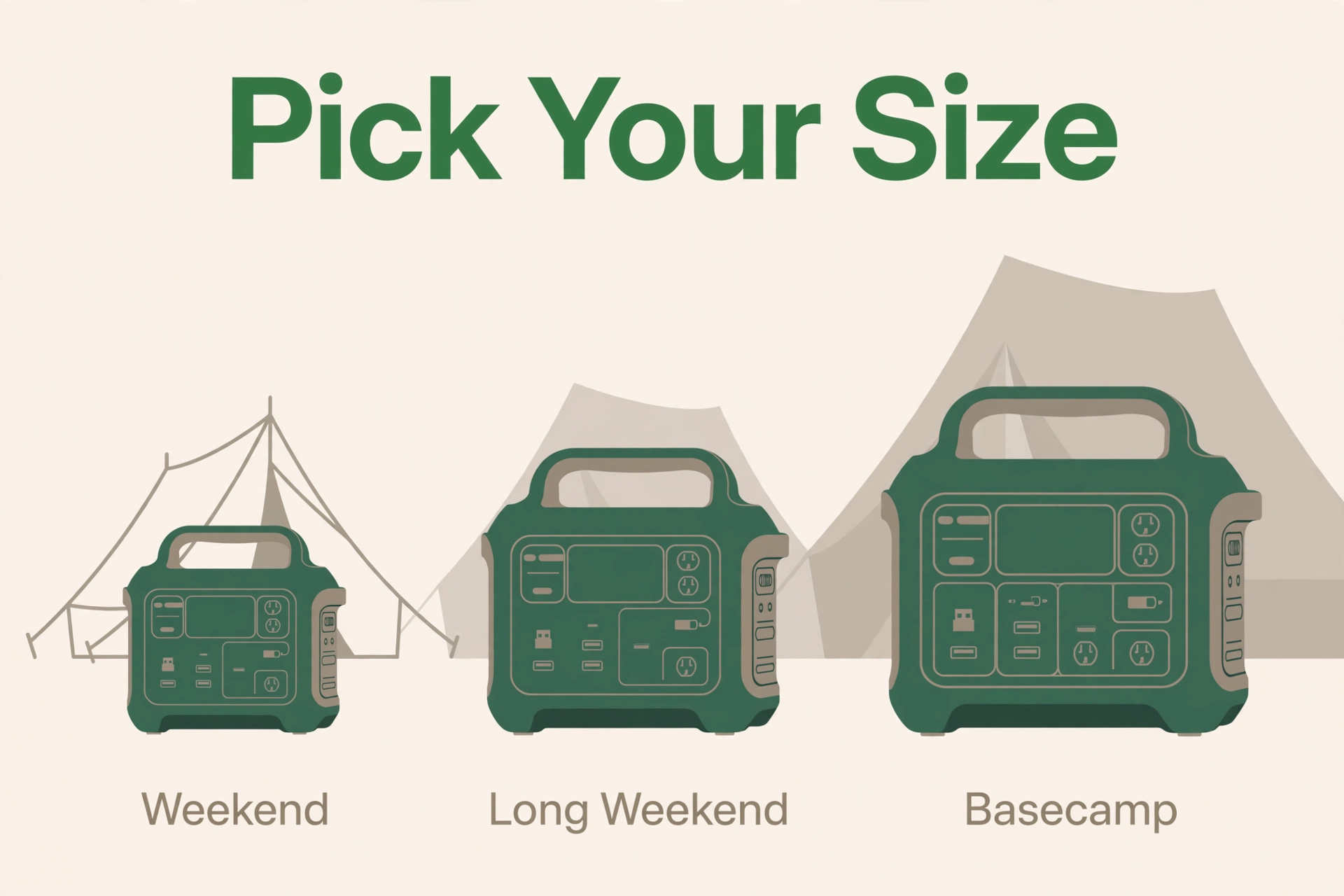
Match the station to your trip length and recharge plan, not to vague aspirations. Three tiers cover nearly every camper.
300–500Wh: weekend minimalists. Fine for two-night trips running phones, lights, and small electronics with no fridge — or one night with a small fridge. Light enough to carry in one hand. If this is your whole kit, see our best portable power station roundup for the models campers actually buy in this class.
500–1000Wh: the camping sweet spot. Covers the full classic kit — fridge, lights, phones, laptop — for two to four days, or indefinitely with a 200W panel. This is the tier most experienced campers land on after their first upgrade cycle. Heavy enough to notice (15–25 pounds) but still genuinely portable.
1000–2000Wh: basecamp and families. For week-long stays, two fridges, electric cooking experiments, or powering the whole family’s devices. You gain days of autonomy and the ability to run hungrier loads, at the cost of weight (35–50+ pounds) — this tier rides in the vehicle, not in a backpack.
One sizing trap to avoid: buying for the single heaviest appliance you might someday run. If you use an electric kettle twice a year, you do not need a 2000W inverter year-round — boil water on the camp stove like everyone else and keep the station sized for your daily loads.
Packing and Transport: Getting It to Camp Safely
Power stations are dense, heavy boxes with lithium batteries inside — pack them like it. Always transport the station upright with the vents unobstructed, wedged so it cannot slide or tip in the vehicle. Never stack heavy gear on top of it; a crushed vent or cracked case is a safety issue, not a cosmetic one.
Charge to 80–100% at home before every trip — wall charging is faster and cheaper than any field method, and starting full gives you a buffer day if the weather turns. Coil cables separately rather than stuffing them against the station; damaged DC cables are a common and avoidable failure point. Bring the solar panel’s extension cable even if you think the panel will sit close — campsite geometry never cooperates.
If you are buying gear last-minute before a trip, check local availability rather than gambling on shipping times — our guide to finding a portable power station nearby covers the store types that stock them and what to verify before you drive over. As a packing checklist: station charged to full, solar panel plus extension cable, DC fridge cable, phone/laptop cables, and a small power strip so one AC outlet serves several small chargers at once. Lay it all out the night before — the one cable you forget is always the one you need at camp.
Camp Safety: Batteries, Heat, Water, and Fire Rules
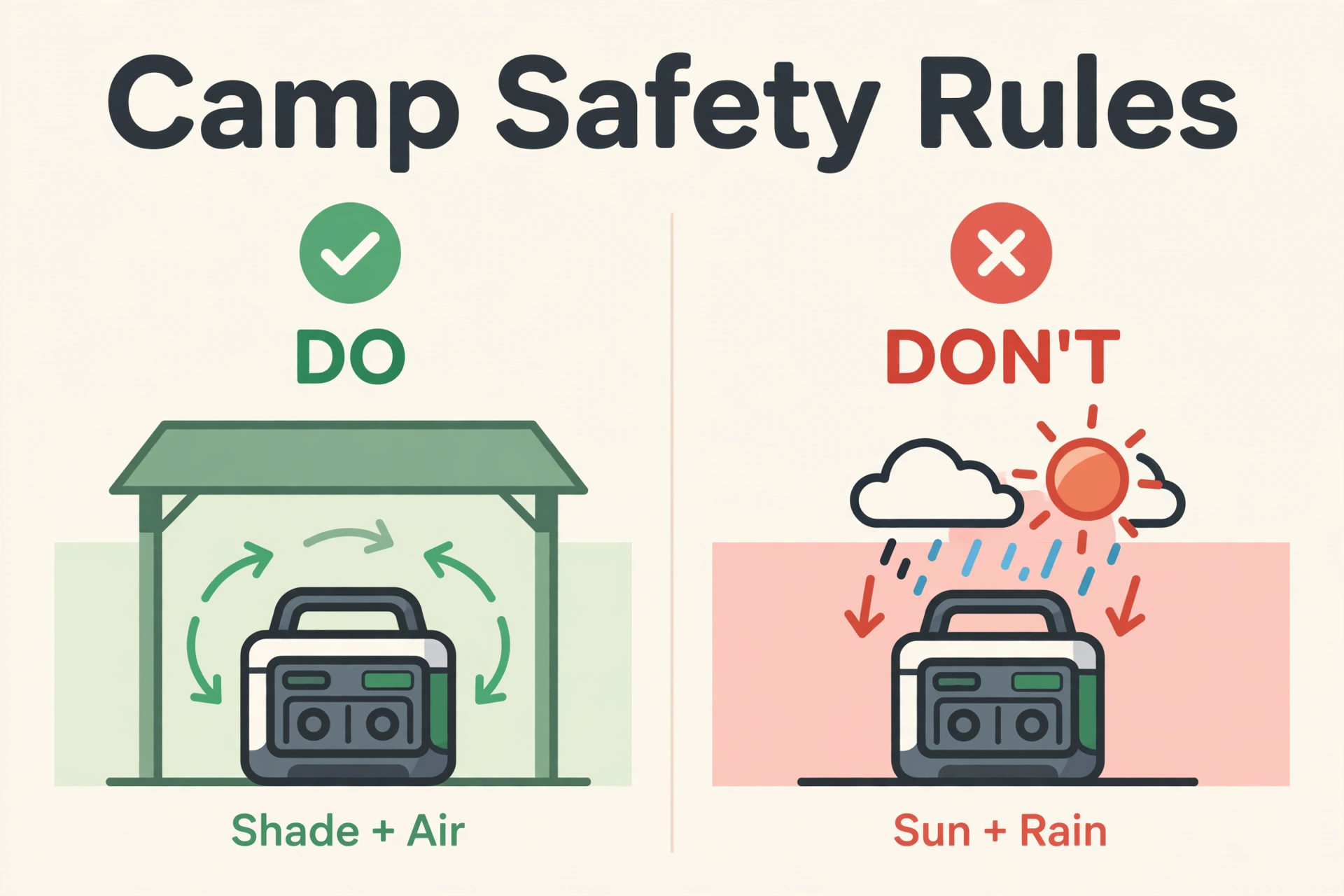
Lithium power stations are far safer than gas generators — no carbon monoxide, no fuel spills, no deafening roar — but they still demand respect. These are the rules experienced campers follow.
Ventilation and heat. The inverter generates heat under load; never run the station inside a sealed tent, a closed cooler, or wrapped in a blanket. Shade is mandatory in summer — a station baking in 40°C direct sun will throttle its output or shut down to protect the battery. A simple camp chair with a towel draped over it makes a fine shade shelter.
Water. Power stations are not waterproof. Morning dew is usually fine, but rain is not — keep it under the awning or vestibule, elevated off wet ground on a crate or dry bag. If the forecast turns truly foul, the station rides out the storm inside the vehicle.
Fire regulations. Some campgrounds and fire-restricted areas have rules about battery storage, and a few prohibit charging inside tents. Check the specific campground’s regulations when you book, especially in the western US during fire season. Solar panels themselves are unrestricted everywhere — it is the battery placement that occasionally draws a rule.
Night routine. Before bed, check the battery percentage and do quick math: fridge overnight (~200Wh) plus phones (~40Wh) needs roughly 25% of a 1,000Wh station. If you are below that with no morning sun expected, shed loads — turn off the fan, dim the lights, put the fridge in eco mode. Waking up to warm food because the station died at 3 AM is the classic preventable camping failure.
Frequently Asked Questions
What size portable power station do I need for camping?
For the classic kit — 12V fridge, phones, LED lights, laptop — a 500–1000Wh station covers two to four days, or indefinitely with a 200W solar panel. Go bigger only for week-long basecamps, multiple fridges, or electric cooking.
Can I charge a portable power station with solar panels while camping?
Yes — that is the intended design. Most stations have a built-in solar charge controller; connect a compatible panel, place it in full sun, and you can both run loads and recharge simultaneously. A 200W panel in good sun roughly replaces a typical camp’s daily energy use.
How long will a power station run a camping fridge?
A 12V fridge averaging 20 watts runs about 40 hours on a 1,000Wh station (1000 ÷ 20 × 0.85 for inverter losses). In hot weather the average draw climbs, so budget closer to 24–30 hours — which is why daytime solar matters on summer trips.
Can I run a CPAP machine while camping?
Yes, and a power station is the standard solution for CPAP users who camp. Without the heated humidifier, most CPAPs draw 30–60 watts — roughly 250–500Wh for an eight-hour night, or about a quarter to half of a 1,000Wh station. Turn off the humidifier and heated tube, and many campers get two to three nights per charge. Pair it with daytime solar and a CPAP never has to end your camping life.
Are portable power stations safe in a tent?
They produce no carbon monoxide, so the gas-generator danger does not apply — but do not seal one inside a tent either. The inverter needs airflow and the battery dislikes heat buildup. Run it in the vestibule or under the awning with ventilation, and keep it dry.
Can a portable power station replace a gas generator for camping?
For everything except heavy heating, cooling, and big power tools — yes, and most campers prefer the silence. A gas generator still wins for running an RV air conditioner or a full electric kitchen. For the fridge-lights-devices kit that 90% of campers actually run, the battery station is the better tool.
A good portable power station camping setup is boring in the best way: size it once with honest numbers, add enough solar to cover the daily burn, keep it shaded and dry, and it simply works — trip after trip. For model-by-model picks across every size tier, browse our best portable power station roundup before you buy.
