

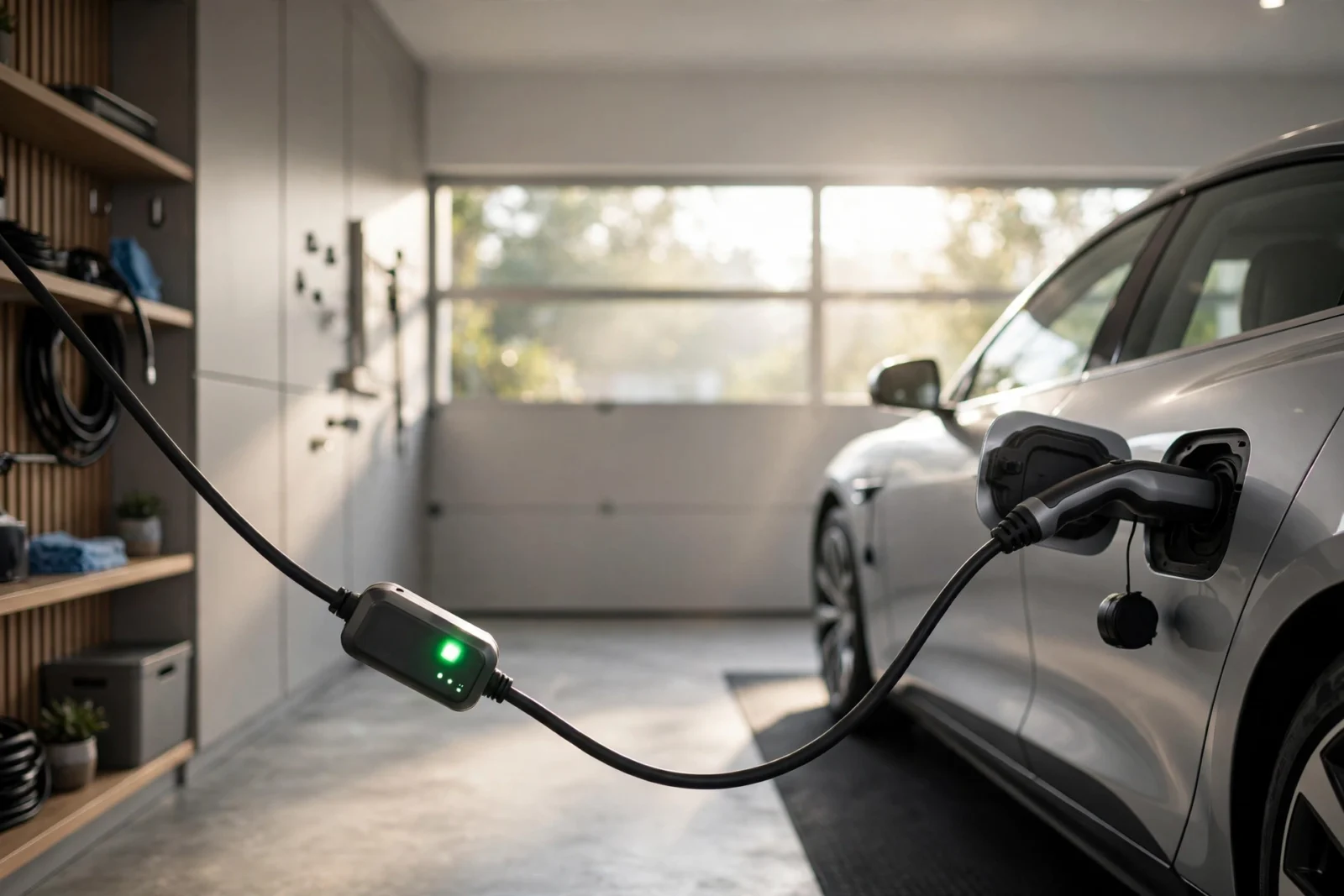
The Lectron Portable Level 2 J1772 EV Charger is a 32-amp portable charger that plugs into a NEMA 14-50 outlet for Level 2 charging or a standard wall outlet for Level 1. Lectron rates it at up to 7.68 kW, which the company says adds up to 31 miles of range per hour on 240 volts. For drivers who rent, travel, or want an affordable backup charger, it is one of the most practical budget options available — typically priced around $200 to $350. Check the current price before you buy, since it moves around.
This review covers the real specifications from the user manual, how fast it actually charges, who it suits, and where it falls short — so you can decide whether it belongs in your trunk.
Lectron Portable Level 2 J1772 EV Charger: Key Specs
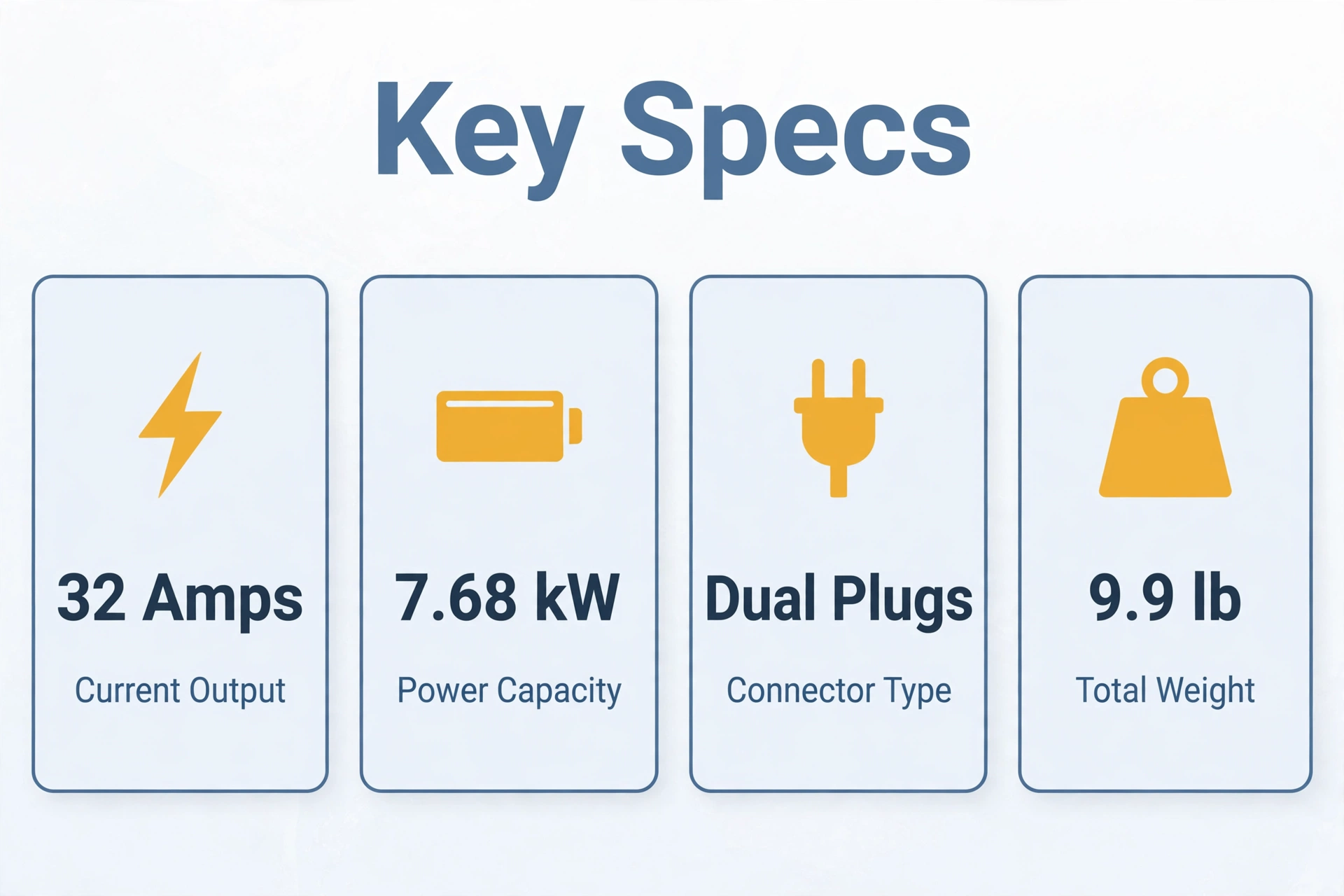
Before the opinions, here are the facts. The specifications below come from Lectron’s own user manual and product listings, not from marketing fluff.
Table: Lectron Portable Level 2 J1772 EV Charger specifications
| Specification | Detail |
|---|---|
| Maximum current | 32 A (adjustable; 12 A on Level 1) |
| Input / output voltage | 100–250 V, 50/60 Hz |
| Maximum power | 7.68 kW at 240 V / 32 A |
| Plugs included | NEMA 14-50 (Level 2) and NEMA 5-15 (Level 1) |
| EV connector | SAE J1772 |
| Cable length | 16 ft (18 ft total reach, per user manual) |
| Weight | 9.9 lb |
| Dimensions | 16.5 × 13 × 5 in |
| Operating temperature | -22°F to 122°F |
| Display | LED charging-status indicator |
| Warranty | 1 year (Lectron limited warranty) |
Specifications can change between production runs, so it is worth confirming the details on Lectron’s official site before you order.
Design and Portability
The first thing you notice about the Lectron portable charger is that it is a single self-contained cable with a control box in the middle — no wall bracket, no app, no setup wizard. The control box houses the electronics, with a NEMA 14-50 plug on one end and the J1772 handle on the other. At 9.9 pounds it is light enough to toss in the trunk and forget about until you need it.
The build feels rugged. Lectron describes the materials as heavy-duty and weatherproof, which matters because portable chargers live rough lives: they get coiled and uncoiled daily, dragged across driveways, and left out in rain. The operating range of -22°F to 122°F covers nearly every climate in North America, from a Minnesota January to an Arizona August.
The LED indicator on the control box shows charging status at a glance — blinking while charging, solid when the battery is full. It is simple, but it works. Do not expect a screen with kilowatt-hours or session history; that kind of data lives on wall-mounted smart chargers, not on portable units at this price.
If you are new to portable charging in general, our guide to the portable EV charger explains how these units fit into daily EV life and when they beat a wall-mounted station.
Charging Performance: Level 1 vs Level 2
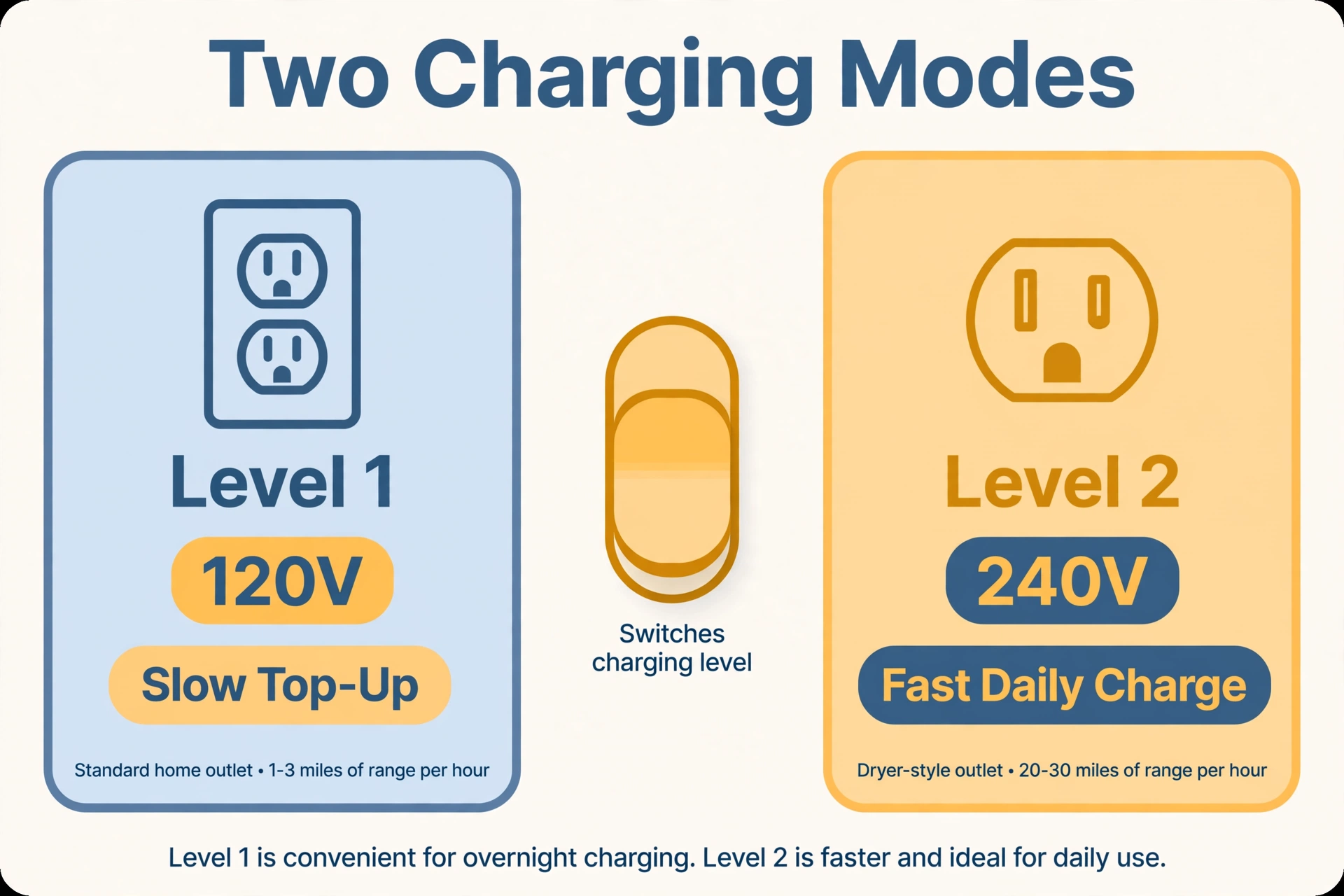
The Lectron ships with two plugs, which effectively makes it two chargers in one. Which plug you use changes everything about speed.
Level 2 Mode: NEMA 14-50 Plug at 32 Amps
Plug into a 240-volt NEMA 14-50 outlet and the Lectron delivers up to 32 amps, or about 7.68 kW. Lectron says this adds up to 31 miles of range per hour. Real-world results vary with your car’s efficiency — a efficient sedan gains more miles per kWh than a heavy electric truck — but 25 to 30 miles per hour is a realistic expectation for most EVs.
To put that in practical terms: the average American drives about 40 miles a day. On Level 2 mode, the Lectron replaces a full day of driving in under two hours. Plug in after dinner and you are fully topped up long before morning, even after a 150-mile day.
One important electrical note: a 32-amp continuous load needs a 40-amp circuit, per the standard 80% rule for continuous loads. Most NEMA 14-50 outlets are wired for 40 or 50 amps, so this is usually fine — but if your outlet is on a 30-amp dryer circuit, you must dial the charger down. Which brings us to the next section.
Level 1 Mode: NEMA 5-15 Plug at 12 Amps
Swap to the standard 120-volt plug and the Lectron runs at 12 amps, delivering about 1.4 kW. Lectron says this adds up to 6 miles of range per hour. That is slow, but it is also universal: every garage, every friend’s house, and every motel parking lot has a 120-volt outlet.
Level 1 mode is your emergency and travel mode. Visiting family for the weekend? A 120-volt outlet adds 60 to 70 miles over 12 hours — easily enough to cover local driving and the trip home. It will not refill a depleted long-range battery overnight, but it keeps you moving.
Table: Lectron charging modes compared
| Charging mode | Plug | Power | Miles per hour (per Lectron) | Best use |
|---|---|---|---|---|
| Level 2 | NEMA 14-50 | Up to 7.68 kW | Up to 31 | Daily home charging |
| Level 1 | NEMA 5-15 | ~1.4 kW | Up to 6 | Travel, emergencies, top-ups |
Adjustable Amperage: The Feature That Matters Most
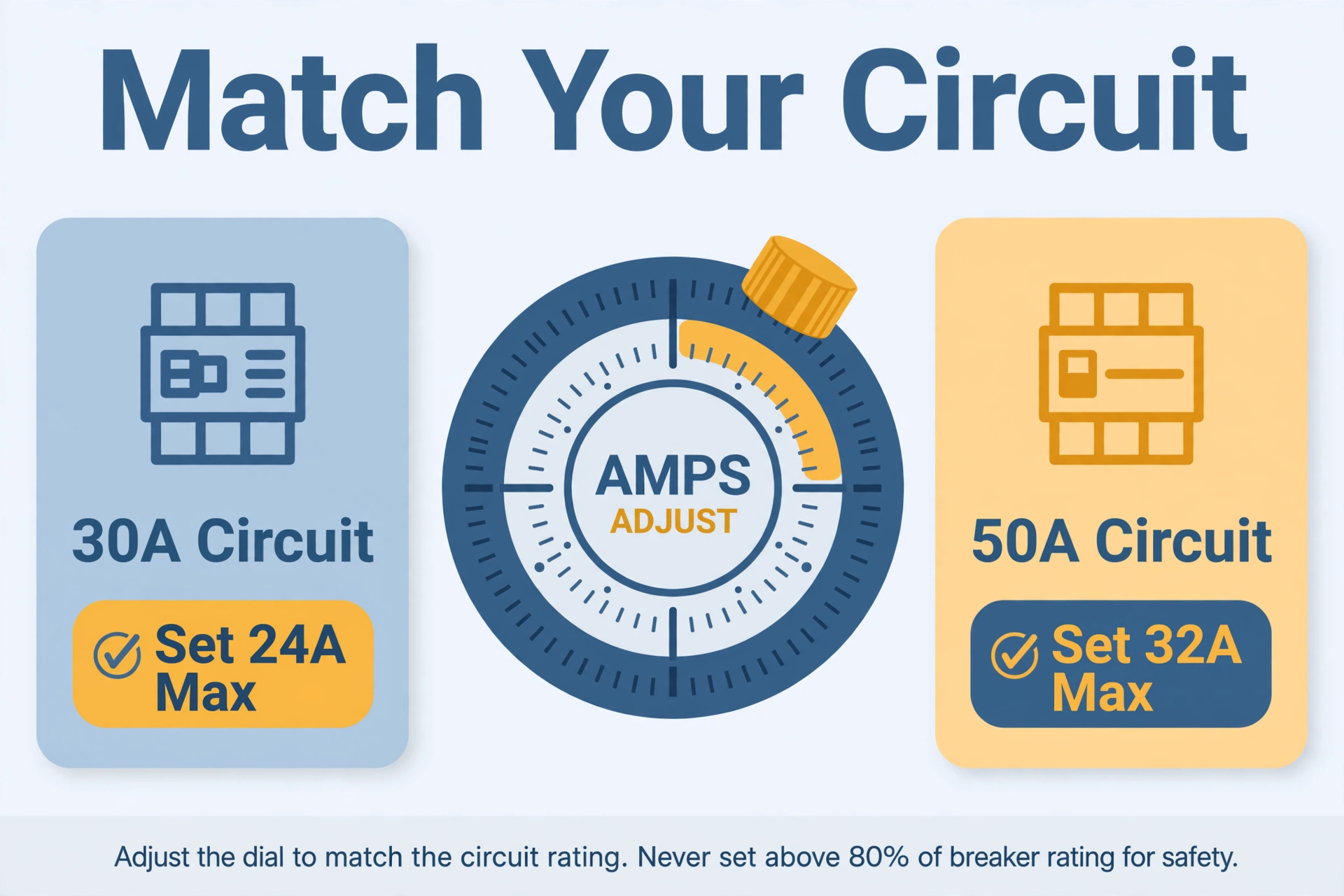
The standout feature of this charger is adjustable charging current. The user manual instructs you to set the current before plugging the handle into the car — meaning you can run it below the 32-amp maximum when the circuit demands it.
This matters more than it sounds. Many garages have a 30-amp dryer outlet (NEMA 14-30) rather than a 50-amp range outlet. A fixed 32-amp charger would overload that circuit. With the Lectron, you dial down to a safe level and charge a bit slower instead of tripping breakers — or worse. Owners who split time between homes with different outlets consistently call this the most useful feature.
It also helps on shared circuits. If your 14-50 outlet shares a panel with power-hungry appliances, running at a lower amperage keeps everything within safe limits. Flexibility like this is exactly what separates a good portable charger from a frustrating one.
Who Should Buy the Lectron Portable Charger
Renters. You cannot install a wall charger in a property you do not own. The Lectron plugs into whatever outlet is available and moves with you. Nothing is left behind when the lease ends.
Road-trippers and frequent visitors. Keep it in the trunk and any 240-volt dryer outlet at a relative’s house becomes a fast charging stop. Even 120-volt outlets work in a pinch. For cabin weekends and family visits, it removes range anxiety without a single stop at a public charger.
Two-EV households on a budget. If your wall charger serves the main car, the Lectron covers the second car through a dryer outlet — no second electrician visit required. At around $200 to $350, it is far cheaper than installing another station.
New EV owners who are not ready to commit. A wall-mounted charger plus installation can easily pass $1,000. The Lectron lets you experience home charging for a few hundred dollars while you learn your real habits. Many owners report that they never felt the need to upgrade afterward.
For the full picture on how portable units stack up against permanent stations, see our ChargePoint vs Wallbox comparison of two popular wall-mounted options.
Who Should Skip It
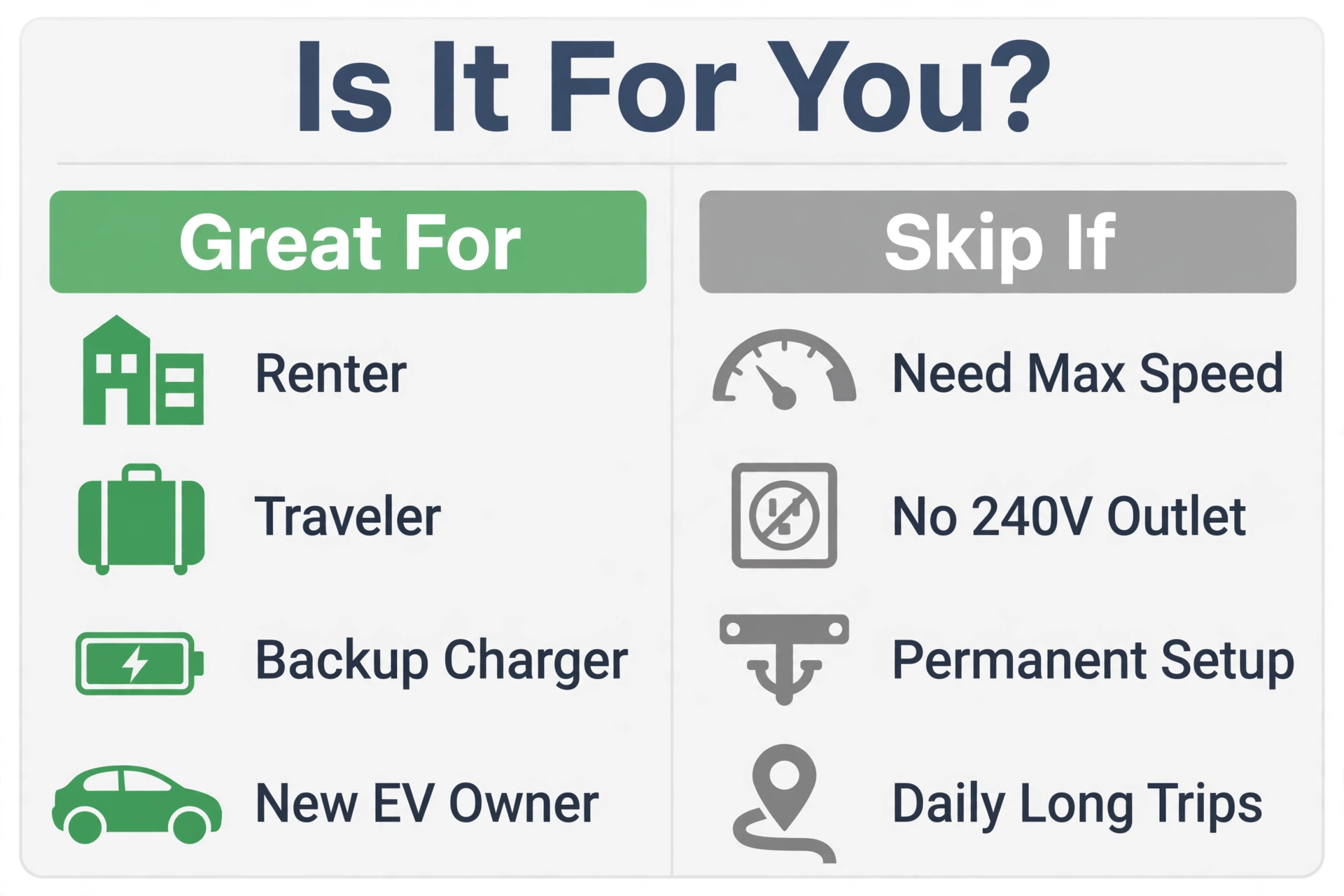
No product fits everyone, and honest reviews say so. Skip the Lectron if any of these describe you.
You want smart features. There is no Wi-Fi, no app, no scheduled charging, and no energy tracking. If your utility offers cheap overnight rates and you want charging to start automatically at midnight, you need a smart wall charger — your car’s own scheduling can partly cover this, but the Lectron itself cannot.
You drive a Tesla and hate adapters. The J1772 handle works fine with Teslas using the J1772-to-Tesla adapter, but it is one more thing to carry and connect. Tesla drivers who want a native plug should look at NACS portable chargers instead — or check our Tesla Universal Wall Connector vs ChargePoint Home Flex breakdown for a permanent setup that handles both connector types.
You need the fastest possible home charging. The Lectron tops out at 32 amps. Hardwired wall chargers reach 48 amps (11.5 kW), which matters if you regularly arrive home nearly empty with a big battery and leave early. For most drivers this is overkill, but heavy commuters should know the ceiling.
Your parking spot is far from any outlet. The 16-foot cable (18 feet of total reach) suits most garages, but if your outlet is on the far wall and your charge port faces the street, measure first. An extension cord is not a safe workaround for EV charging — if the cable cannot reach comfortably, this is not the charger for you.
Pros and Cons
Table: Lectron Portable Level 2 J1772 EV Charger pros and cons
| Pros | Cons |
|---|---|
| Dual Level 1 / Level 2 plugs included — two chargers in one | No Wi-Fi, app, or smart scheduling |
| 32 A / 7.68 kW is fast enough for overnight full charges | 16 ft cable may be short for some parking setups |
| Adjustable amperage suits different outlet circuits | J1772 only — Tesla drivers need an adapter |
| No installation cost; works with existing outlets | Tops out at 32 A vs 48 A hardwired wall units |
| Rugged, weatherproof build for outdoor use | Only basic LED status — no charging data or history |
| Affordable at around $200–$350 | 1-year warranty is shorter than some competitors |
Safety and Everyday Use
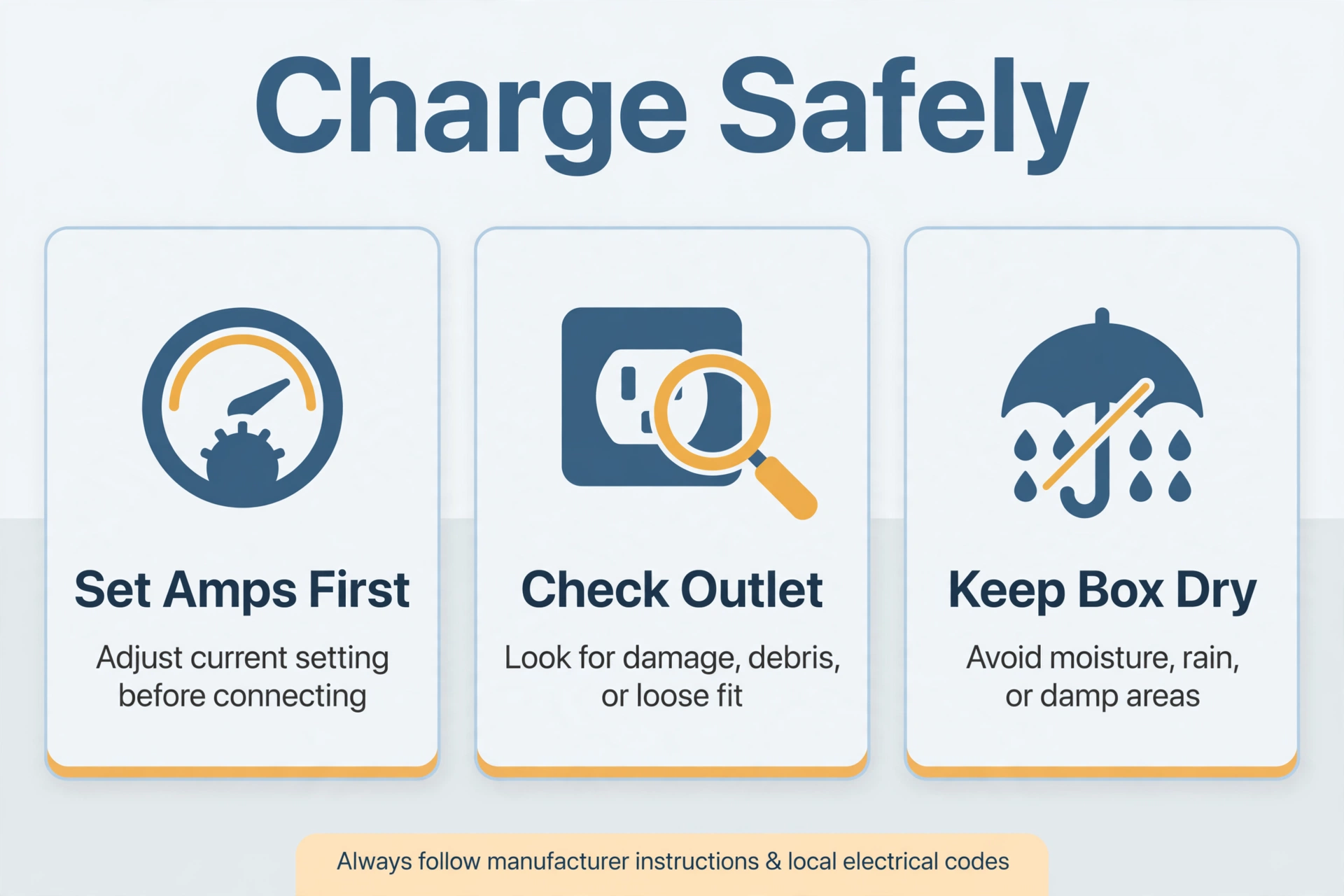
A portable charger handles serious power, so safe habits matter. Always set the amperage before connecting to the car, as the manual instructs. Make sure the outlet you use is in good condition — loose or scorched outlets are a fire risk with any high-power device, so replace them before charging.
Keep the control box off wet ground when charging outdoors, even though the unit is built for weather. Coil the cable loosely for storage rather than wrapping it tightly around the box, which stresses the internal wiring over time. And never use a standard extension cord to reach a distant outlet; if the cable does not reach, the parking arrangement needs to change, not the wiring.
Check what safety certifications are printed on the unit you receive and confirm they are current. Certification marks are your assurance that an independent lab tested the charger — worth verifying on any high-voltage device you bring home.
Frequently Asked Questions
Does the Lectron portable charger work with Tesla vehicles?
Yes, with an adapter. The J1772 handle plugs into the J1772-to-Tesla adapter that ships with most Teslas, and charging works normally. If you would rather skip the adapter entirely, Lectron also sells versions with a native Tesla-style plug — but this review covers the J1772 model, which suits all non-Tesla EVs directly.
Can I leave it plugged in outside in the rain?
The charger is built with weatherproof materials and rated for -22°F to 122°F, so rain during a charging session is within its design limits. Owners routinely charge in driveways. That said, keeping the control box sheltered and connections off standing water is always the safer habit with any electrical equipment.
Will 32 amps be enough for my EV?
For most drivers, yes. At 32 amps you add roughly 25 to 30 miles of range per hour, so even a 200-mile driving day is fully recovered in about seven hours overnight. Only drivers with very large batteries and very short overnight parking windows genuinely need more than 32 amps.
Do I need an electrician to use it?
Not for the charger itself — it plugs into existing outlets. You only need an electrician if you do not have a 240-volt outlet where you park and want one installed. Many owners start with the 120-volt plug on day one and add a 240-volt outlet later once they are sure of their setup.
How does it compare to the charger that came with my car?
Many EVs now ship without any portable charger, or with a basic Level 1 cord. The Lectron is a major step up from a basic Level 1 cord because of the 32-amp Level 2 mode and adjustable amperage. If your car did come with a dual-voltage portable charger, compare its maximum amperage — the Lectron’s 32 amps beats most included cords.
Final Verdict
The Lectron Portable Level 2 J1772 EV Charger does exactly what a portable charger should do: it delivers fast-enough Level 2 charging from a dryer outlet, falls back to any wall socket in a pinch, and costs a fraction of a wall-mounted station with installation. The adjustable amperage is genuinely useful, the build is tough, and the dual plugs mean you are covered almost anywhere.
Its limits are honest ones: no smart features, a 16-foot cable, and a 32-amp ceiling. None of these are flaws so much as trade-offs of the portable format at this price. If you rent, travel, need a second charger, or simply want home charging without the electrician bill, the Lectron is an easy recommendation — just check the current price, confirm your outlet type, and measure your cable run before ordering.
