

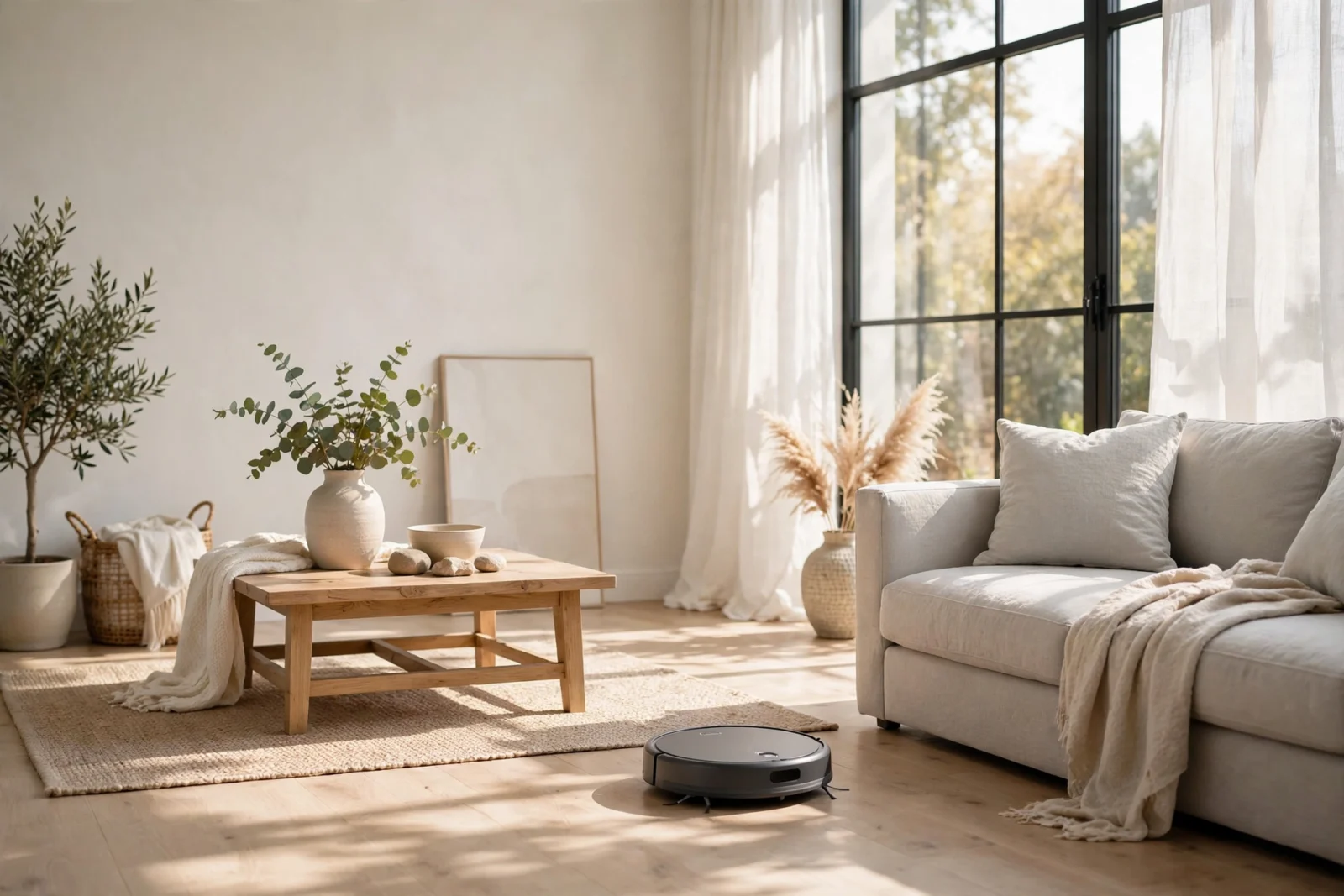
Roborock vs Roomba: Which Robot Vacuum Brand Should You Buy in 2026?
If your floors are mostly hard tile, wood, or laminate and mopping matters as much as vacuuming, buy Roborock. If your home has wall-to-wall carpet and pets, and you want a robot that guarantees your rugs stay bone dry, buy Roomba. That is the honest answer to the roborock vs roomba question, and the rest of this guide explains exactly why.
These are the two biggest names in robot vacuums, and they took very different paths to the top. Roborock started as a Xiaomi-backed engineering outfit and built its reputation on raw cleaning tech: laser navigation, vibrating mop pads, and docks that wash and dry themselves. Roomba, from iRobot, is the brand that invented the category — it wins on navigation smarts, a dirt-detection brain that learns your home, and a mop that physically retracts away from carpets.
This guide compares the two brands head to head: their flagship models (the Roborock S8 Pro Ultra and the Roomba Combo j9+), navigation, mopping, apps, smart home fit, and 2026 prices — so you can pick the right one for your floors.
Roborock vs Roomba at a Glance
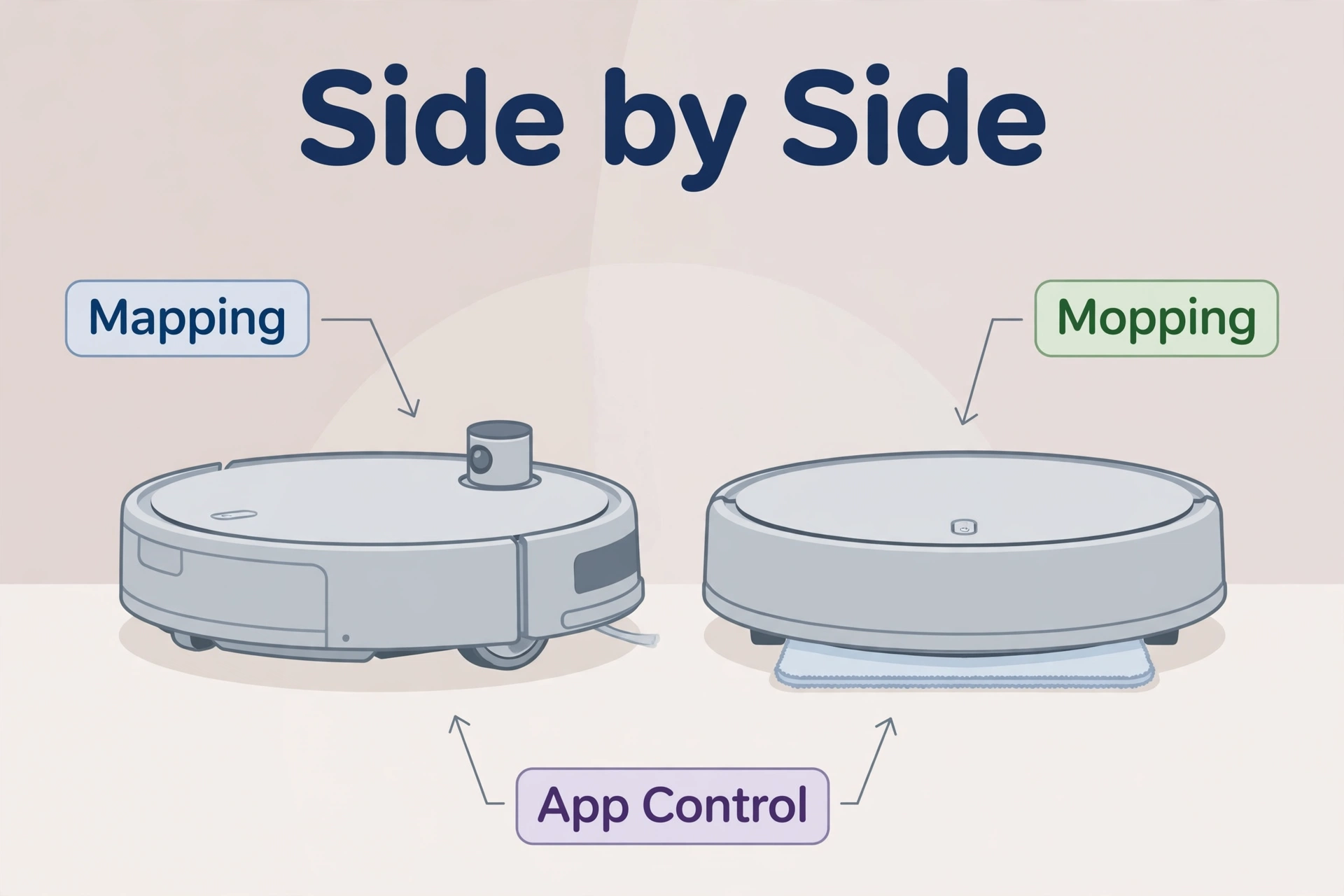
The whole comparison on one screen.
| Feature | Roborock (S8 Pro Ultra) | Roomba (Combo j9+) |
|---|---|---|
| Core strength | Cleaning tech: suction power and mopping | Navigation smarts: mapping and dirt detection |
| Navigation | PreciSense LiDAR — fast, no camera needed | PrecisionVision camera + advanced sensors |
| Obstacle avoidance | Reactive 3D (structured light + infrared), 42 object types | Camera-based, recognizes cords, shoes, pet waste |
| Mopping system | VibraRise 2.0 — sonic scrubbing 3,000 times/min, lifts on carpet | SmartScrub — back-and-forth with pressure; mop fully retracts on carpet |
| Flagship suction | 6,000 Pa | iRobot doesn’t publish Pa; 4-stage system with Carpet Boost |
| Self-cleaning dock | RockDock Ultra: empties, washes mop, dries mop, refills water | Clean Base Auto-Fill: 60-day debris, 30-day water refill; no mop washing |
| Voice assistants | Alexa, Google Assistant, Siri Shortcuts | Alexa, Google Assistant, Siri |
| Home Assistant fit | Strong — active community integration, camera-free privacy | Good — community integration, camera-based navigation |
| Flagship price (US) | $1,599.99 launch, often discounted | $1,399.99 official price |
| Best for | Hard floors, mopping priority, tech tinkerers | Carpeted homes, pet owners, set-and-forget automation |
Roborock’s Strengths
Roborock wins the spec sheet. The S8 Pro Ultra’s 6,000 Pa of suction is among the highest numbers any flagship publishes, and its dual rubber roller brush resists tangles better than the old bristle designs. On carpet, that combination pulls embedded dust that weaker robots leave behind.
Mopping is where Roborock really pulls ahead. The VibraRise 2.0 system scrubs the floor up to 3,000 times per minute with steady pressure — closer to what you’d do with a hand mop than the gentle dragging most robot mops do. When the robot senses carpet, the mop lifts out of the way so one cleaning run can vacuum rugs and mop hard floors without you touching anything.
The RockDock Ultra is the most complete dock in this fight. It empties the dustbin into a 2.5L bag, washes the mop pad, dries it with warm air so it doesn’t smell, and refills the robot’s water tank — all on its own. Roborock says the dust bag lasts up to about seven weeks, though that depends on how dirty your home is.
Two more things matter for smart home people. First, navigation is LiDAR-based with structured-light obstacle avoidance — there is no camera on the robot, which is a real plus if you’re uncomfortable with a camera wandering around your home. Second, the Roborock app is one of the best in the business: precise room maps, multi-floor support, no-go zones, and per-room suction and water settings.
Roomba’s Strengths
Roomba wins on brains. The Combo j9+ runs iRobot OS, and its headline feature — Dirt Detective — learns which rooms get dirty fastest from past cleaning runs and prioritizes them automatically. It also adjusts suction, scrubbing, and the number of passes per room. You schedule the cleaning; the robot decides the strategy.
The mop design is genuinely clever. Instead of lifting a few millimeters like most robots, the Combo j9+’s mop arm retracts completely to the top of the robot when carpet is detected — iRobot calls this D.R.I. (Dry Rug Intelligence). Your carpets physically cannot touch a damp mop. For homes that are mostly carpeted with some hard floors, that’s the safest design on the market.
SmartScrub gives the mop real elbow grease: back-and-forth scrubbing with about 1.16 lb of consistent downforce, which iRobot rates as twice the scrubbing depth of a standard vacuum-and-mop pass. Muddy pawprints and dried kitchen spills are the target here.
Pet owners get two things Roborock doesn’t match as confidently. PrecisionVision navigation recognizes and avoids pet waste, charging cables, shoes, and socks — and iRobot backs it with the Pet Owner Official Promise (P.O.O.P.): if the robot fails to avoid solid pet waste, they replace it free. Roborock has obstacle avoidance too, but no equivalent written guarantee.
Finally, the Clean Base Auto-Fill Dock is built for hands-off ownership: up to 60 days of debris capacity and up to 30 days of water and cleaning solution before you touch it. It deliberately skips mop washing — iRobot’s reasoning is that washed mop pads in an enclosed dock get messy and start to smell.
Navigation and Mapping Compared
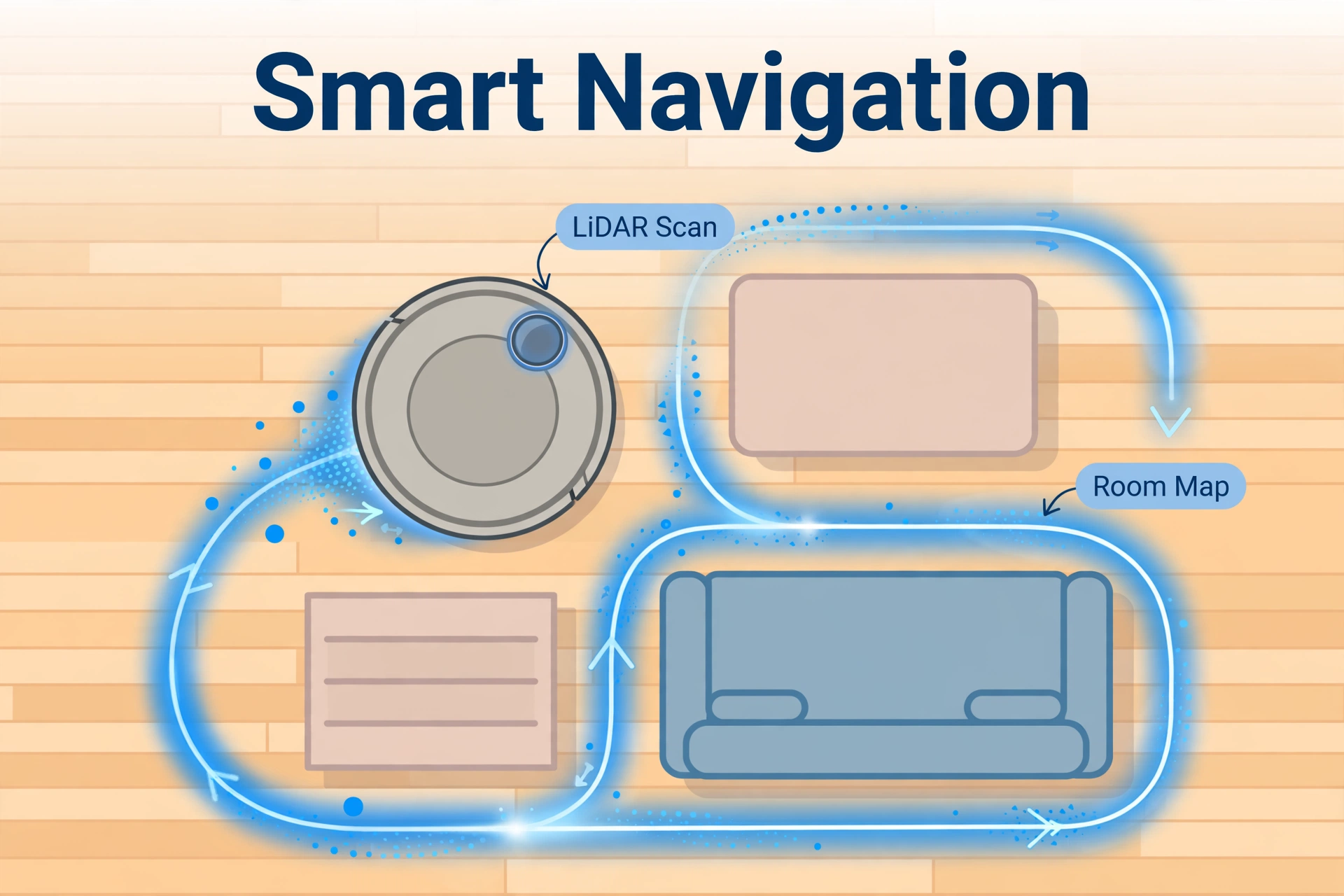
Both robots map your home, but they see it differently. Roborock’s LiDAR turret spins and measures the room with lasers, building an accurate map fast — even in pitch darkness, since lasers don’t need light. The structured-light sensors up front detect shoes, cables, and furniture legs and route around them. LiDAR is fast, precise, and private.
Roomba’s PrecisionVision uses a camera plus sensors. It needs some light to see best, but the camera lets it identify objects by type — a sock, a cord, pet waste — rather than just as “unknown obstacle.” iRobot says mapping runs up to seven times faster than its older technology, and the app automatically labels rooms with up to 90% accuracy. In practice, both navigate well; Roborock maps slightly faster in the dark, Roomba identifies what it’s avoiding more precisely.
For multi-floor homes, both save multiple maps. Both handle virtual barriers and no-go zones. If you run cleanings at night with the lights off, Roborock’s laser navigation has the edge. If your floors are an obstacle course of toys, cables, and pet gear, Roomba’s object recognition earns its keep.
Mopping Compared
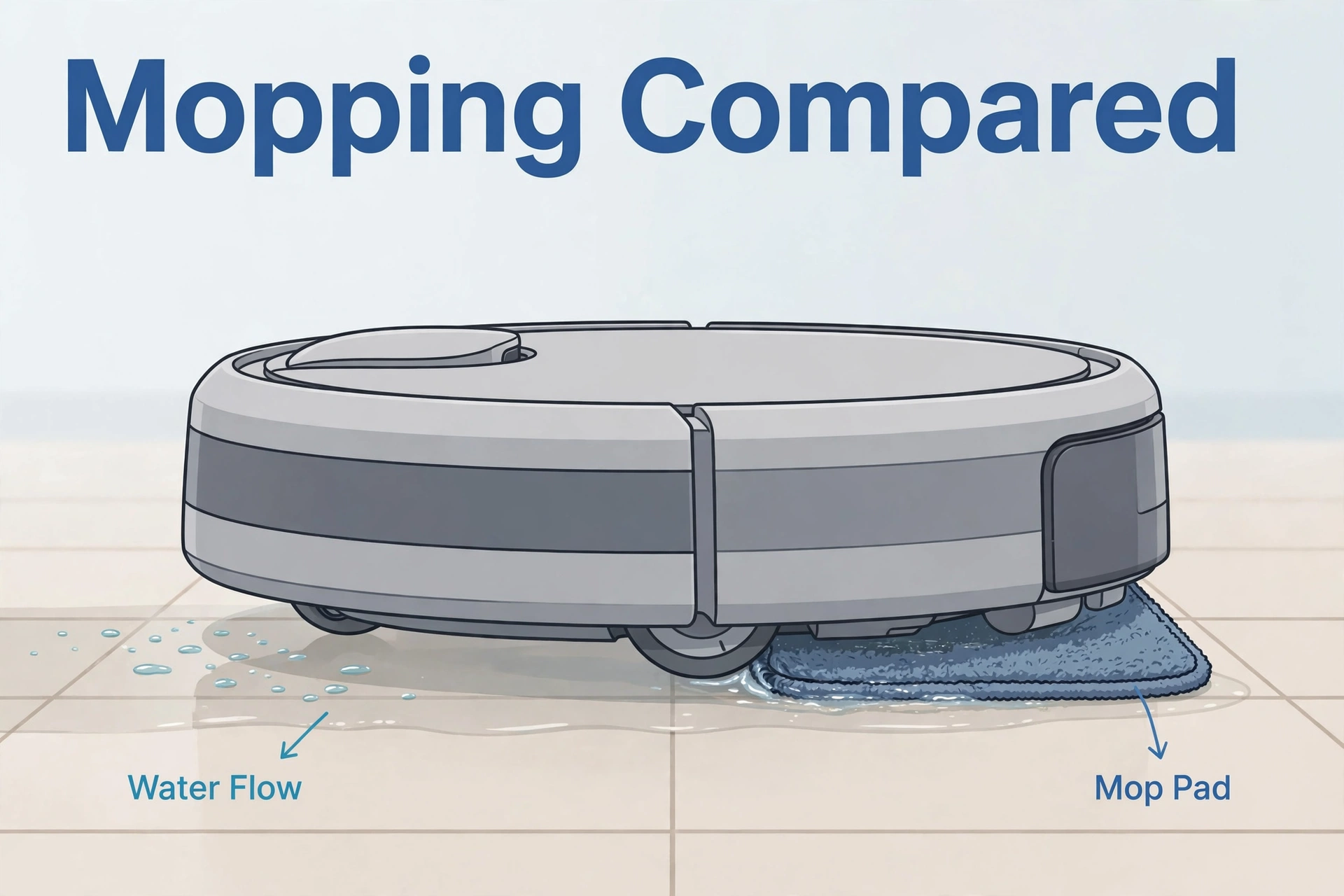
Here’s the honest breakdown of the two mopping philosophies.
Roborock mops harder. VibraRise 2.0’s 3,000 sonic scrubs per minute genuinely outperform a pad that just drags behind the robot. If your hard floors see real traffic — kitchen grease, hallway grime, dried spills — Roborock’s scrubbing does more of the work. The RockDock Ultra then washes and dries the pad, so the mop stays fresh between runs instead of turning into a dirty rag on wheels.
Roomba mops safer. Nothing in this price range keeps carpets drier than the fully retracting mop arm — the mop leaves the floor entirely instead of hovering just above it. SmartScrub’s back-and-forth motion with real downforce handles tough spots when you enable it for specific rooms. What Roomba won’t do is wash its own mop; you rinse the pad yourself, or swap in a fresh one (the dock conveniently stores spares).
So: mostly hard floors with serious mopping needs — Roborock. Mixed floors where carpet protection matters most — Roomba. Neither will replace a proper deep clean with a real mop, but both keep floors noticeably cleaner week to week.
App, Voice and Smart Home Integration
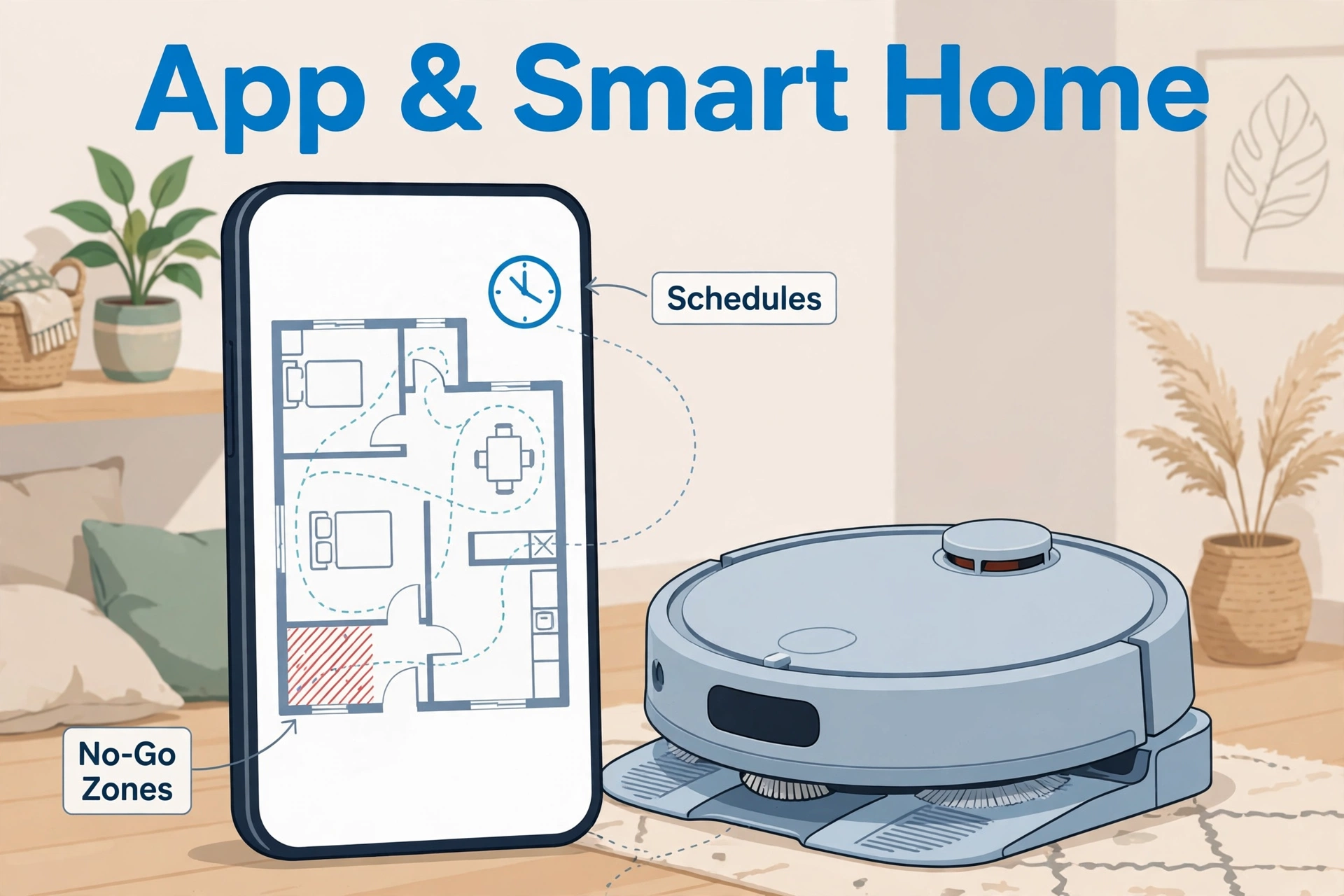
Both apps are mature. The Roborock app gives you more manual control — custom routines, per-room settings, map editing, and detailed cleaning history. The iRobot Home app is simpler and more guided; it leans on Dirt Detective and smart suggestions so you make fewer decisions. Power users prefer Roborock’s app; set-and-forget people prefer iRobot’s.
Voice control is a wash: both work with Alexa, Google Assistant, and Siri (via Siri Shortcuts on Roborock). You can say “clean the kitchen” and either robot handles room-targeted commands. If voice privacy matters to you, read our guide to the best offline voice assistant for options that keep commands inside your home instead of the cloud.
For Home Assistant users, Roborock has the friendlier story: a well-maintained community integration, granular control over rooms and settings, and no camera onboard for the privacy-conscious. Roomba integrates too, but iRobot’s cloud-dependent approach makes it the less tinkerer-friendly of the two. If you’re building a local-first setup, start with our Home Assistant on Raspberry Pi 5 guide and pair the vacuum with room-level automations.
One automation worth copying: use a presence sensor to trigger cleaning only when nobody’s home. Our roundup of the best presence sensors for Home Assistant covers mmWave options that detect you reliably — and if you’re deciding between sensor types, our mmWave vs PIR comparison explains which one suits a “clean while away” routine.
Price and Value
Prices below are US prices checked on 2026-10-02. Robot vacuum prices swing hard with sales, so re-check before you buy.
The Roomba Combo j9+ lists at $1,399.99 on iRobot’s official store, and it’s the simpler value story: one flagship price, frequently discounted during sale events. The vacuum-only Roomba j9+ sits lower at $899 list for homes that don’t need mopping.
The Roborock S8 Pro Ultra launched at $1,599.99 — the more expensive flagship on paper. But Roborock discounts aggressively, and street prices have dropped well below list at various points, so the real-world gap is often smaller than the MSRPs suggest. Always compare the current sale price, not the launch price.
Budget shoppers should know both brands have cheaper lines. Roborock’s Q series and Roomba’s mid-range Combo models cover the core vacuum-and-mop experience for much less, minus the self-washing docks and flagship navigation. If you’re buying your first robot vacuum, a mid-range model is often the smarter move — the flagships earn their price mainly through automation (self-emptying, mop washing) rather than dramatically better daily cleaning.
Who Should Buy Which
Buy Roborock if…
- Your floors are mostly hard — tile, wood, or laminate — and mopping quality matters.
- You want the most hands-off dock: auto-empty, mop wash, mop dry, and water refill.
- You prefer a camera-free robot for privacy, or you clean in the dark.
- You like fine-grained control in the app and tinker with Home Assistant.
Buy Roomba if…
- Your home is mostly carpeted with some hard floors, and keeping rugs dry is non-negotiable.
- You have pets — obstacle avoidance with a written pet-waste guarantee matters.
- You want the robot to plan its own cleaning strategy with Dirt Detective.
- You prefer a simpler app and the longest-running brand in the business.
Roborock vs Roomba FAQs
Which is better for pet hair, Roborock or Roomba?
Both handle pet hair well thanks to rubber roller brushes that resist tangles. Roborock’s higher suction (6,000 Pa on the S8 Pro Ultra) gives it an edge pulling hair from deep carpet. Roomba counters with better avoidance of pet-related obstacles and the P.O.O.P. guarantee — if avoiding pet accidents matters more than raw suction, Roomba wins that trade.
Can both vacuum and mop in a single run?
Yes. Both the Roborock S8 Pro Ultra and the Roomba Combo j9+ vacuum and mop simultaneously on hard floors, and both lift or retract the mop on carpet. Roborock lifts the mop pad; Roomba retracts the entire mop arm to the top of the robot, which keeps carpets drier.
Do Roborock and Roomba need Wi-Fi to work?
Both need Wi-Fi and their apps for the full experience — mapping, scheduling, room targeting, and software updates. Both can do a basic spot clean with the button on the robot without Wi-Fi, but you’ll lose everything that makes a smart robot smart. They only support 2.4GHz Wi-Fi networks.
Which app is better?
The Roborock app offers deeper manual control: per-room suction and water flow, custom routines, detailed maps, and multi-floor management. The iRobot Home app is simpler and more automated, built around Dirt Detective’s smart scheduling. Tinkerers prefer Roborock’s; hands-off owners prefer iRobot’s.
Which is cheaper, Roborock or Roomba?
At the flagship level, the Roomba Combo j9+ ($1,399.99 official) undercuts the Roborock S8 Pro Ultra’s $1,599.99 launch price — but Roborock discounts deeply, so compare live prices. Both brands also sell cheaper mid-range models that skip the self-washing docks. Check current prices on the official Roomba Combo j9+ page and Roborock’s official S8 lineup page before deciding.
The Bottom Line
There is no universal winner in roborock vs roomba — there’s only the right robot for your floors. Roborock is the cleaning-technology pick: stronger suction, harder scrubbing mops, a dock that does almost everything, and camera-free LiDAR navigation. Roomba is the intelligence pick: a mop that can’t wet your carpets, a brain that learns your dirtiest rooms, pet-waste avoidance with a written promise, and the simplest path to set-and-forget cleaning.
Match the robot to your home — hard floors and mopping lean Roborock, carpets and pets lean Roomba — and either way you’ll end up with one of the two best robot vacuum brands you can buy in 2026.
