

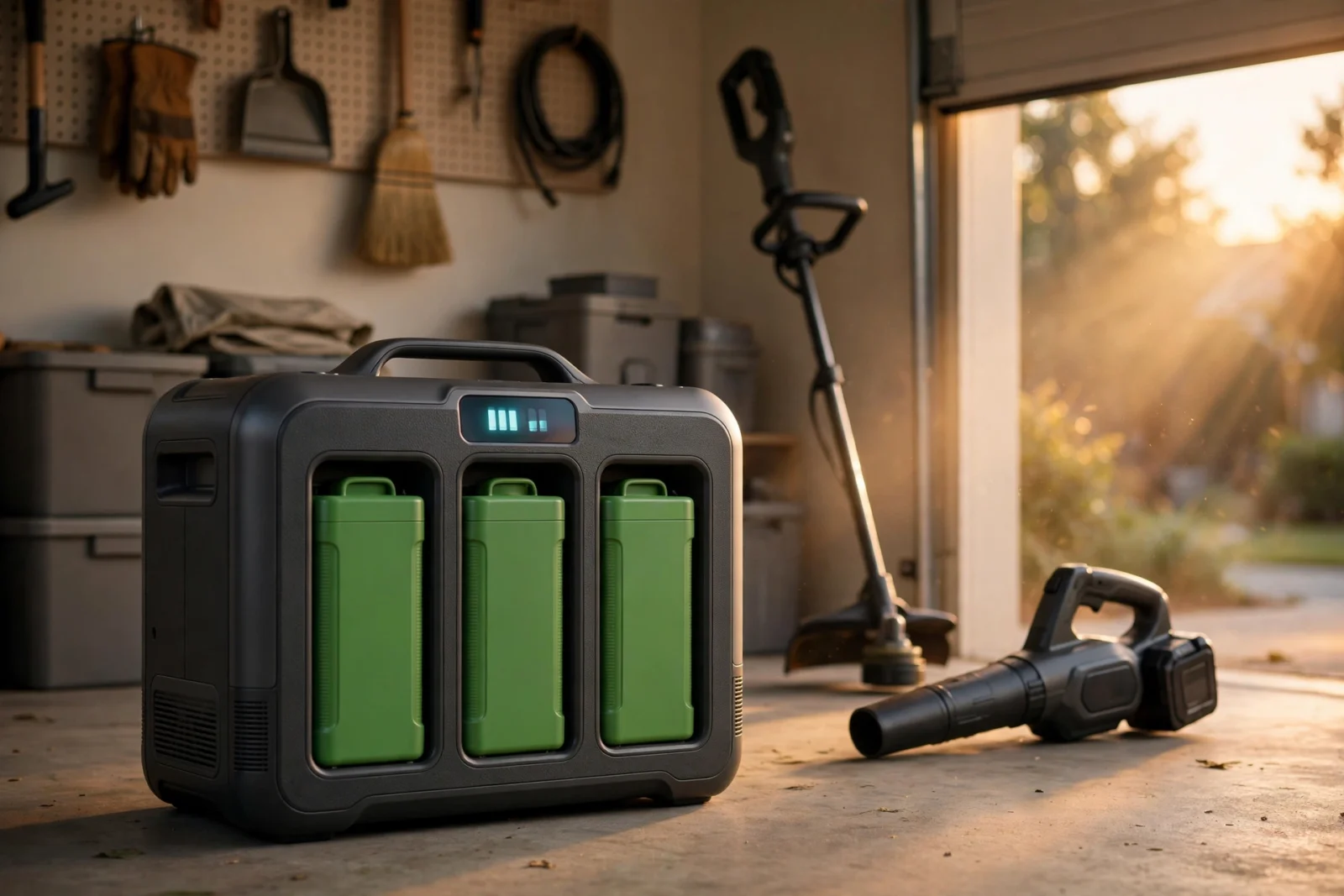
The EGO Nexus portable power station is EGO’s battery-powered alternative to a gas generator: 2,000W of continuous power (3,000W peak) from up to four EGO 56V ARC Lithium batteries, with three AC outlets, four USB ports, and pure sine wave output safe for sensitive electronics. If you already own EGO lawn tools, your batteries double as a home backup system — and if you are choosing between the full-size Nexus and the smaller 1400W model, this guide covers both. Here is the full breakdown — specs, real runtimes, honest comparisons, and who should buy it.
What Is the EGO Nexus Portable Power Station?
The EGO Nexus (model PST3042) is a portable inverter unit that turns EGO’s 56V tool batteries into household AC power. Instead of a built-in battery like Jackery or EcoFlow units, the Nexus has four battery bays — you slot in one to four EGO 56V ARC Lithium batteries and it converts their DC power into clean 120V AC.
It delivers 2,000 watts continuous and 3,000 watts peak, which covers refrigerators, microwaves, TVs, power tools, and most household essentials. It is quiet, produces no fumes, and is safe to run indoors — the three things gas generators cannot claim. And because it runs on the same batteries as EGO’s mowers and blowers, many buyers discover they already own half the system.
The recommended kit ships with the Nexus unit and two 7.5Ah batteries (about 420Wh combined), plus an inline charger. EGO also sells a smaller sibling, the Nexus 1400W (PST1405-2), with 1,400W continuous output for lighter needs.
EGO Nexus Key Specifications
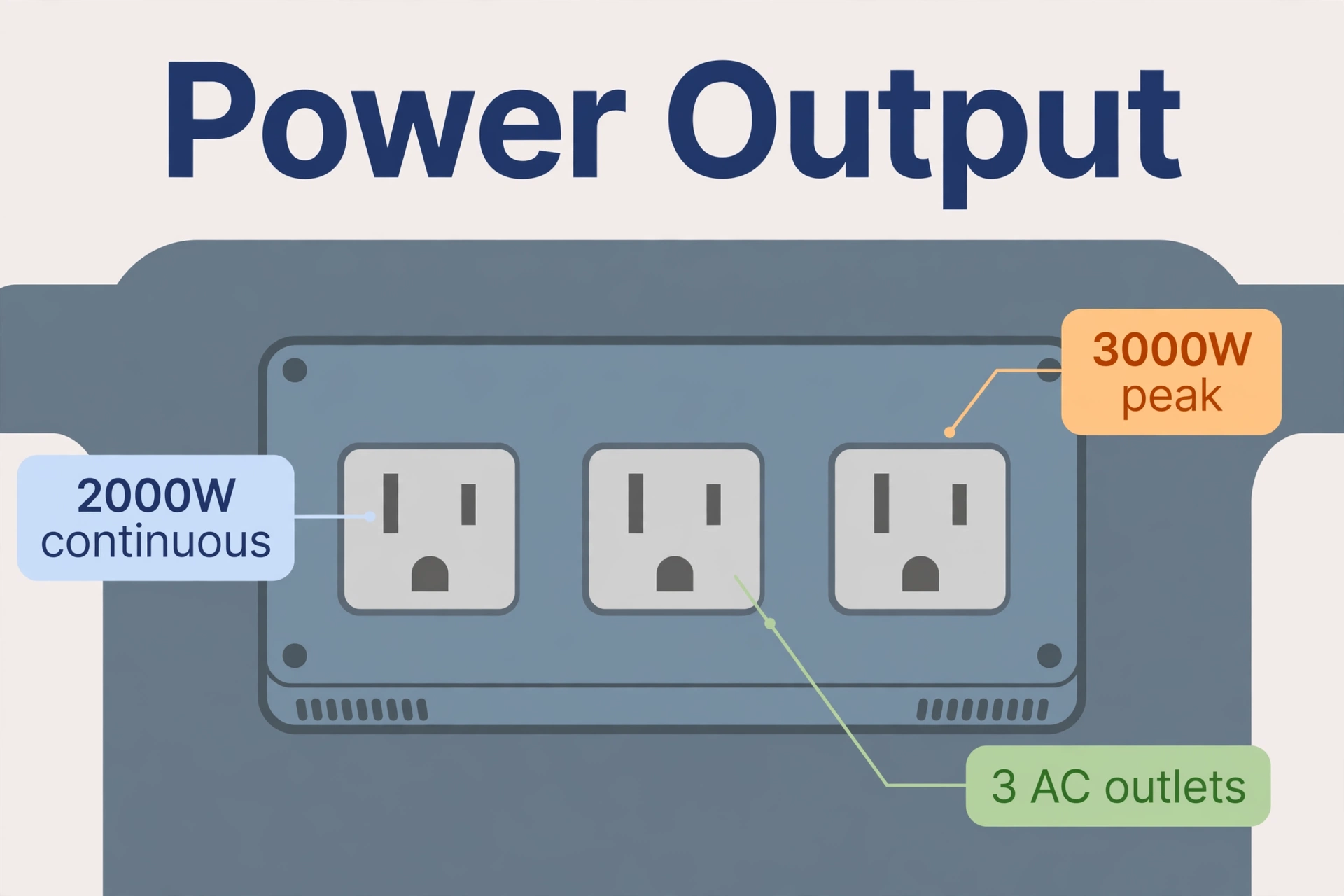
Table 1: EGO Nexus PST3042 specifications (from EGO’s official page)
| Specification | Value |
|---|---|
| Continuous output | 2,000W |
| Peak output | 3,000W |
| AC outlets | 3 × 120V |
| USB ports | 4 |
| Waveform | Pure sine wave |
| Battery bays | 4 (works with 1–4 EGO 56V batteries) |
| Included batteries (kit) | 2 × 7.5Ah ARC Lithium (~420Wh) |
| Warranty | 5-year tool / 3-year battery |
| Construction | Weather-resistant, steel handles |
| Display | LED runtime display |
Pure sine wave output deserves emphasis: it means the power is as clean as wall power, so laptops, routers, medical devices, and modern appliance electronics run safely. Cheap modified-sine inverters can damage or shorten the life of sensitive gear — and can make some devices buzz, overheat, or refuse to charge. For anything with a circuit board, pure sine wave is non-negotiable, and the Nexus delivers it.
EGO Nexus 1400W: The Smaller Sibling
EGO also sells a compact version, the Nexus 1400W (PST1405-2). It delivers 1,400W continuous and 2,100W peak — enough for TVs, laptops, lights, fans, and small kitchen appliances, though not full-size microwaves or power-hungry tools. The kit includes two 6.0Ah batteries.
Where the 1400W shines is charging flexibility: up to 900W wall charging, 200W solar input, and 100W USB-C PD with pass-through charging (power devices while the batteries charge). It also connects to the EGO Connect app for remote monitoring — outlet control, runtime estimates, and battery status from your phone.
Which to choose? Pick the PST3042 (2000W) for home backup covering fridges and microwaves. Pick the 1400W for camping, tailgating, and light emergency use where portability and faster charging matter more than raw output.
How the EGO Nexus Works
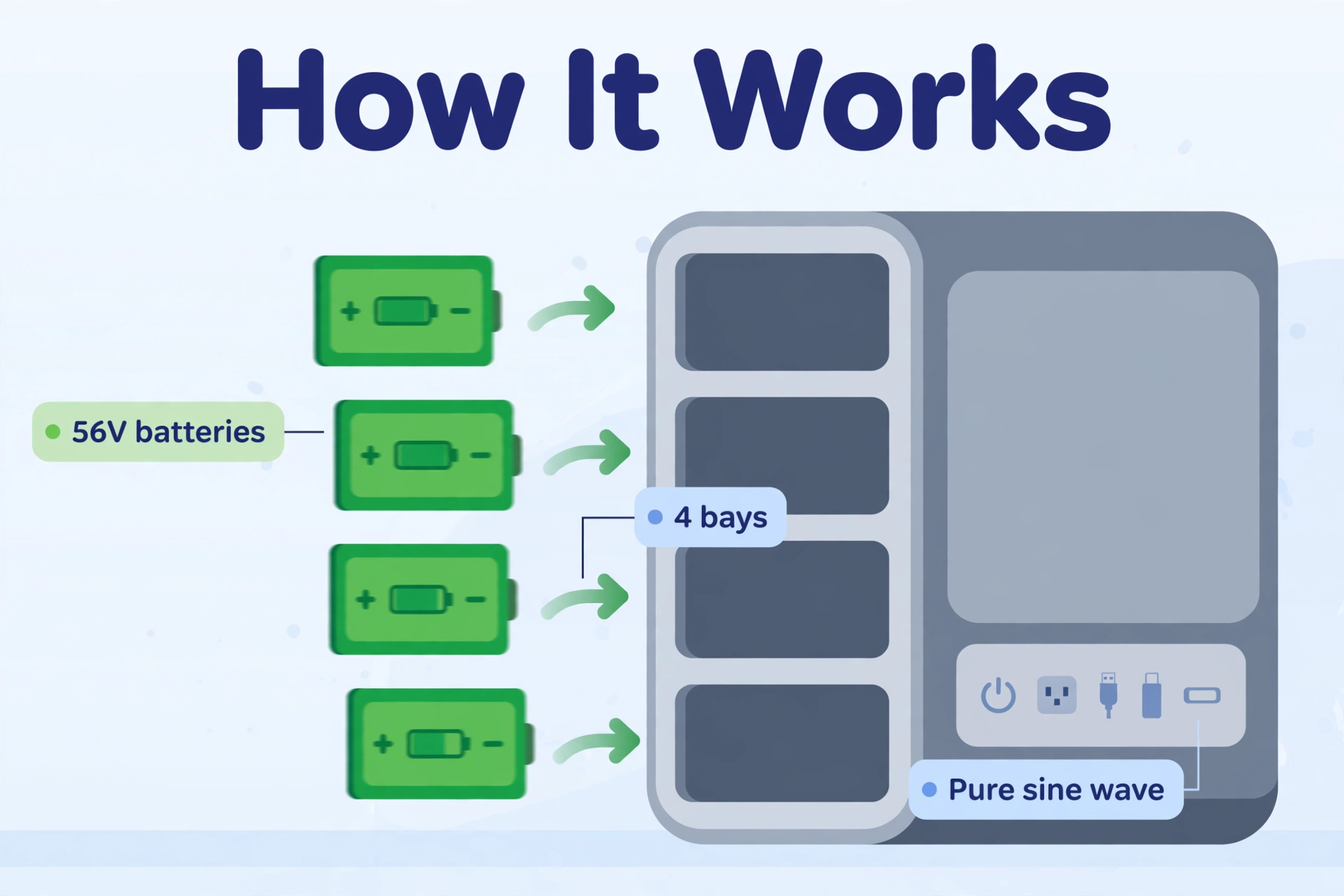
The concept is simple. EGO’s 56V ARC Lithium batteries — the same ones that run their mowers, blowers, and chainsaws — slide into the Nexus’s four bays. The unit’s inverter converts the battery DC into 120V AC for the three outlets, plus regulated USB power for phones and tablets.
You can run it on a single battery for light loads or fill all four bays for maximum runtime. More batteries = more watt-hours = longer runtime. The LED display shows remaining runtime, input/output wattage, and each battery’s status, so you always know where you stand.
When the grid is up, the Nexus doubles as a 4-port battery charger: plug it into the wall and it charges your EGO batteries while powering your devices. EGO’s newer Nexus 1400W even supports pass-through charging at up to 900W from the wall, 200W from solar, or 100W USB-C PD.
Charging the Nexus: All Your Options
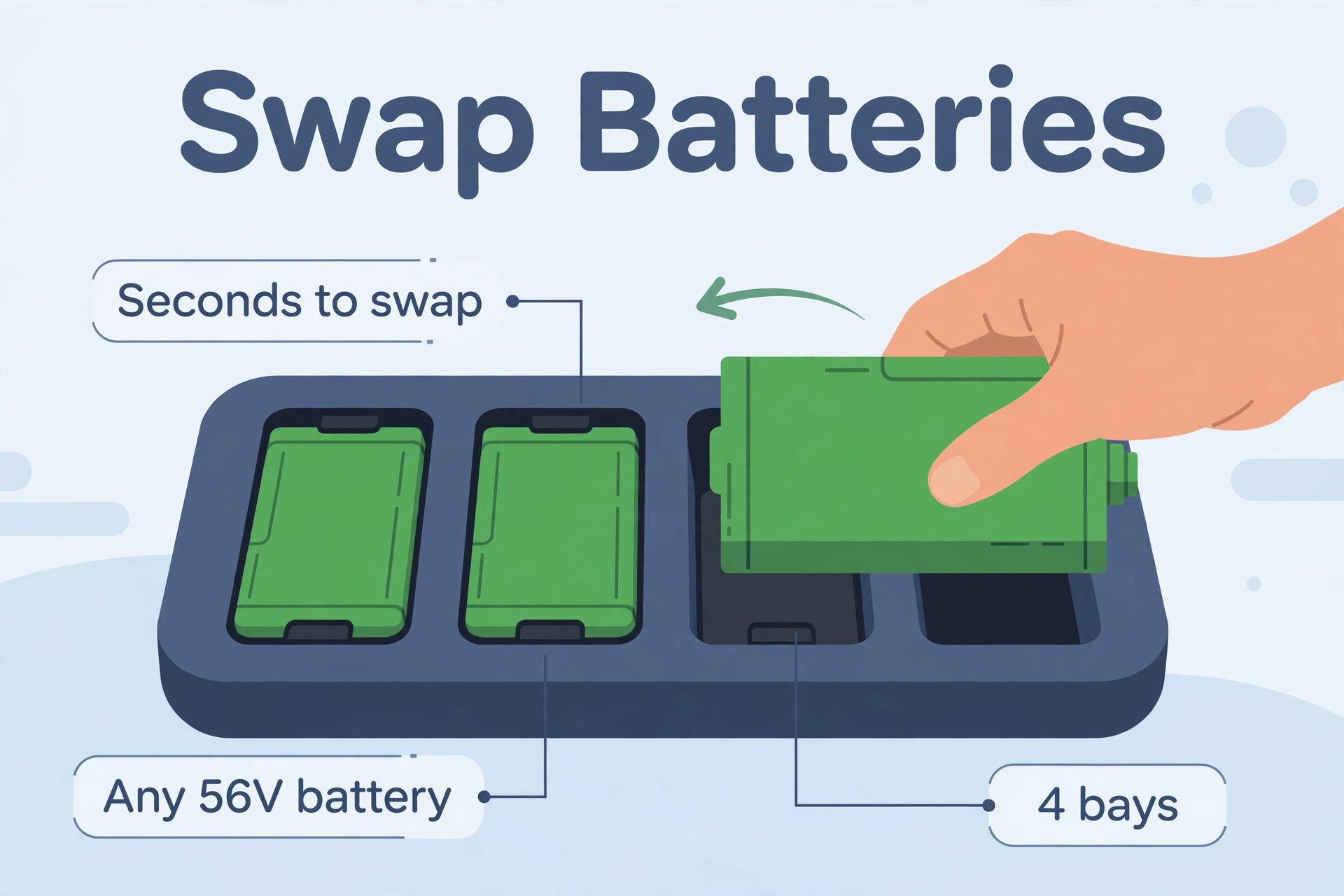
The Nexus is unusually flexible about recharging because the “battery” is really four removable packs:
- Wall charging: plug the Nexus into AC and it becomes a 4-port rapid charger for your EGO batteries while simultaneously powering connected devices.
- Individual battery chargers: charge batteries separately on EGO’s standalone chargers — handy if you own more batteries than bays.
- Solar: EGO’s 200W SP2000 panel trickle-charges the system during daylight (supported on the Nexus 1400W).
- Hot-swap: the fastest “recharge” is no recharge at all — pull depleted batteries and slot in fresh ones in seconds.
This modularity is the Nexus’s superpower in extended outages. While a conventional station sits tethered to a wall for hours, Nexus owners with a stack of charged batteries just keep swapping.
What Can the EGO Nexus Power? Real Runtimes
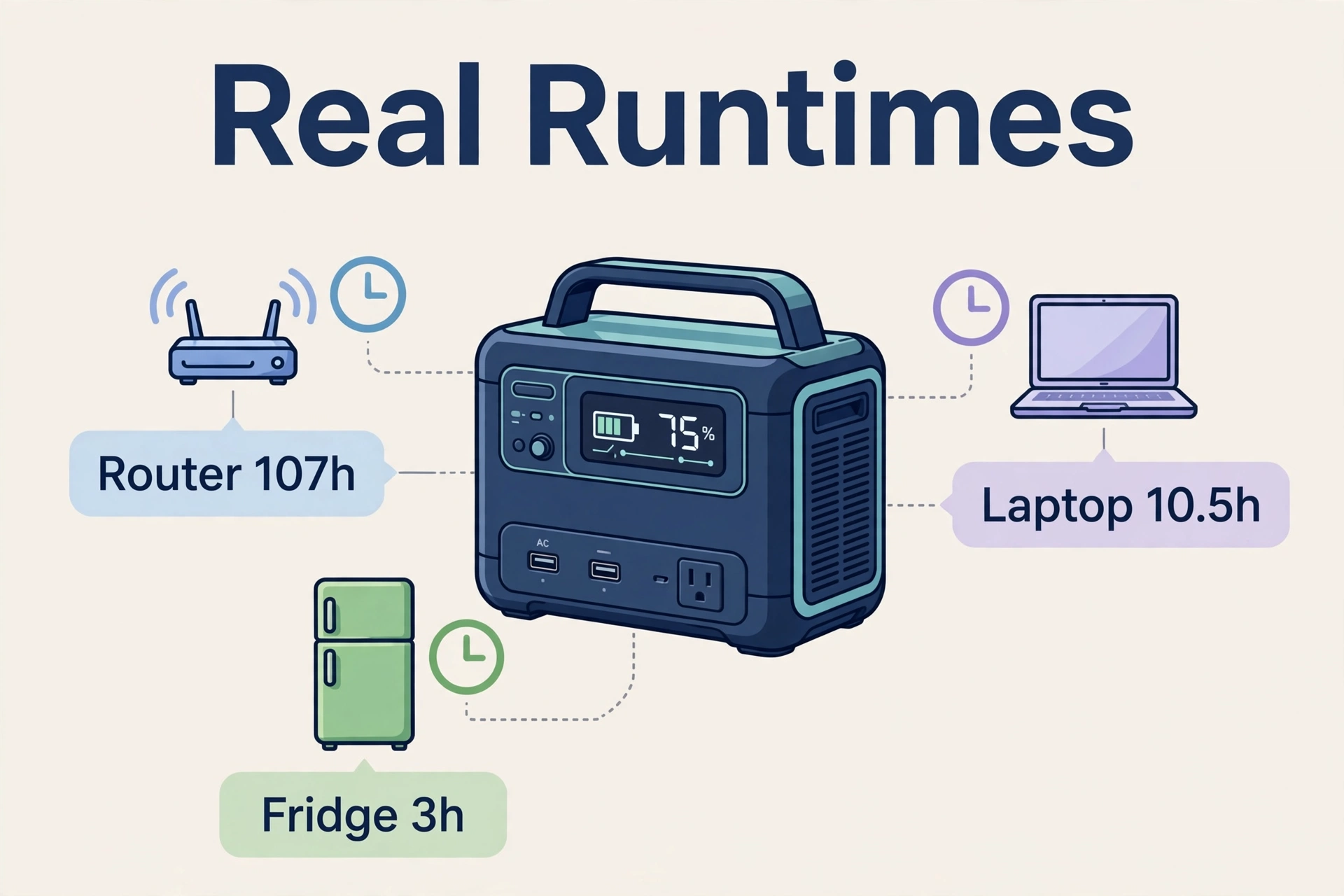
EGO publishes estimated runtimes for the PST3042 kit (with two 7.5Ah batteries). These are the official figures:
Table 2: EGO Nexus PST3042 estimated runtimes (official)
| Device | Estimated Runtime |
|---|---|
| Wi-Fi router | ~107 hours |
| Smartphone | ~53 recharges |
| Laptop | ~10.5 hours |
| Box fan | ~9 hours |
| 50-inch TV | ~4 hours |
| Full-size fridge | ~3 hours |
| Microwave | ~35 minutes |
| Coffee maker | ~45 minutes |
| Mini fridge | ~6 hours |
| Crock pot | ~5.3 hours |
The pattern is clear: low-draw electronics (router, phones, laptop) run for days; heating appliances (microwave, coffee maker) are measured in minutes. That 107-hour router figure is the smart-home headline — one Nexus kit keeps your internet and smart home hub alive for over four days. Add two more batteries and you extend everything proportionally.
EGO Nexus vs Gas Generator
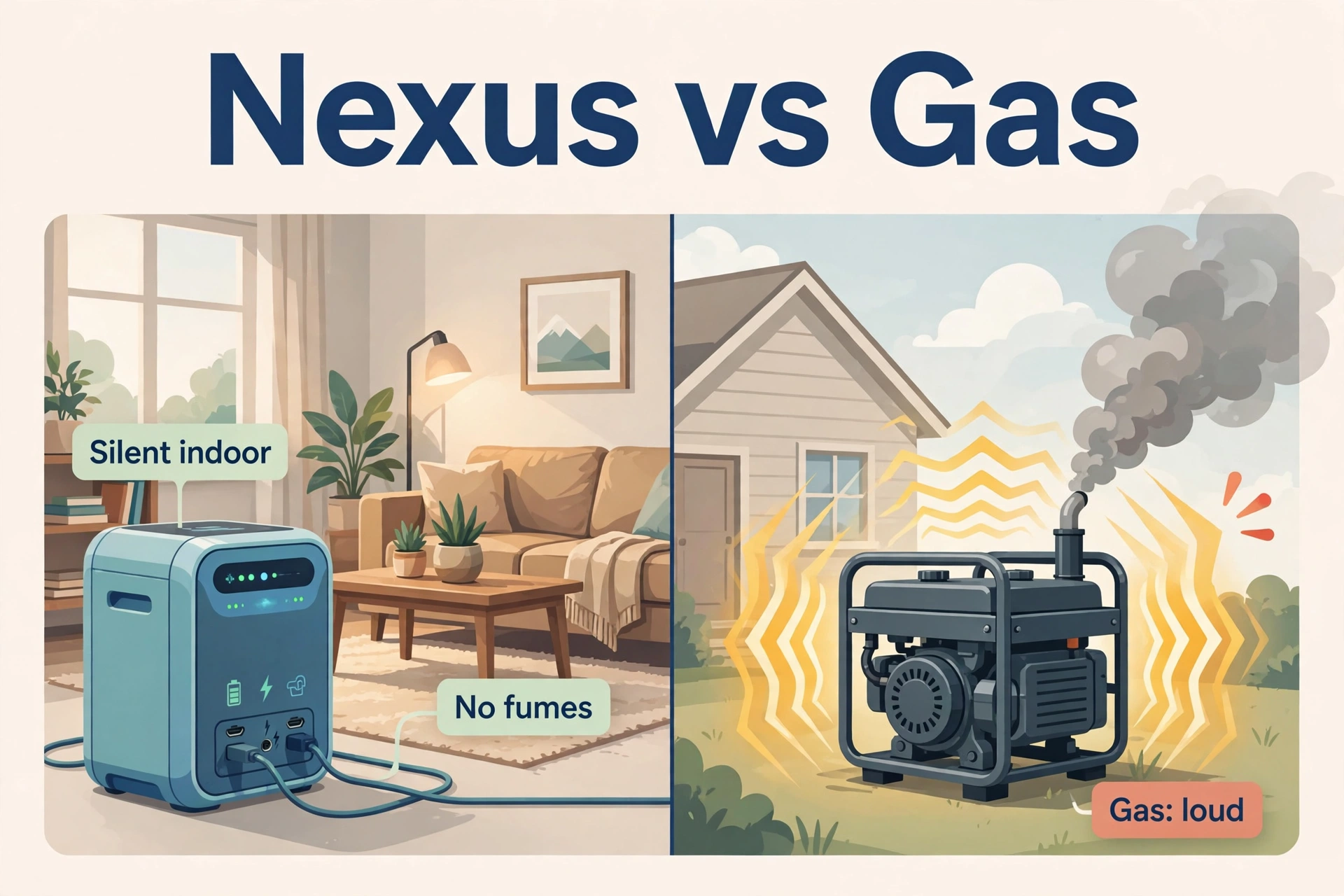
Table 3: Nexus vs a typical portable gas generator
| Feature | EGO Nexus | Gas Generator |
|---|---|---|
| Noise | Near-silent | Loud (65–75 dB) |
| Indoor use | Safe — no exhaust | Never — carbon monoxide |
| Fuel | Rechargeable batteries | Gasoline |
| Startup | Instant | Pull cord / electric start |
| Maintenance | Charge batteries | Oil, filters, fuel stabilizer |
| Runtime | Hours (add batteries to extend) | Hours to days (refuel) |
For short-to-medium outages, the Nexus wins on every convenience metric. A gas generator only pulls ahead on multi-day runtime where refueling beats recharging — and even then, EGO’s solar panel option (SP2000, 200W) can trickle-charge batteries during the day.
EGO Nexus vs Built-in Battery Power Stations
Here is the honest comparison against Jackery/EcoFlow-style stations:
Where the Nexus wins: swappable batteries. When a built-in station runs dry, you wait hours for a recharge. With the Nexus, you swap in fresh EGO batteries in seconds — if you own several. EGO tool owners effectively get a power station “free” since the batteries are the expensive part. The 5-year tool warranty is also among the longest in the industry.
Table 4: Nexus vs a typical 1kWh built-in power station
| Feature | EGO Nexus PST3042 | Typical 1kWh Station |
|---|---|---|
| Battery | Swappable EGO 56V packs | Built-in, non-removable |
| Capacity (kit) | ~420Wh (grows with batteries) | ~1,024Wh fixed |
| Fastest “recharge” | Seconds (swap batteries) | 1–2 hours (wall charging) |
| Continuous output | 2,000W | 1,500–1,800W |
| Ideal buyer | Already owns EGO tools | Starting from zero |
Where built-in stations win: energy per dollar for non-EGO owners. A 1,024Wh EcoFlow or Bluetti typically costs less than a Nexus plus enough EGO batteries to match that capacity, and charges faster from the wall. If you own zero EGO tools, the math favors a conventional power station.
The verdict: the Nexus is the best power station in the world for EGO battery owners, and a harder sell for everyone else. Count your existing EGO batteries before deciding.
Nexus Accessories Worth Considering
- Extra 56V batteries: the single best upgrade. Each additional 7.5Ah battery adds ~420Wh. Four batteries roughly double the kit runtime, and they work in all your other EGO tools too.
- SP2000 200W solar panel: EGO’s folding panel trickle-charges the system during daylight outages. Do not expect fast refills — treat it as runtime extension, not a primary charger.
- Nexus Escape inverters (180W/400W): smaller single-battery inverters for grab-and-go use — camping, tailgating, or powering a laptop in another room while the big Nexus stays put.
- Rapid chargers: EGO’s fast standalone chargers refill depleted batteries while the Nexus keeps running on the remaining ones — a continuous rotation during long outages.
Who Should (and Shouldn’t) Buy the EGO Nexus
Buy it if: you own two or more EGO 56V batteries (the math becomes unbeatable); you want swappable batteries for instant “recharging”; you need 2,000W of silent indoor-safe power; or you value the 5-year tool warranty.
Skip it if: you own zero EGO tools (a conventional 1kWh station gives more capacity per dollar); you need maximum wall-charging speed (built-in stations refill faster); or you want a single lightweight grab-and-go unit (the Nexus plus batteries is a two-trip carry).
Consider the 1400W instead if: your loads are light (camping, tailgating, office backup) and you prefer faster charging plus app control over maximum output.
Using the Nexus for Smart Home Backup
The Nexus fits a smart home outage plan perfectly. Its near-silent operation means it can sit in a utility room without driving you crazy, and pure sine wave output protects sensitive hubs and networking gear.
A practical setup: plug your router, Home Assistant hub, and camera NVR into the Nexus’s AC outlets. With the router sipping ~15W, the official 107-hour figure means your Home Assistant on Raspberry Pi 5 setup and internet stay alive for days — automations, notifications, and remote access keep working while the grid is down.
Pair it with security cameras with local storage so footage keeps recording without cloud access, and review our home security upgrade guide to layer your defenses. Outages are when security matters most — a silent backup that keeps cameras rolling is worth more than the loudest alarm.
Frequently Asked Questions
How many watts is the EGO Nexus power station?
The EGO Nexus PST3042 delivers 2,000 watts continuous and 3,000 watts peak. The smaller Nexus 1400W (PST1405-2) delivers 1,400 watts continuous and 2,100 watts peak. Both produce pure sine wave AC power.
How long will the EGO Nexus run a refrigerator?
EGO’s official estimate is about 3 hours for a full-size fridge with the standard two-battery kit. Adding more EGO 56V batteries extends runtime proportionally — four batteries roughly doubles it. Keep the fridge closed to stretch every watt-hour.
Can I use any EGO battery with the Nexus?
Yes. The Nexus works with all EGO 56V ARC Lithium batteries, from 2.5Ah to 12.0Ah, and you can mix capacities across the four bays. Larger amp-hour batteries simply provide longer runtimes.
Is the EGO Nexus safe to use indoors?
Yes. It is battery-powered with no engine, no exhaust, and no carbon monoxide risk, so indoor use is safe. EGO does advise against exposing it to rain or damp locations.
Can the EGO Nexus charge from solar panels?
The Nexus 1400W supports up to 200W solar charging, and EGO sells compatible panels such as the 200W SP2000. The original PST3042 charges via wall AC (it also functions as a 4-port battery charger when plugged in).
Is the EGO Nexus worth it if I don’t own EGO tools?
Probably not as a first choice. Without existing batteries you must buy the kit plus extra batteries, and a conventional 1kWh power station usually gives more capacity per dollar. The Nexus shines brightest for existing EGO owners whose batteries pull double duty.
Final Thoughts
The EGO Nexus portable power station is a clever, well-built machine: 2,000W of silent, fume-free, pure sine wave power running on batteries you may already own. For EGO tool owners it is arguably the smartest backup purchase available — your mower batteries become a multi-day smart home lifeline, and the swappable-battery design means you are never stuck waiting on a recharge. If you are starting from zero, a conventional 1kWh station likely gives you more energy per dollar — but count your EGO batteries first, because every pack you own tips the math further toward the Nexus. Check EGO’s official Nexus page for the latest kits and bundles, and size your outage plan around the 107-hour router figure: in a blackout, connectivity is everything.
