

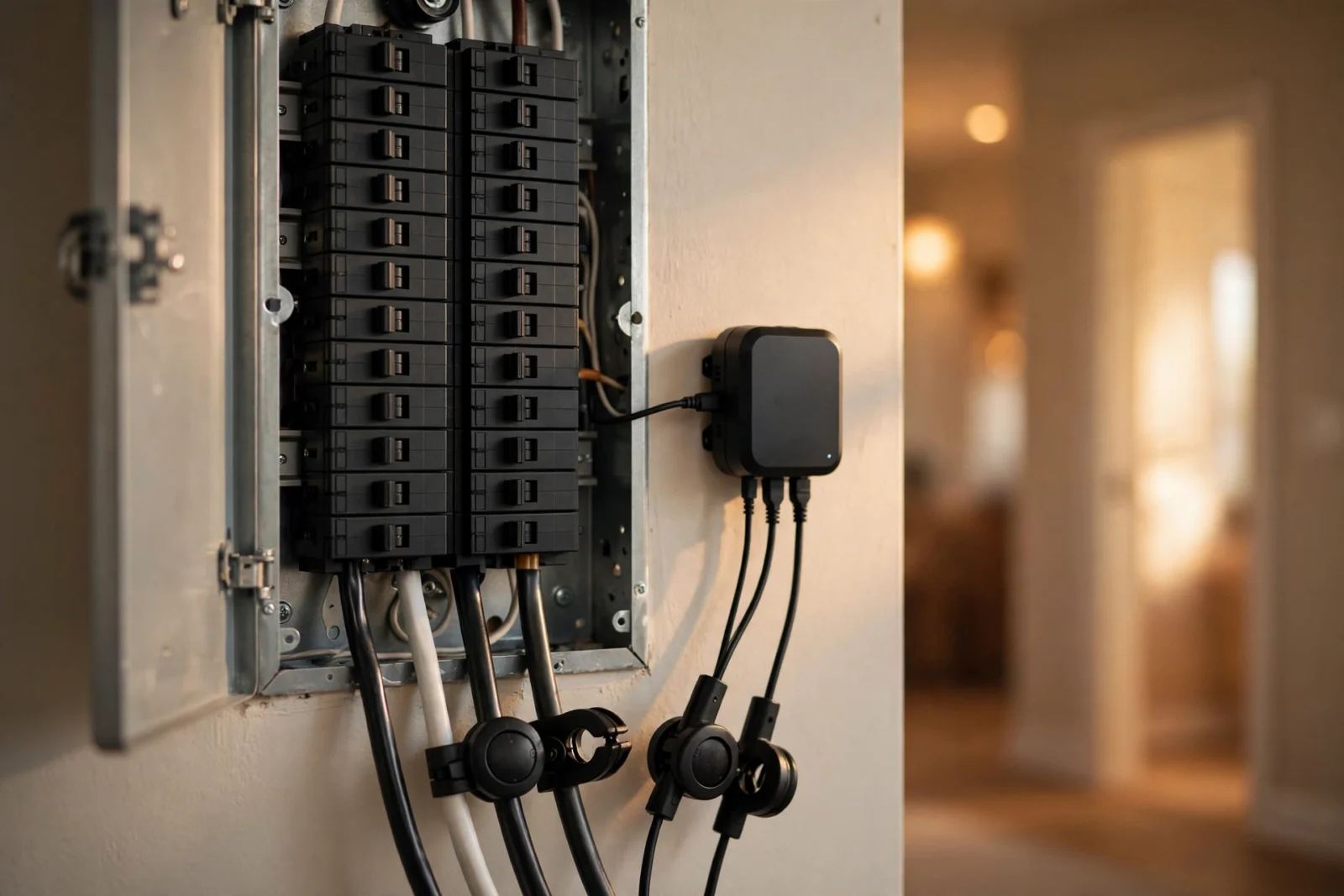
Pick the Emporia Vue 3 if you want per-circuit data and home automations at the lowest price — it is the only one of these two you can actually buy new in 2026. Sense, the former champion of this category, stopped selling consumer hardware on December 31, 2025 and pivoted to utility smart-meter software, so it is a legacy comparison point now, not a current buying option. That is the honest answer to the emporia vue vs sense question.
Neither approach was better in every home. This guide covers how each monitor worked, current Vue 3 pricing versus Sense’s historical pricing, detection, solar support, smart-home fit, and installation — plus a clear verdict at the end: what to buy now, and what to do if you already own a Sense. If you are still comparing options, our roundup of the best whole-home energy monitors puts the Vue 3 in context with the rest of the market.
Emporia Vue vs Sense at a Glance
The whole comparison on one screen. Emporia prices are current US figures checked on 2026-10-02 — re-check before buying, because Emporia runs sales. Sense prices are historical: Sense stopped selling consumer hardware on December 31, 2025, so those figures are what the lineup cost, not what you can buy today.
| Feature | Emporia Vue 3 | Sense |
|---|---|---|
| Core approach | CT clamps on up to 16 individual circuits — you see each circuit by name | Machine learning on your mains — it detects devices by their power signatures |
| Starting price | $199.99 for the 16-sensor kit on Emporia’s official store (current, verified 2026-10-02) | $299 for the base Sense monitor (historical — no longer sold new) |
| Solar version | Supported on all kits (net metering built in) | Sense Solar: $349 (historical — no longer sold new) |
| Dedicated-circuit option | Up to 16 circuits included in the 16-sensor kit | Sense Flex: $349 (historical — no longer sold new); flex sensors were $50 as an add-on |
| Measurement speed | 1-second readings, rated ±2% accuracy | Real-time sampling; samples mains millions of times per second for detection |
| Subscription | None — app is free | None — app is free |
| Automation | Yes — time-of-use, peak demand, excess solar automations; works with Emporia smart plugs | Limited — alerts and integrations, no built-in device control |
| Smart home | Alexa, Google Assistant; Home Connect appliance integration (Bosch, Siemens, Thermador); local API options for tinkerers | Alexa, Google Assistant; works with select smart plugs to fill detection gaps |
| Safety certification | UL listed | ETL/Intertek certified for in-panel installation |
| Availability | Built for North American panels; check your panel type before ordering | Discontinued — no new units sold after December 31, 2025 (was US/Canada only) |
| Best for | Hands-on owners who want exact per-circuit numbers and automations | Existing Sense owners comparing what they have against a modern per-circuit monitor |
How Each Monitor Works
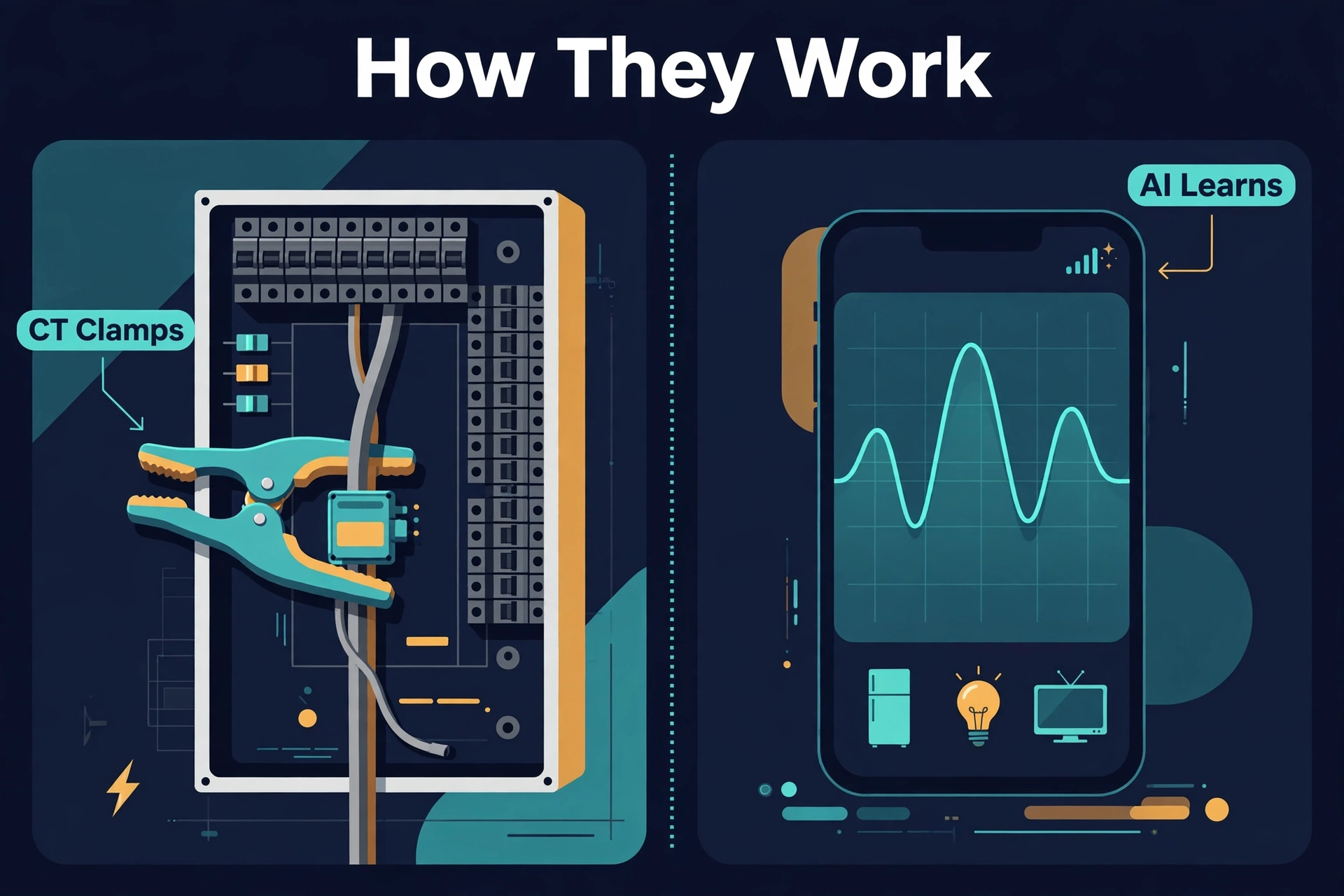
The two products look similar in the box — a small hub, clamp sensors, an app — but what happens after installation is completely different.
- Emporia Vue 3: you clip current-transformer (CT) sensors around your mains and around up to 16 individual branch circuits. From minute one, the app shows each circuit by the name you gave it: “HVAC,” “water heater,” “EV charger.” There is no learning period because the monitor measures each wire directly.
- Sense: you clip two sensors around your mains and nothing else. Sense’s machine learning studies the electrical noise on those mains and gradually learns to tell devices apart — the fridge’s compressor has a different signature than the toaster’s heating element. Devices appear in the app over days and weeks as the algorithm gains confidence.
That difference shapes everything else. Emporia gives you complete data on day one but asks for more work at the panel. Sense installs in minutes — two clamps and you are done — but you wait for detection, and some devices never get identified.
Detection: Exact Circuits vs Learned Devices
Emporia’s circuit-level approach is exact by construction. If you put a sensor on the water-heater breaker, every watt on that line is your water heater — no guessing, no “unidentified heat source” entries. When your bill spikes, you can point at the culprit in seconds. The trade-off is appliance-level granularity: if your kitchen circuit feeds the fridge, the microwave, and the toaster, Emporia shows one combined “kitchen” number. You can add sensors to split circuits, but only up to 16.
Sense’s machine-learning approach was more magical when it worked. Without touching a single branch circuit, it could tell you the garage freezer cycled 14 times today and the dryer ran for 52 minutes. Simple resistive loads (space heaters, toasters) and basic motors typically got detected within the first week or two, while always-on electronics, variable-speed inverter devices, and rarely-run devices could take much longer — or never get a clean signature. Sense knew this, which is why it supported select smart plugs: put a stubborn device on a smart plug and Sense counted its usage exactly.
Practically speaking: if your main question is “which circuit is eating my bill,” Emporia answers it on day one. If you already own a Sense and love its device-level detection, you understand its appeal — with the honest caveat that detection was always probabilistic, not guaranteed.
Emporia Vue 3: Price and What Is Included
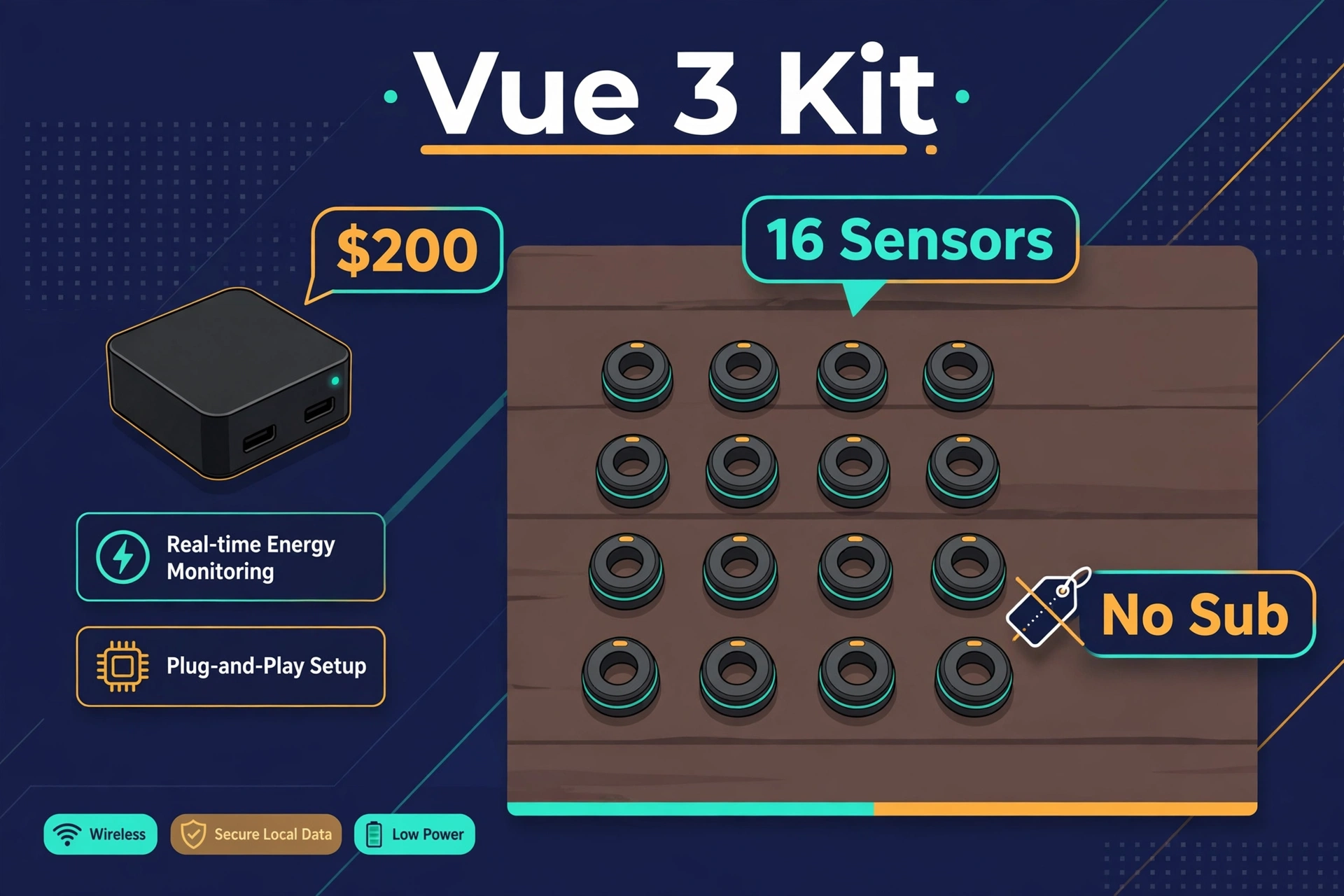
The Vue 3 is the current generation, and it is aggressively priced. On Emporia’s official store (checked 2026-10-02):
- Vue 3, 16-sensor kit — $199.99. The full package: monitor, mains sensors, and 16 branch-circuit CTs.
- Vue 3 with flexible sensors (16 sensors, 2-phase) — $279.99. Larger flexible CTs for tight or awkward panels.
- Vue 3 + 4-pack of Emporia smart plugs — $229.98. Pairs circuit monitoring with plug-level control for automations.
- At launch, Emporia also offered a whole-home-only kit from $99 and an 8-sensor kit at $149 — worth checking if you only care about a few circuits.
What you get for that money: 1-second data resolution, ±2% stated accuracy, UL listing, 2.4 GHz Wi-Fi connectivity, a free iOS/Android/web app with no subscription, and solar/net-metering support on every kit. The Vue 3 also consolidated the sensor ports to one side, added DIN-rail mounting, and simplified onboarding with QR codes.
Sense: Historical Pricing and What Owners Got
Heads-up: Sense stopped selling consumer hardware on December 31, 2025. Existing owners are still supported — Sense promised continued app and firmware updates, detection improvements, and security patches — but no new units are being made. The pricing below is therefore historical: what the lineup cost, useful for existing owners weighing an upgrade, not something you can order today. We keep this section because thousands of homes still have a Sense in their panel, and the comparison only makes sense with the full picture.
Sense cost more up front than the Vue 3, and the lineup had a few branches:
- Sense Home Energy Monitor — $299. The base unit for non-solar homes: mains sensors, real-time app, device detection.
- Sense Solar — $349. Added a second sensor set for solar production monitoring.
- Sense Flex — $349. Combined the monitor with flex sensors: mains plus one extra job — dedicated-circuit monitoring, generator support, or a 400A split-service setup. (One extra job at a time; it could not do all three simultaneously.)
- Flex sensors as an add-on — $50. For base-monitor owners who later wanted dedicated-circuit or generator tracking.
Sense’s app was free with no subscription, and it supported time-of-use rate plans so costs reflected the actual tariff. The hardware is ETL/Intertek certified for installation inside the panel. One hard limitation, even when it was sold: Sense stated its monitor was not available or compatible outside the United States and Canada.
Sense’s own site cites 4–8% average annual energy savings across users; Emporia’s marketing claims 10% or more. Both are manufacturer averages, not promises — your results depend on what you find and what you actually change.
App, Alerts, and Automations
Both apps show real-time usage, history by minute/hour/day, and per-device or per-circuit breakdowns. The difference is what you can do with the data.
Emporia leans into automation: time-of-use rules (run the EV charger when rates drop), peak-demand thresholds (shed load near your limit), and excess-solar diversion (heat water with sunshine instead of exporting it). Pair the Vue with Emporia smart plugs or supported appliances and those rules become actions. It also integrates with Home Connect appliances (Bosch, Siemens, Thermador) and offers local API options for Home Assistant tinkerers.
Sense leaned into awareness. Its strength was notifications: custom alerts when the sump pump ran too long, when the well pump behaved oddly, or when the flat iron was still on. A stuck sump pump caught early could pay for the monitor. But Sense never switched devices on and off itself; for control you paired it with a separate smart-home platform.
Accuracy, Solar, and Smart-Home Fit
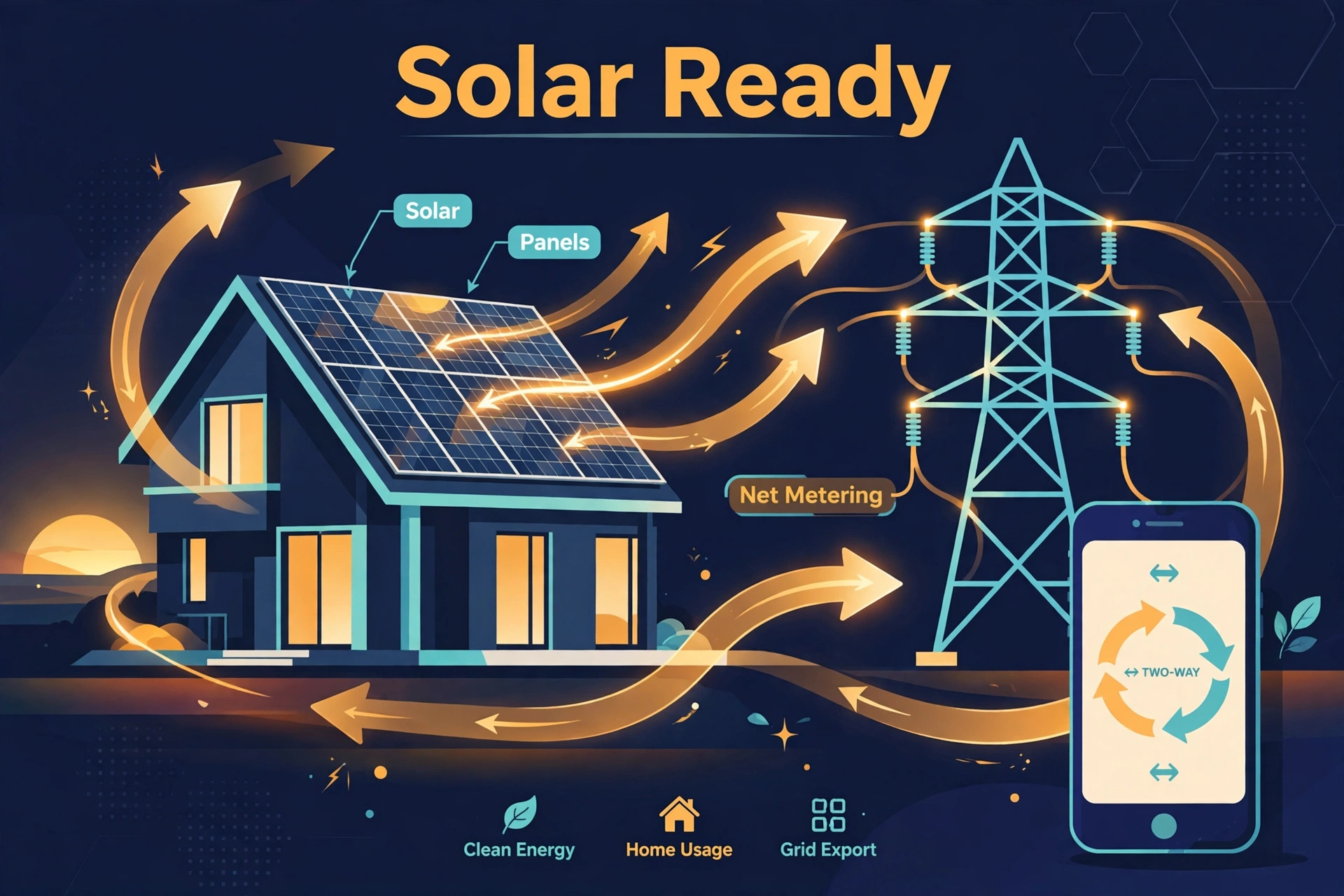
Solar and net metering
Every Emporia Vue 3 kit supports solar and net metering — the app shows production, consumption, and net flow. Sense owners used the Sense Solar bundle ($349, historical) for the extra solar sensor set; the base monitor was consumption-only.
Smart-home integrations
Both work with Alexa and Google Assistant for voice check-ins on usage. Emporia’s ecosystem play is control: smart plugs, the Vue’s automation engine, and Home Connect appliance integration, plus local API options for Home Assistant. Sense’s ecosystem play was detection support: integrations with select smart plugs let you hand it exact data for devices its ML could not identify.
For HVAC-heavy homes, energy data pairs naturally with thermostat control. If a big chunk of your usage turns out to be heating and cooling, our guides to the best smart thermostat for a heat pump and the Ecobee vs Nest comparison pick up where the monitor leaves off.
Installation: What to Expect
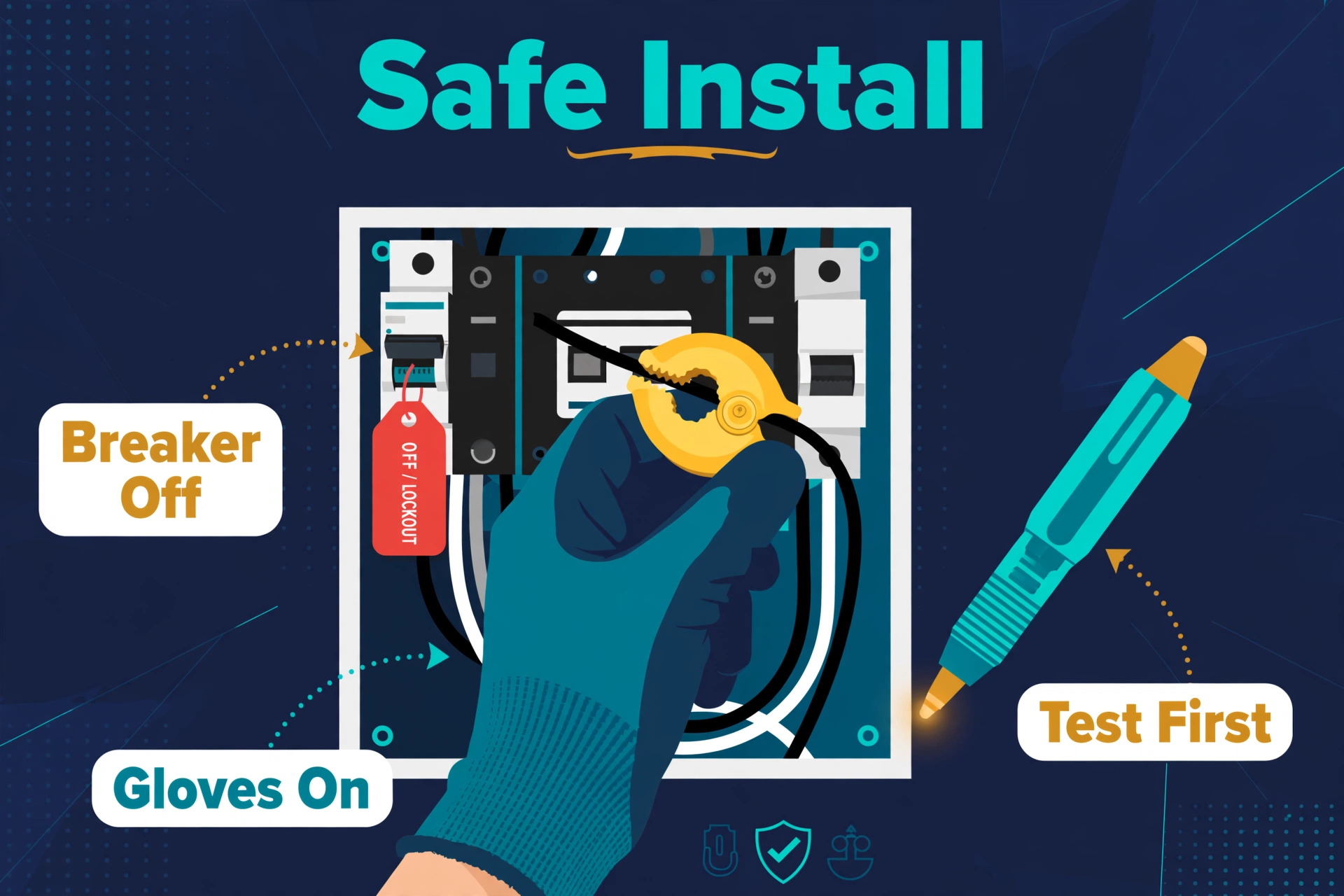
Both monitors install inside your electrical panel, near live components. The safe default is a licensed electrician — budget for an hour of their time. Confident DIYers do install these themselves, but if the inside of your panel makes you nervous, trust that instinct.
- Kill the main breaker (branch circuits go dead, but treat the incoming mains lugs as live regardless).
- Mount the monitor — the Vue 3 supports DIN-rail mounting; Sense mounts with its bracket near the panel.
- Clip the CT sensors around the mains (both brands), then around each branch circuit (Emporia) or the solar feed / dedicated circuit (Sense Solar / Flex).
- Connect power and Wi-Fi. Both need 2.4 GHz Wi-Fi reaching the panel — check signal strength at the panel location before you buy, because a dead zone there is a common gotcha.
- Set up the app: name your Emporia circuits, or let Sense begin its learning period.
Installation is where Sense earned back some of its price premium: two mains clamps versus up to sixteen branch clamps is a meaningfully easier afternoon. In a crowded panel, routing sixteen Emporia sensor leads without pinching anything takes genuine patience.
Pick Emporia Vue 3 If…
- You want exact numbers on day one, not a learning period.
- You have specific suspects — EV charger, water heater, pool pump, workshop — and want each on its own sensor.
- You want automations: time-of-use shifting, peak-demand shedding, excess-solar diversion.
- Budget matters: the 16-sensor kit costs $100 less than the base Sense.
- You tinker with Home Assistant and want local access to your energy data.
Still Own a Sense? Keep or Replace?
If you already have a Sense in your panel, there is no reason to rip it out tomorrow — existing owners are still supported, and its AI detection remains genuinely useful for device-level alerts. But with no new hardware coming, long-term support will wind down, and if the unit ever fails or you move house, you will be shopping for a replacement. The Vue 3 is the practical successor: exact per-circuit data on day one, no detection learning period, automations that act on the data — and $199.99 for the 16-sensor kit, less than Sense’s historical $299.
Should you buy a used Sense? Only at a low price that reflects the risk: no warranty, no guaranteed future support, no fallback if the hardware fails. For most shoppers in 2026, a new Vue 3 (or the Refoss EM16P for local-first privacy) is the safer money. Consider switching from a working Sense if you want exact day-one numbers, per-sensor visibility on big loads, time-of-use automations, or local Home Assistant access.
Emporia Vue vs Sense FAQs
Do I need an electrician to install an energy monitor?
Both monitors install inside your breaker panel, near live components. A licensed electrician is the safe default and the manufacturers’ recommendation. Many experienced DIYers self-install, but if you are unsure, hire it out — the install cost is small next to the price of a mistake.
Does Sense work outside the US?
It never did — Sense stated its monitor was not available or compatible outside the United States and Canada, and it stopped selling consumer hardware entirely on December 31, 2025. Emporia’s Vue kits are built around North American panel types, so check your panel configuration against the kit’s requirements before ordering.
Which is more accurate, Emporia Vue or Sense?
They measure accuracy differently. Emporia publishes a ±2% accuracy rating on 1-second readings, and because each sensor measures its circuit directly, the numbers are exact by construction. Sense never published a single accuracy figure, though owners reported its totals tracked utility bills closely. The practical difference was never the mains total — it was the breakdown: Emporia’s per-circuit numbers are measured, while Sense’s per-device numbers were inferred by machine learning.
Will an energy monitor lower my electric bill?
A monitor cannot lower your bill by itself — it shows you where the money goes, and you act on it. Treat manufacturer savings claims (Sense’s historical 4–8%, Emporia’s 10%+) as marketing, not guarantees. The households that save the most find one big, fixable load — a misbehaving water heater, a pool pump on the wrong schedule — and fix it. Before buying, run your own numbers through a smart thermostat savings calculator to see what realistic savings look like.
Which is better for a home with solar panels?
For new buyers, Emporia: every Vue 3 kit includes solar/net-metering support with no price step-up. For existing Sense owners, the Sense Solar bundle ($349, historical) added the solar sensor set; the base $299 monitor was consumption-only, and $50 flex sensors were the cheapest upgrade path.
The bottom line on emporia vue vs sense: in 2026 there is only one of the two you can buy — the Emporia Vue 3, which gives you the most data per dollar and automations that act on it. Sense was the pioneer and its AI detection was brilliant, but with hardware sales ended on December 31, 2025, it is now a legacy product: fine to keep if you already own one, not something to buy new. Either way, you will learn things about your home’s energy use that your utility bill never told you.
