

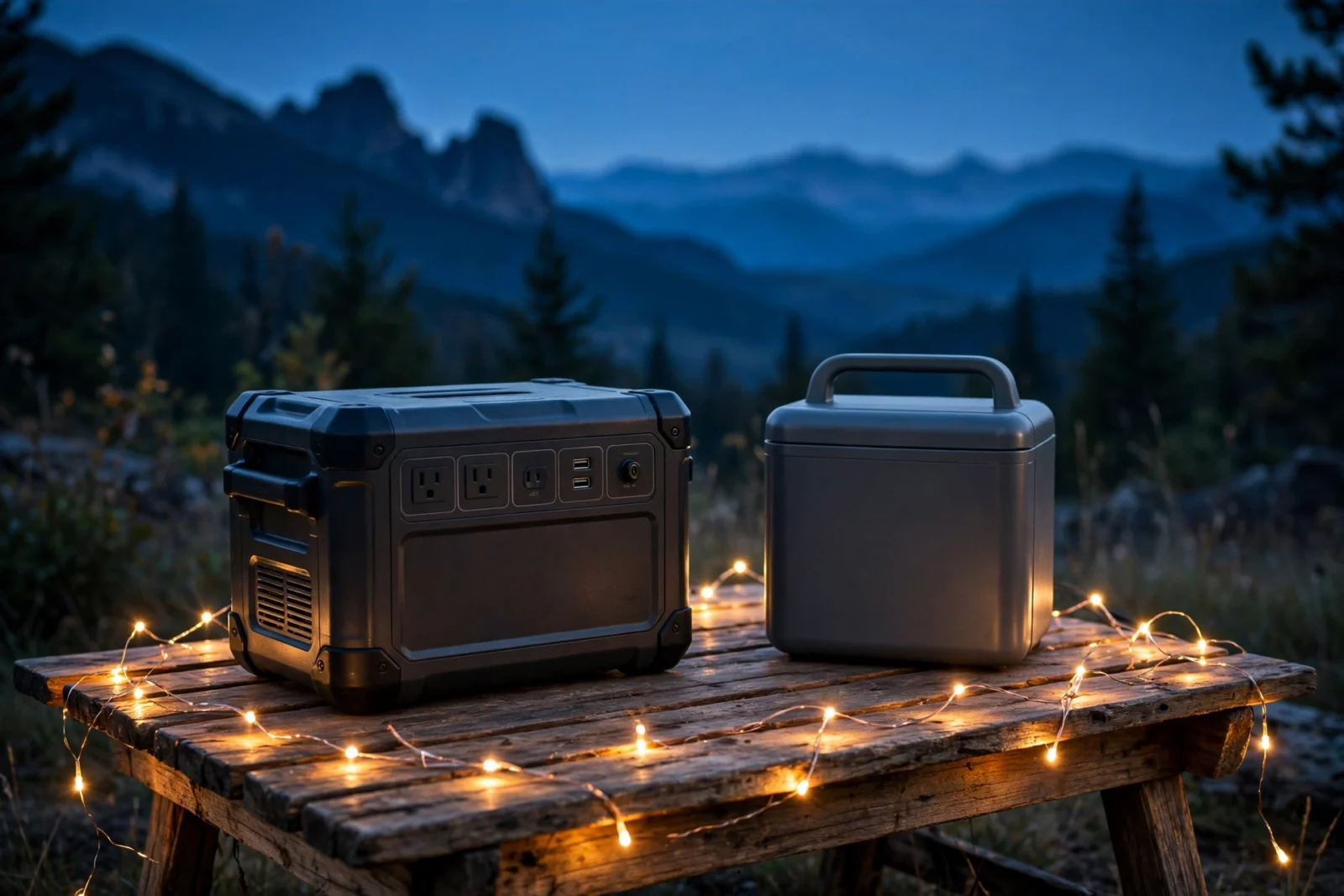
A portable power station 1000w hits the sweet spot for most buyers: it runs a 12V camping fridge, your laptop, phones, lights, and even a CPAP machine — all at once, in most cases. As a quick rule of thumb, a typical 1,000-watt station holds about 1,000 watt-hours of energy, which means it can power a 100-watt device for roughly 8–9 hours, or a 500-watt device for about 1.5–2 hours. It will not run heavy appliances like full-size air conditioners, electric heaters, or large microwaves for long. This guide shows you the simple runtime math, exactly what fits in a 1000W budget, and when you should size up to 2000W instead.
Watts vs Watt-Hours: The Two Numbers That Decide Everything
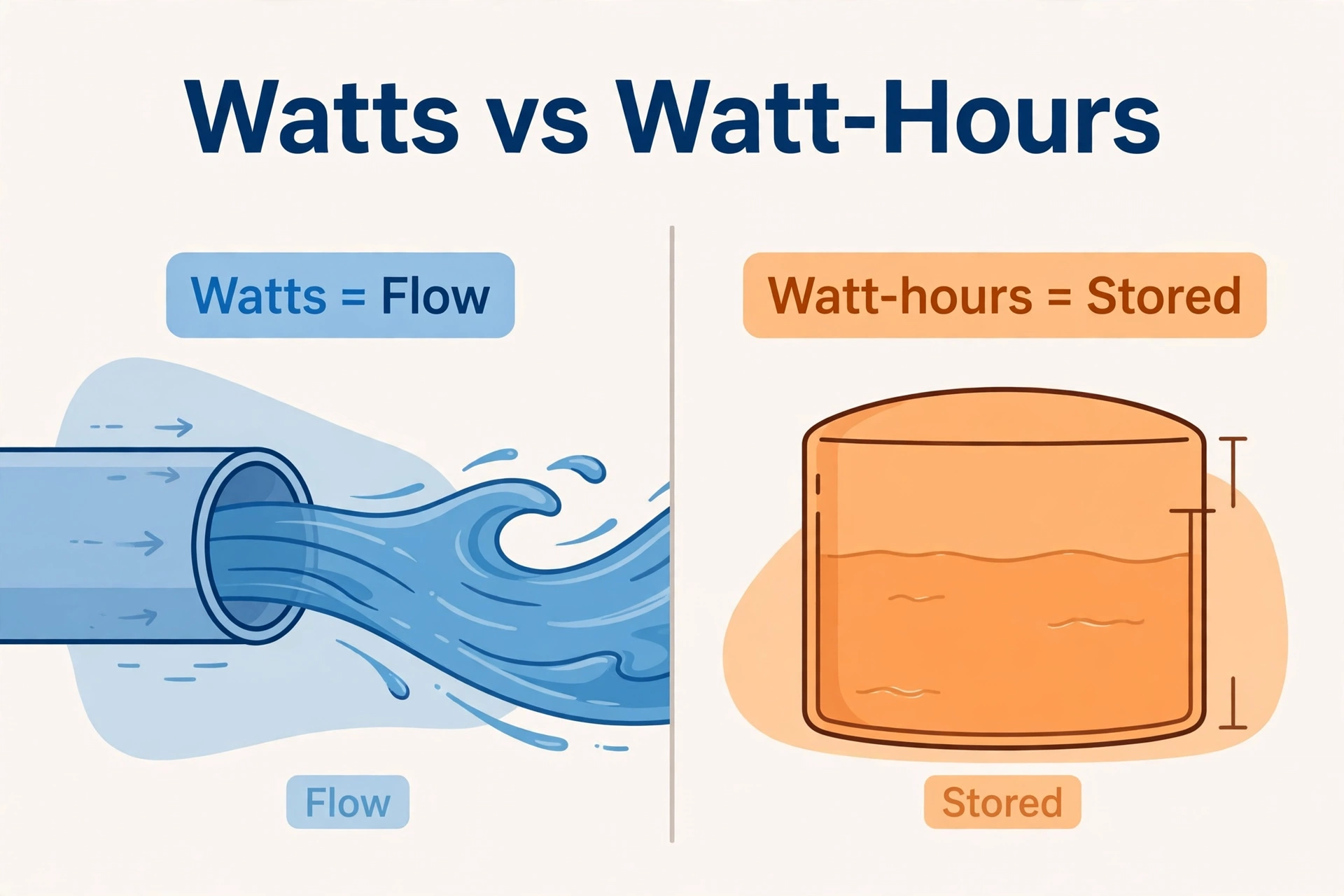
Every portable power station is sold with two headline numbers, and mixing them up is the most common buying mistake. Watts (W) measure how much power the station can deliver at any one moment — think of it as the size of the pipe. Watt-hours (Wh) measure how much total energy the battery holds — think of it as the size of the tank.
A “1000W portable power station” usually pairs a 1,000-watt inverter (the pipe) with a battery around 800–1,100 watt-hours (the tank). The inverter decides which devices you can run — a 1,400-watt hair dryer will trip a 1,000-watt inverter instantly, no matter how full the battery is. The battery decides how long everything runs. Both numbers matter, and you need both to be big enough for your plan.
The Runtime Formula: Do the Math in 60 Seconds
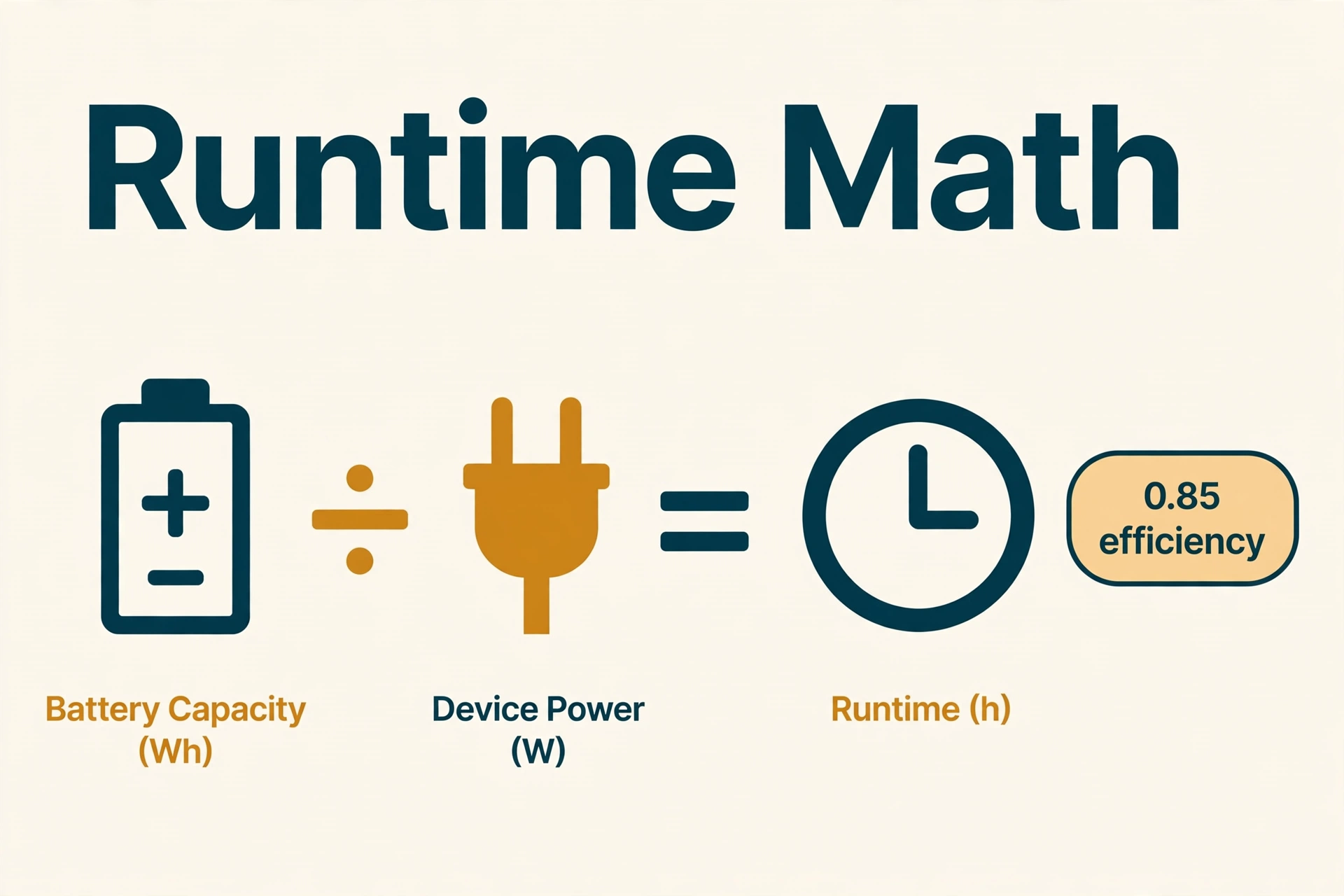
Runtime math is one simple division:
Runtime (hours) = Battery capacity (Wh) ÷ Device draw (watts) × 0.85
The 0.85 accounts for real-world inverter losses — converting battery DC power to AC power wastes roughly 10–15% of the energy. Manufacturers quote ideal numbers; this correction keeps your estimates honest. Work through a few examples and the formula becomes second nature.
A typical 1000W-class station holds about 1,000Wh. A phone charger drawing 20 watts: 1,000 ÷ 20 × 0.85 = roughly 42 hours of charging. A 60-watt laptop: 1,000 ÷ 60 × 0.85 = about 14 hours. A 700-watt microwave: 1,000 ÷ 700 × 0.85 = about 1.2 hours — technically possible on the power side if the inverter allows it, but it drains the whole tank fast, which tells you something important about how this class of station is meant to be used.
For devices that cycle on and off, like fridges, use the average draw, not the peak. A 12V camping fridge might draw 45 watts while the compressor runs but average only 15–25 watts over a day. At a 20-watt average: 1,000 ÷ 20 × 0.85 = about 42 hours — nearly two days of cold food from one charge.
Portable Power Station 1000W: What It Can Actually Run
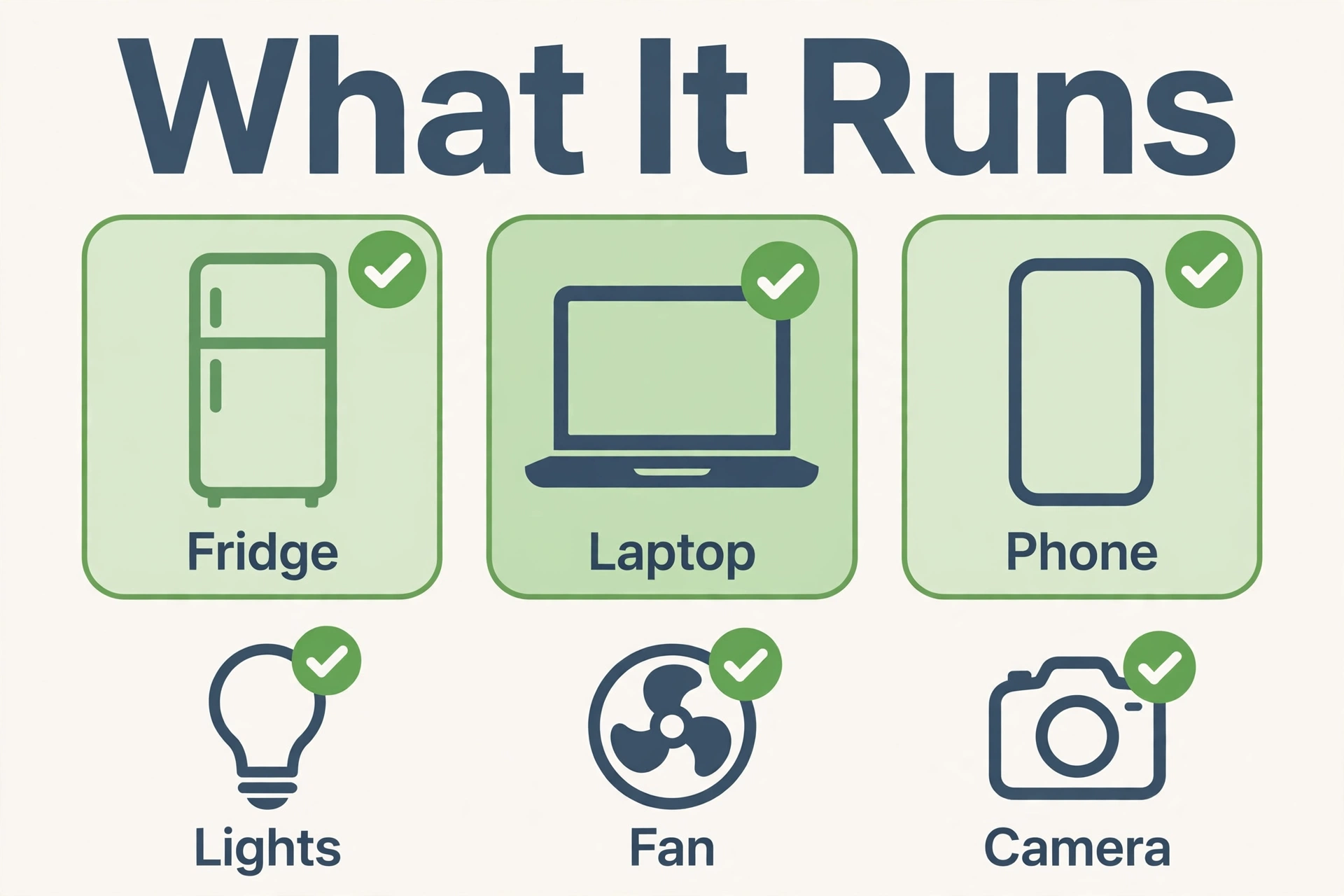
Here is the practical menu. These are realistic combinations that fit comfortably inside a 1,000-watt inverter and a ~1,000Wh battery — the kind of loads campers, van-lifers, and outage preppers actually run. For the full field of models in this class, see our best portable power station roundup.
Table: Common devices, their draw, and estimated runtime on a 1000Wh station
| Appliance | Typical draw | Estimated runtime (1000Wh) | Notes |
|---|---|---|---|
| Smartphone charging | 15–25W | 35–55 hours | Charges dozens of phones |
| Laptop (charging/working) | 60–90W | 9–14 hours | A full work week of top-ups |
| LED camp lights (string) | 10–20W | 42–85 hours | Barely dents the battery |
| 12V camping fridge | 15–25W average | 34–57 hours | The classic 1000W use case |
| Wi-Fi router + phone hotspot | 10–15W | 55–85 hours | Stay connected for days |
| CPAP machine (no humidifier) | 30–60W | 14–28 hours | Several nights of sleep |
| Portable fan | 20–50W | 17–42 hours | All-night comfort |
| TV (32–43 inch LED) | 60–100W | 8–14 hours | Movie nights covered |
| Electric blanket | 75–150W | 5–11 hours | One to two cold nights |
| Coffee maker (drip, 4-cup) | 600–900W | 1–1.5 hours | Brews many pots, drains fast |
| Small power tools (drill charging) | 80–150W | 5–10 hours | Great for job sites |
The pattern is clear: low-draw electronics and DC appliances run for days, while heating elements and motors measured in the hundreds of watts are short-burst guests. A 1000W station is a marathon runner for small loads and a sprinter for big ones.
What 1000W Struggles With or Cannot Run
Honesty matters more than hype here. The 1,000-watt inverter ceiling rules out a whole category of appliances, and the ~1,000Wh battery makes some technically-possible loads impractical.
Full-size air conditioners draw 1,000–1,500 watts running and surge far higher at compressor startup — beyond what a 1000W inverter can supply. Even small window units will trip it. Electric space heaters (1,200–1,500W) are out for the same reason. Full-size microwaves (1,000–1,200W) sit right at or above the ceiling; some stations with surge headroom can start one briefly, but it empties the battery in about an hour.
Electric kettles and toaster ovens (1,200–1,800W) exceed the inverter. Hair dryers on high (1,500–1,800W) will trip the overload protection immediately. And anything with a big motor startup surge — table saws, large air compressors — can spike to 2–3× its rated draw for a second or two, which a 1000W inverter cannot ride through.
The practical takeaway: if your must-run list includes heating, cooling, or full-size cooking appliances, this is not your class. That is exactly the signal to look at bigger hardware.
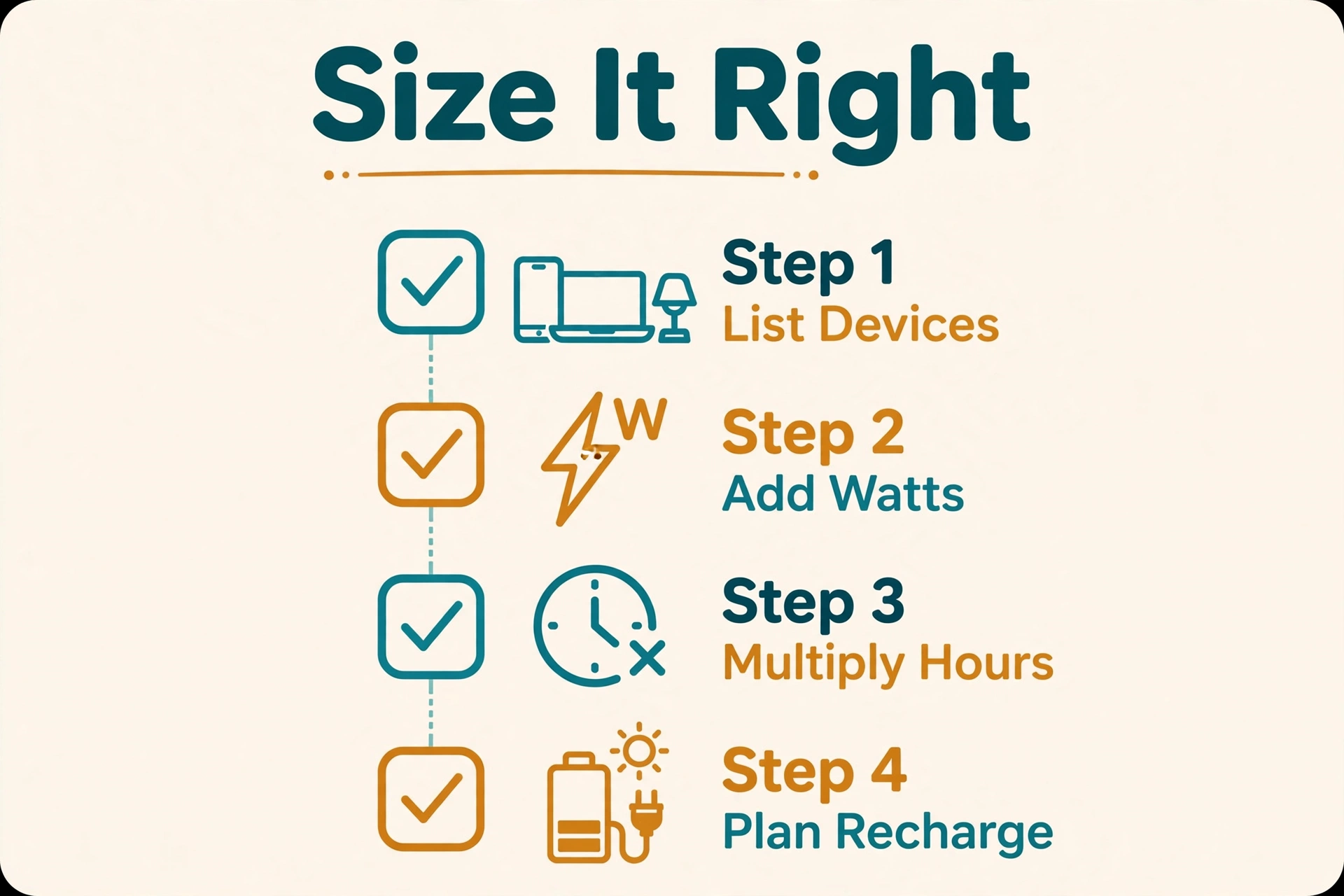
How to Size Your Own Setup in 4 Steps
Stop guessing and run this quick worksheet before you buy. It takes ten minutes and prevents the two classic mistakes: buying too small (tripped inverter on day one) or too big (paying double for capacity you never use).
Step 1: List every device you will run
Write down each device, its watt draw (check the label or manual — look for “input power” in watts), and how many hours per day you will run it. Be honest about simultaneous use: the fridge and the laptop run together, but the coffee maker runs alone for ten minutes.
Step 2: Add up the simultaneous watts
Find your peak moment — everything running at the same time — and total the watts. Add a 20% safety margin. If that number is under 800 watts, a 1000W inverter handles it with room to spare. If it lands between 800 and 1,000, you are cutting it close; consider whether any load can wait its turn.
Step 3: Multiply out the daily watt-hours
For each device: watts × hours = watt-hours, then sum the column. A camper running a fridge (20W avg × 24h = 480Wh), laptop (70W × 4h = 280Wh), lights (15W × 5h = 75Wh), and phones (40Wh) needs about 875Wh per day. A 1,000Wh station covers that day with a small buffer — but only one day without recharging.
Step 4: Decide your recharge plan
A station is a tank, not a well — it needs refilling. Wall charging before the trip is the baseline. For multi-day use, add solar panels (more on that below) or plan a recharge stop. If your daily burn exceeds the battery and you cannot recharge daily, you need either a bigger battery or a panel array that replaces your daily use.
When to Size Up to a 2000W Station
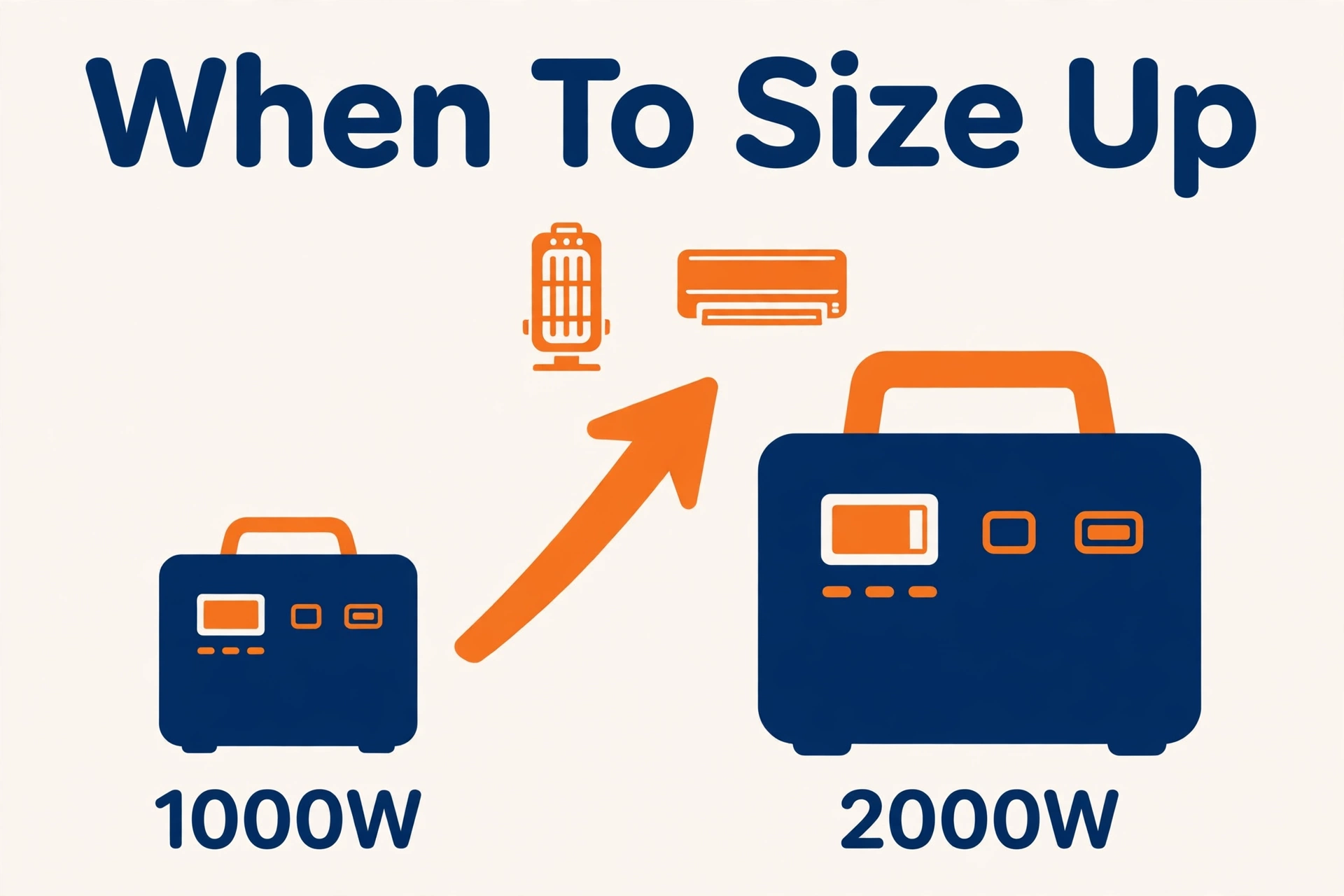
There are clear signals that 1000W is not enough, and recognizing them before you buy saves an expensive upgrade cycle. Size up when any of these describe your plan.
You need to run heating or cooling. A small space heater, an electric kettle for morning coffee, or a compact microwave used daily all push past 1,000 watts. Our portable power station 2000w guide covers what that next class unlocks — roughly double the inverter headroom and batteries in the 2,000Wh range.
Your daily burn exceeds 1,000Wh with no recharge. A family running two fridges, multiple laptops, and lights through a long weekend can burn 1,500Wh+ daily. A bigger battery means fewer recharge chores and a real buffer for cloudy days.
You want whole-room home backup. Keeping a full-size fridge (150W running, 600W+ startup surge), the Wi-Fi, some lights, and a TV alive through an outage is comfortable 2000W territory. A 1000W station can do the fridge alone, but add the surge of the compressor kicking on while the TV is playing and you are at the edge.
You run power tools. Circular saws, angle grinders, and shop vacs draw 800–1,400 watts with nasty startup surges. The 2000W class handles them; the 1000W class trips.
The cost jump is real — expect to pay roughly 60–100% more — but so is the capability jump. Buy the station for the loads you will actually run, not the loads you wish were smaller.
Solar Pairing: Refilling the Tank Off-Grid
Most 1000W-class stations accept 200–400 watts of solar input through a built-in MPPT controller. In good sun, a 200-watt panel delivers roughly 150–170 real watts, so plan on 6–8 hours of solid sun to refill a 1,000Wh battery from empty. That math is why panel wattage matters as much as battery size for multi-day trips.
Two practical tips. First, panels are rated in perfect lab conditions — expect 70–80% of the sticker number in the field, less with partial shade or a low sun angle. Second, you can use the station while it charges from solar; a fridge drawing 20 watts while 150 watts flow in still nets +130 watts into the battery. Daytime solar plus nighttime battery is the rhythm that makes a 1000W station work indefinitely at camp.
If camping is your main use case, our portable power station camping guide walks through building the whole setup — sizing for phones, lights, and a fridge, plus panel placement and camp safety.
1000W vs Smaller Stations: Is Less Enough?
Stations in the 300–500W class cost less and weigh less, and for phone-and-lights-only trips they are fine. The moment a 12V fridge enters the picture, though, the math changes: a fridge needs to run 24 hours a day, and a 500Wh battery gives you roughly one day with no margin for cloudy solar or a second device. The 1000W class is the first tier where a fridge plus everything else fits comfortably with a buffer. If your trips always include cold food or more than two people’s devices, skip the small tier and start here — it is the cheapest class that does not feel limiting.
Frequently Asked Questions
How long will a 1000W portable power station last?
It depends entirely on the load: roughly 40+ hours for phones and LED lights, 30–55 hours for a 12V camping fridge, 9–14 hours for a laptop, and about an hour for a 700-watt appliance. Use the formula Wh ÷ watts × 0.85 for any device.
Can a 1000W power station run a refrigerator?
A 12V camping fridge, easily — that is the signature use case. A full-size home fridge (150W running, 600W+ startup surge) is technically within a 1000W inverter, and many people run one through short outages, but the surge plus the ~1–2kWh daily appetite means a bigger station is more comfortable.
Can it run a CPAP machine?
Yes. Without the heated humidifier, most CPAPs draw 30–60 watts, giving you roughly 14–28 hours — several nights of sleep per charge. Turn off the humidifier and heated tube to roughly double your runtime.
Can a 1000W station run a microwave?
Small microwaves (600–700W) can run briefly if the inverter allows, but they drain a 1,000Wh battery in about an hour. It is an emergency option, not a cooking plan. Full-size 1,000W+ microwaves will trip the inverter.
Is 1000W enough for camping?
For most campers, yes — it covers the classic trio of fridge, lights, and device charging for a long weekend, especially with a solar panel refilling it daily. It falls short only if your camp kitchen runs electric cooking or heating appliances.
The bottom line: a portable power station 1000w is the right call when your loads are electronics, lighting, a 12V fridge, and small appliances — with total simultaneous draw under ~800 watts and daily energy under the battery’s capacity. Run the four-step worksheet above with your real numbers, plan your recharge, and you will buy once and buy right.
