

Best Smart EV Chargers with Solar Integration
If you have rooftop solar, the short answer is this: buy the Emporia Pro. It is the only US charger under $600 that ships with a whole-home energy monitor and can charge your car only from excess solar power. Tesla owners with a Powerwall should get the Tesla Universal Wall Connector for its Charge on Solar feature, and the Wallbox Pulsar Plus is the best compact option with its Eco-Smart solar modes. That is the honest answer to the best smart ev charger solar question — and below is exactly why, including how much solar you actually need and how to wire it safely.
Charging an EV at home already beats public charging on price. Charging it with your own solar panels can drop the fuel cost close to zero. But not every smart charger can do it: a charger with real solar integration watches your home’s power flow and sends only the surplus electricity — the watts your panels make but your house is not using — into the car. That is the feature worth paying for.
What “Solar Integration” Actually Means
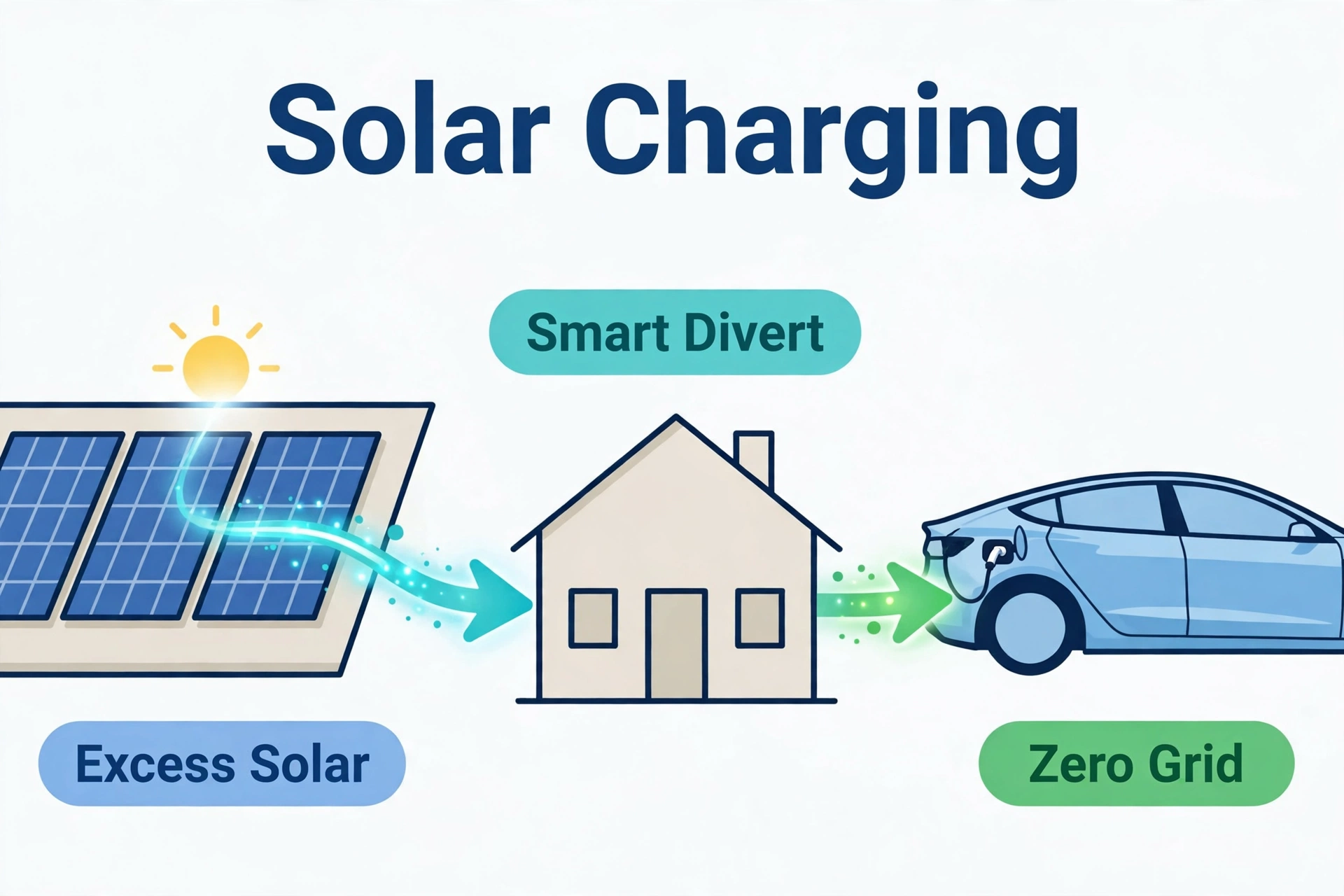
Manufacturers throw around a lot of green buzzwords. Here is what genuine solar integration looks like:
- Excess-PV diversion: the charger detects when your panels produce more than your home consumes, and ramps charging to match that surplus — so your car drinks the extra sunshine instead of the grid buying it cheap.
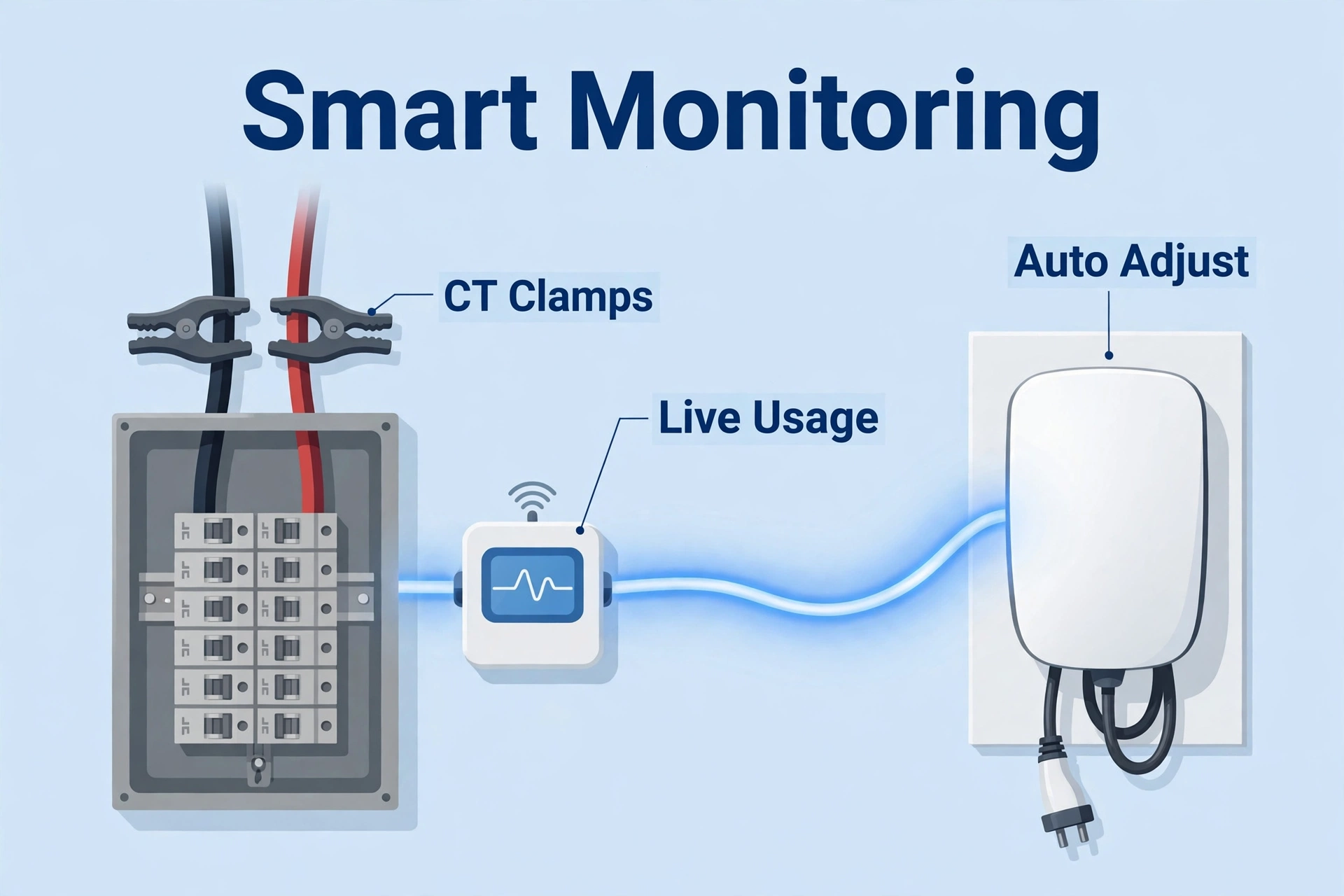
- CT clamp monitoring: small current-transformer clamps on your main cables measure power flow in real time. This is how the charger knows the difference between “the house needs 2 kW” and “the house has 3 kW of solar going spare.” Some chargers include these sensors; others sell them separately.
- Scheduled and blended charging: on cloudy days there may not be enough surplus. Good solar chargers let you set a backup schedule (midnight on cheap rates) or blend solar with grid power so the car is full by morning.
If a charger cannot do at least the first two, it does not have real solar integration — it just has a nice app. All four chargers below passed that test.
Best Smart EV Charger Solar Picks at a Glance
The whole comparison on one screen. Prices checked on 2026-10-02.
| Feature | Emporia Pro | Tesla Universal Wall Connector | Wallbox Pulsar Plus | myenergi Zappi |
|---|---|---|---|---|
| Price (checked 2026-10-02) | $599 | $660 (recently raised from $600) | From $649.99 (40A); 48A about $699 | £599 in the UK (not sold in the US) |
| Max power | 48A / 11.5 kW | 48A / 11.5 kW | 40A or 48A / up to 11.5 kW | 7.4 kW single-phase (UK) |
| Solar feature | Excess-solar charging mode with included Vue 3 monitor | Charge on Solar (needs Tesla Powerwall) | Eco-Smart: 100% solar or solar-plus-grid (needs Wallbox Power Meter) | ECO and ECO+ diversion modes, CT clamp included |
| CT clamps included | Yes — Vue 3 home energy monitor in the box | No — works through Powerwall’s own metering | No — Wallbox Power Meter sold separately | Yes — grid CT clamp included |
| Connector | J1772 (adapter needed for Tesla) | NACS with built-in J1772 adapter | J1772 (US version) | Type 2 tethered |
| Cable length | 24 ft | 24 ft | 25 ft | 6.5 m |
| Load management | Yes — dynamic, avoids panel upgrades | Yes — power sharing across up to 6 units | Yes — Power Boost dynamic load balancing | Yes — dynamic load balancing |
| Outdoor rating | NEMA 4 | IP55 | NEMA 4 | IP65 |
| Warranty | 3 years | 4 years | 3 years | 3 years |
| Best for | Any solar home on a budget | Tesla owners with a Powerwall | Tight garages and small spaces | UK and EU solar homes |
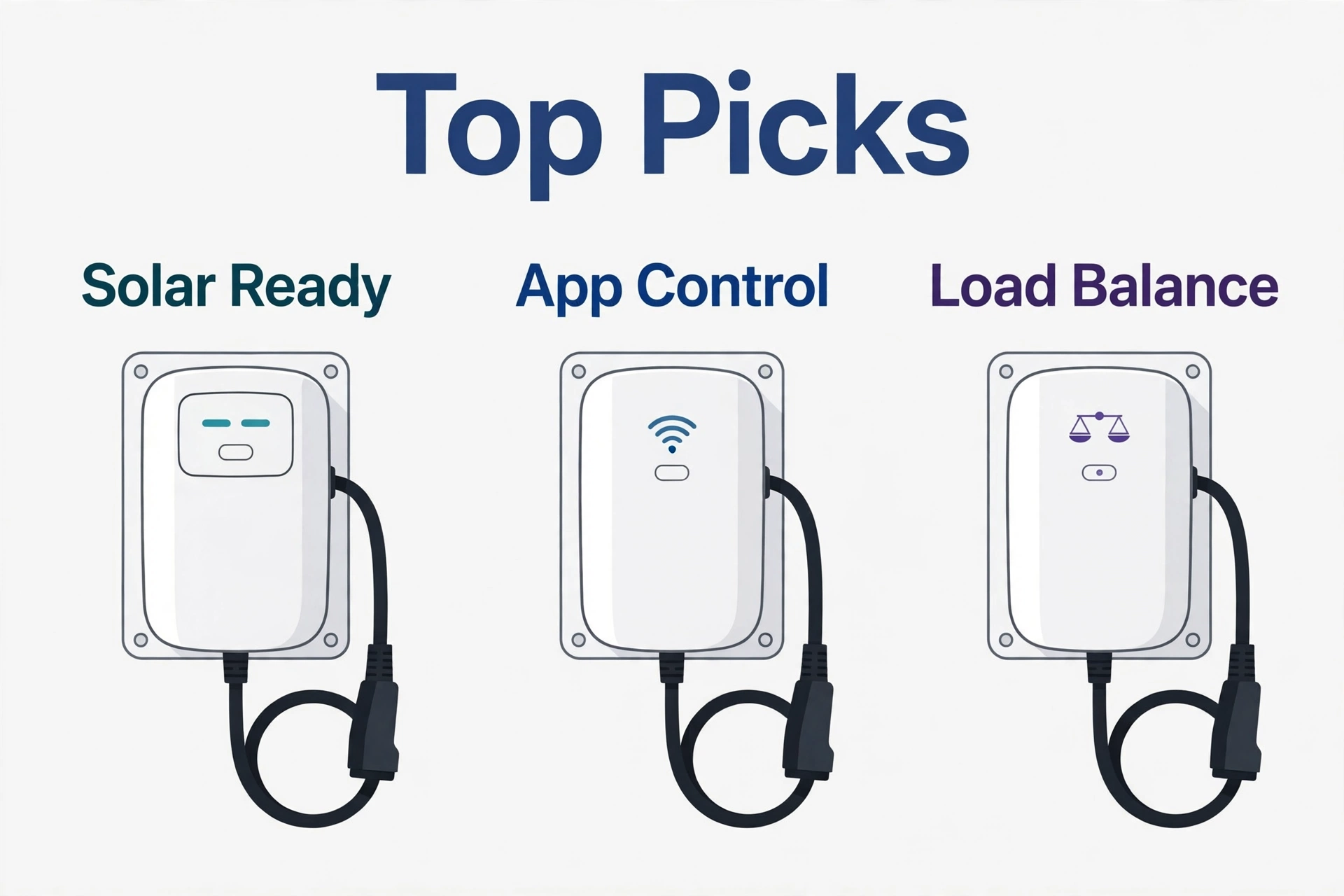
1. Emporia Pro EV Charger — Best Overall for Solar Homes
The Emporia Pro is the standout because of one thing: the Vue 3 home energy monitor comes in the box at no extra cost. Those CT clamps go on your main breaker cables and tell the charger exactly how much solar power is leaving your house unused. Flip on excess-solar mode in the Emporia app and your EV charges only from that surplus.
Beyond solar, it is a lot of charger for $599: 48 amps (11.5 kW) of Level 2 charging, a 24-foot cable, UL listing, Energy Star certification, a NEMA 4 weatherproof enclosure, and a 3-year warranty. The dynamic load management is the quiet hero — by watching your whole panel’s draw, it throttles the car when the oven and dryer are running, which can save you a $2,000–$7,000 panel upgrade on a 100-amp service.
The included monitor also does the job of a dedicated whole-home energy monitor, and we have compared Emporia Vue vs Sense head to head if you want the full breakdown. The tradeoff is polish: the app is functional rather than beautiful. But at this price, with real excess-solar charging included, nothing else in the US comes close.
2. Tesla Universal Wall Connector — Best Pick for Tesla and Powerwall Homes
If you own a Tesla — especially with a Tesla Powerwall — the Universal Wall Connector is the natural choice. Its solar trick is called Charge on Solar: with a Powerwall in the system, the Tesla app coordinates panels, battery, and car so the vehicle charges from excess solar instead of draining the battery or pulling from the grid.
The hardware is excellent: 48 amps (11.5 kW), a 24-foot cable, Wi-Fi with over-the-air updates, and a 4-year warranty — the longest here. The “Universal” part matters too: the connector has a built-in J1772 adapter, so it charges Teslas and every other EV (Ford, Hyundai, Kia, GM) with no dongle. Up to six units can share one circuit with power sharing — handy for two-EV households.
Two caveats. First, the price jumped to $660 in the US in September 2026 (it was $600) — still fair for the hardware, but the value gap with Emporia has widened. Second, Charge on Solar only works inside the Tesla ecosystem: no Powerwall, no excess-solar charging. If your panels feed a non-Tesla inverter, the Emporia or Wallbox will do more for you.
3. Wallbox Pulsar Plus — Best Compact Charger with Solar Modes
The Pulsar Plus is one of the smallest 48-amp chargers you can buy, which matters if your garage wall space is tight. Its solar feature is called Eco-Smart, and it gives you two modes: full-green charging (100% solar, charging pauses when a cloud passes) or eco mode (a minimum solar floor with grid power making up the rest so the car keeps charging).
The catch is that Eco-Smart needs the Wallbox Power Meter, sold separately — the CT clamps are not in the box, so factor that into the price. You also get Power Boost dynamic load balancing, a 25-foot cable, Wi-Fi plus Bluetooth, Alexa and Google voice control, Energy Star certification, a NEMA 4 enclosure, and a 3-year warranty. Note that Wallbox’s own site says solar charging is not compatible with multi-charger installations or OCPP setups.
For the full official feature list and current pricing, see Wallbox’s official Pulsar Plus page. It is the premium pick — you pay more than the Emporia for a smaller box and a slicker app, but the Eco-Smart modes are genuinely flexible.
4. myenergi Zappi — Best for UK and EU Solar Homes
The Zappi is the charger that invented this category, and it is still the benchmark everywhere it is sold. Its ECO and ECO+ modes divert surplus solar into the car with a grid CT clamp in the box, and it works with any brand of solar panels — no ecosystem lock-in. British reviewers rated it 9.7 out of 10 in 2026.
The honest limitation: myenergi does not sell the Zappi in the US. The GLO model costs £599 in the UK, running at 7.4 kW on single-phase power. If you are reading from the UK or EU, start your shortlist here. In the US, the Emporia Pro is the closest equivalent.
How Much Solar Do You Need to Charge an EV?
Less than most people think. Here is the simple math:
- The average US driver covers about 37 miles a day.
- A typical EV uses roughly 0.3 kWh per mile, so a day’s driving needs about 11 kWh.
- With around 4 peak sun hours, about 3 kW of panels would cover it on paper.
- In the real world — clouds, seasons, the house using power too — a 5 to 6 kW rooftop system comfortably covers typical daily driving for most households.
You do not need a giant array. A modest 6 kW system produces roughly 24–30 kWh on a decent day — more than double what the average commute consumes. The bigger the system, the more often the car charges purely from surplus, but even a small system meaningfully cuts your charging bill.
Setting Up Excess-Solar Charging
Once the hardware is on the wall, getting true solar-only charging takes an afternoon of configuration. Here is the order that works:
- Confirm your system exports surplus. Check your solar app or utility bill: on sunny middays, are you sending power back to the grid? If yes, there is surplus to divert.
- Install the CT clamps. The Emporia Vue 3 includes them; the Wallbox Power Meter is a separate purchase. They clip around your main service cables inside the breaker panel — a quick job, but it happens inside a live panel, so have your electrician do it during the charger install.
- Get the charger wired on its own dedicated 240V circuit. No sharing with the dryer. Your electrician sizes the breaker and runs the cable.
- Enable the solar mode in the app. In the Emporia app this is the excess-solar setting; in myWallbox it is Eco-Smart. Set the minimum solar threshold — around 6 amps (about 1.4 kW) is a common starting point — so charging only starts when there is real surplus.
- Set a backup schedule for cloudy stretches. Have the app charge overnight on cheap off-peak rates if the car is below target by 10 PM — you will wake up full even after a week of rain.
- Watch it for a week and tune. Check the app’s energy graphs: is the car grabbing the midday surplus hump? Adjust the threshold and schedule until it is.
Sizing Your 240V Circuit the Right Way
A Level 2 charger is the hungriest appliance in most homes. Size the circuit properly:
- Check your electrical service. Look at your main breaker: 100A, 125A, or 200A. This is your total budget for the whole house.
- Get a load calculation done. Your electrician adds up your existing loads (HVAC, water heater, dryer, range) under NEC rules and tells you how many amps are actually free for a charger.
- Pick 40A or 48A charging. 40A needs a 50A breaker; 48A needs a 60A breaker (breakers are sized at 125% of the continuous load). The speed difference is modest — about 30 vs 37 miles of range per hour — so 40A is plenty for overnight charging.
- Consider dynamic load management first. Chargers like the Emporia Pro and Wallbox with Power Boost watch the panel and throttle the car automatically, which can avoid a panel upgrade entirely. That is often cheaper than rewiring the service.
Single-Phase vs Three-Phase: What Matters for US Homes
Almost every US home runs on single-phase 240V (technically split-phase) power. That is what all four chargers above are designed for, and it supports the full 48 amps / 11.5 kW — roughly 37 miles of range per hour of charging.
Three-phase power is common in European and Australian homes and some US commercial buildings, where it enables 22 kW charging. You almost certainly do not have it in a US house, and you do not need it: overnight charging at 11.5 kW fills any EV.
Electrical Safety: Read This Before You Buy
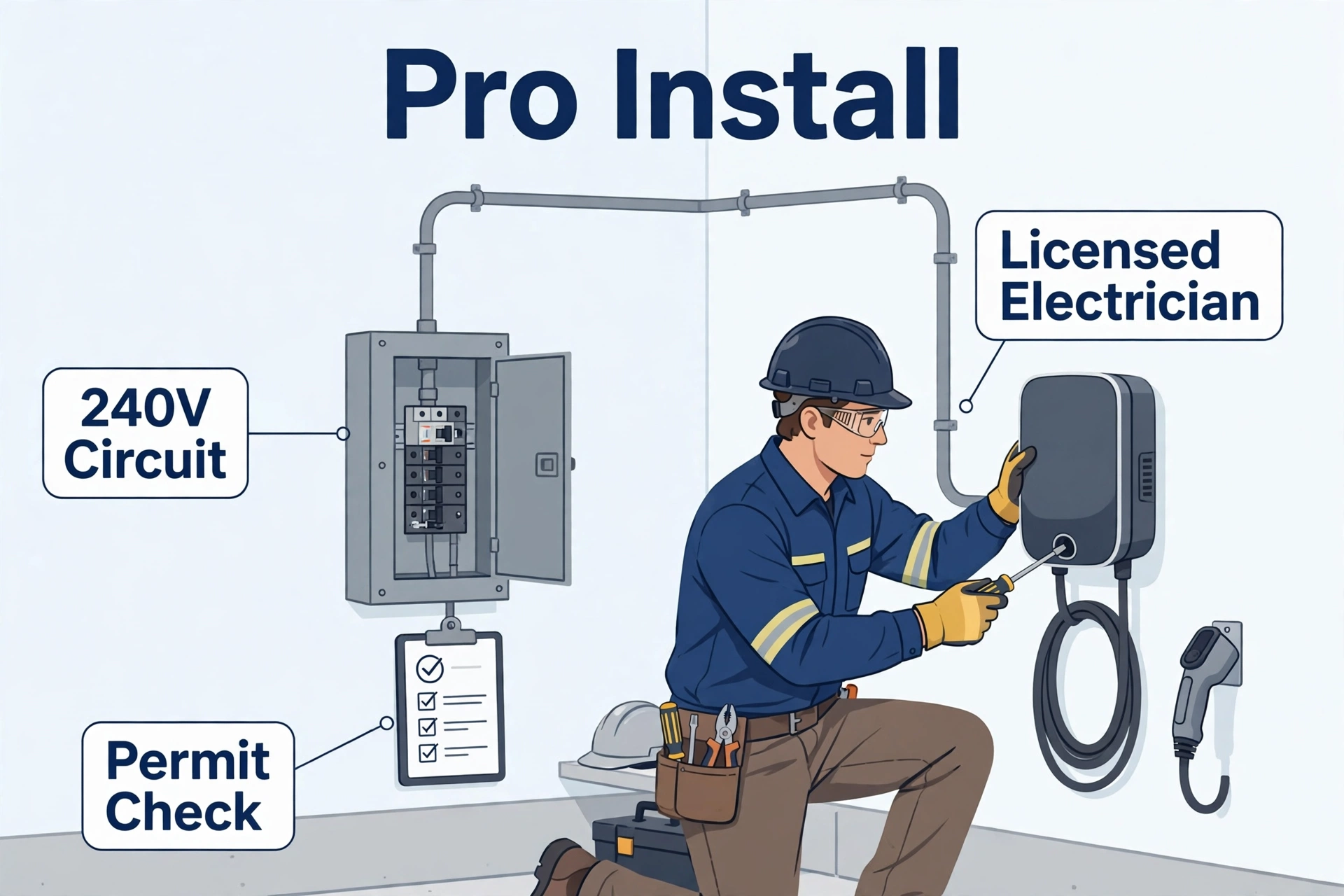
An EV charger runs on a 240-volt circuit pulling as much current as an electric range — for hours at a time. This is not a DIY project:
- Hire a licensed electrician. Every charger on this list needs hardwiring or a new 240V outlet on a dedicated circuit. A licensed electrician sizes the breaker, checks the panel, and makes sure the grounding is correct.
- Get a panel load calculation. Before buying, have the electrician confirm your panel has room for a 50A or 60A breaker. Skipping this step is how breakers trip and wires overheat.
- Check permits and inspections. Most US jurisdictions require an electrical permit and inspection for EV charger installs — your electrician usually handles this, and your homeowner’s insurance will want it documented.
- Never work inside a live panel yourself. CT clamps, breaker swaps, and wire runs happen inches from unfused service cables. That work belongs to a professional, full stop.
App Features Worth Having
The app is where a smart charger earns its “smart” label. Prioritize real-time energy graphs (solar production, home use, and car charging on one screen), solar threshold and blend controls, time-of-use scheduling for cheap overnight rates, and charging history with cost tracking so you can see what the solar setup saves you.
The same monitoring habit pays off elsewhere in the house: we use energy-monitoring smart plugs to catch the standby loads quietly eating the solar surplus you worked so hard to divert.
Best Smart EV Charger Solar FAQs
Do I need solar panels to use these chargers?
No. Every charger here works as an excellent regular smart charger without a single panel on the roof. The solar features simply sit idle until you add panels. If you plan to go solar in the next few years, buying a solar-capable charger now means you will not have to replace it later.
How much solar do I need to charge my car?
For typical daily driving (about 37 miles), you need roughly 11 kWh a day, which a 5–6 kW rooftop system covers comfortably on sunny days. You do not need to cover 100% of charging with solar for it to be worth it — every solar kWh you divert is one you are not buying from the grid.
Can I charge only from excess solar power?
Yes — that is exactly what the Emporia’s excess-solar mode, Wallbox’s Eco-Smart full-green mode, and the Zappi’s ECO+ mode do. The honest caveat: on cloudy days charging slows or pauses, so set an overnight grid backup schedule and the car is always ready in the morning.
What is a CT clamp and why does it matter?
A CT (current transformer) clamp is a small sensor that clips around a power cable and measures how much electricity is flowing through it, without cutting any wires. One clamp on your solar feed and one on your mains tells the charger the magic number: solar production minus home consumption equals surplus available for the car. Chargers that include these sensors (Emporia Pro, Zappi) give you true excess-solar charging out of the box; chargers that sell them separately (Wallbox) need the add-on to unlock it.
